

Why Secure Website Hosting Matters for Healthcare

Secure website hosting in healthcare is the critical foundation for protecting protected health information (PHI) and maintaining HIPAA compliance. Every healthcare website that collects patient data, appointment requests, or contact forms sits on a hosting environment that either meets federal security standards or puts your practice at serious legal and financial risk. The HHS Office for Civil Rights (OCR) enforces HIPAA requirements that directly govern how PHI is stored, transmitted, and accessed. Understanding why secure website hosting in healthcare is non-negotiable starts with knowing what a breach actually costs and what regulators now require.
Why secure website hosting in healthcare is a compliance requirement
Secure healthcare website hosting means your server environment meets the HIPAA Security Rule’s technical, physical, and administrative safeguards for any system that touches PHI. This is not just a technology decision. It is a legal one.
The technical safeguards required under HIPAA cover three core areas:
- Encryption: Data in transit must use TLS 1.2 or higher, and data at rest must use AES-256 encryption. These are not suggestions. They are the baseline.
- Access controls: Every user must have a unique ID. Multi-factor authentication (MFA) is now mandatory under the 2026 HIPAA Security Rule updates. Role-based permissions limit who can see what.
- Audit logging: Immutable logs must capture all access events. Quarterly reviews of those logs are now a formal requirement under the 17 new HIPAA Security Rule requirements taking effect in 2026.
Beyond encryption and access controls, your hosting environment must support backup and disaster recovery. Availability of PHI is itself a HIPAA requirement. If your site goes down and patient records become inaccessible, that is a compliance failure, not just a technical inconvenience.
Pro Tip: Ask any hosting provider to show you their encryption configuration and audit log retention policy before signing anything. A provider that cannot answer those questions clearly is not ready for healthcare data.

Session management matters too. Automatic session timeouts, secure cookie handling, and re-authentication after idle periods are all part of a compliant hosting setup. These details are easy to overlook when you are focused on design and content, but they are exactly what OCR auditors check.
How does secure hosting reduce financial and operational risk?
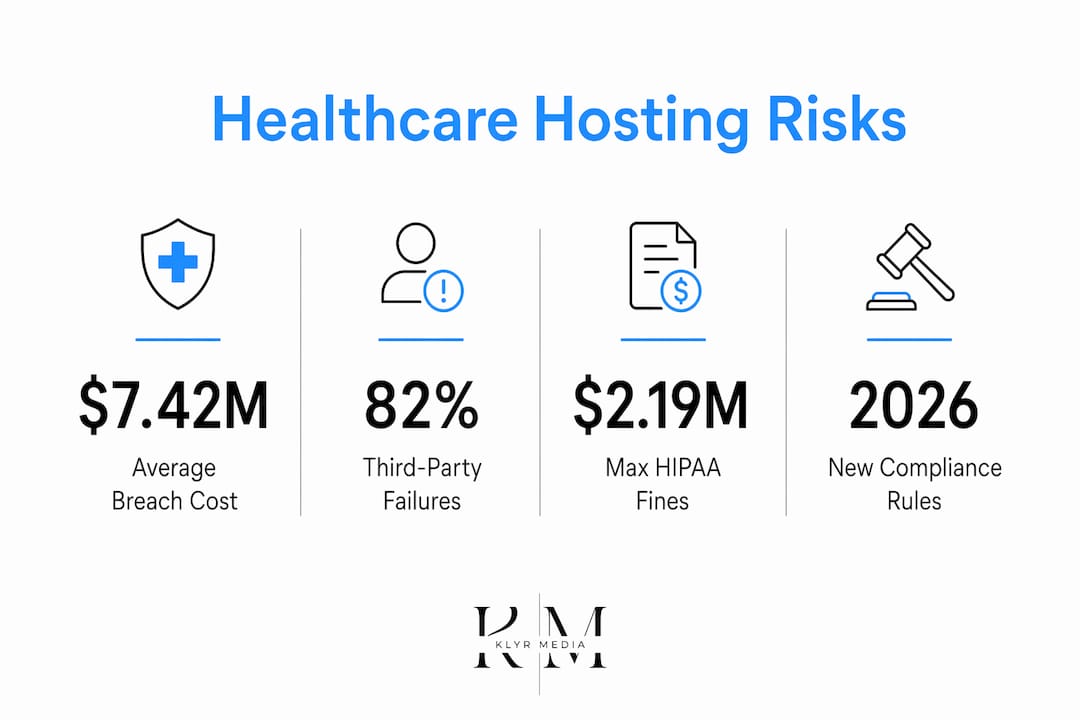
The financial case for secure hosting is not abstract. The average healthcare data breach costs $7.42 million per incident. That figure covers investigation, notification, remediation, legal fees, and lost business. It does not include the reputational damage that follows a public breach.
“HIPAA penalties can reach $2.19 million annually for repeated violations of the same provision. A single misconfigured hosting environment can trigger that exposure across multiple audit cycles.”
HIPAA fines are tiered by culpability. Willful neglect that goes uncorrected carries the highest penalties. Choosing a hosting provider without verifying its security architecture is the kind of decision OCR classifies as willful neglect. That is a category you cannot afford to be in.
The operational benefits of getting this right are equally real. Healthcare organizations using HIPAA-compliant digital infrastructure report up to 40% fewer administrative escalations related to patient data. Fewer escalations mean less staff time spent on incident response and more time on patient care. For an independent clinic or pharmacy already stretched thin, that difference is significant.
Secure hosting also reduces the cost of remediation after a breach. Proactive investment in compliant infrastructure is consistently cheaper than reactive cleanup. The math is straightforward: pay for the right hosting now, or pay multiples of that after an incident.
What does a Business Associate Agreement actually cover?
A Business Associate Agreement (BAA) is the contract between your practice and any vendor that handles PHI on your behalf, including your hosting provider. Every HIPAA-covered entity must have a signed BAA with its hosting provider. No exceptions.
Here is what most healthcare administrators get wrong about BAAs: a signed BAA establishes legal accountability but does not guarantee the technical security of the hosting environment. The contract defines who is liable. It does not configure your firewall or encrypt your database.
Common BAA pitfalls to watch for:
- Scope gaps: The BAA must cover all services that touch PHI, including backups, content delivery networks, and third-party integrations. A BAA that only covers the primary server leaves your backup environment unprotected legally.
- Breach notification timelines: HIPAA requires notification within 60 days of discovering a breach. Your BAA should specify the hosting provider’s obligation to notify you promptly so you can meet that deadline.
- Incident ownership: The BAA should clearly state who investigates a breach, who leads remediation, and who bears the cost.
82% of healthcare data breaches in 2026 involve third-party risk management failures or cloud misconfigurations. That statistic makes one thing clear: a signed BAA without verified technical safeguards is a false sense of security.
Pro Tip: Request a copy of your hosting provider’s most recent security audit report alongside the BAA. If they cannot provide one, treat that as a red flag.
What operational practices keep your hosting environment compliant?
Compliance is not a one-time setup. It is an ongoing operational practice. The 2026 HIPAA updates make this explicit by shifting several previously “addressable” requirements to mandatory status.
Here is a practical framework for maintaining compliance over time:
- Maintain a living evidence catalog. Keep current risk assessments, BAA documentation, and audit logs in one place. OCR audits can happen with little notice. Being audit-ready at all times is the standard, not the exception.
- Run quarterly vulnerability scans. Automated scans catch configuration drift before it becomes a breach. Pair scans with annual penetration testing for deeper coverage.
- Apply patches within defined windows. Unpatched software is one of the most common breach vectors in healthcare. Define a patch management schedule and stick to it.
- Monitor subdomains and legacy endpoints. Forgotten SSL expirations and configuration drift on older subdomains are a common source of hidden vulnerabilities. Automated SSL monitoring catches these before they become problems.
- Test your incident response plan. A written plan that has never been practiced will fail under pressure. Run tabletop exercises at least annually.
| Compliance Task | Frequency | Owner |
|---|---|---|
| Vulnerability scan | Quarterly | IT or hosting provider |
| Audit log review | Quarterly | Compliance officer |
| Penetration test | Annually | Third-party vendor |
| Risk assessment update | Annually or after major changes | Compliance officer |
| BAA review | At contract renewal | Legal and IT |
The 2026 HIPAA Security Rule updates also require mandatory MFA and immutable audit logs across all systems that access PHI. If your current hosting setup does not support these, you are already out of compliance.
How do you evaluate and choose a secure hosting provider?
Choosing the right hosting provider for a healthcare website is a structured decision, not a price comparison. Here is what to verify before signing any contract.
Certifications matter. HITRUST certification offers a higher level of compliance assurance than SOC 2 alone. HITRUST’s r2 certification maps directly to HIPAA requirements and simplifies your own audit process. Providers with HITRUST certification have already done much of the compliance heavy lifting.
Infrastructure architecture is critical. Single-tenant or isolated cloud environments reduce the risk of cross-contamination between clients. Shared hosting environments, where multiple organizations share the same server resources, create configuration risks that are difficult to control. Healthcare data belongs in an isolated environment with audit-ready documentation and clear incident ownership.
Pro Tip: Ask providers whether their environment is single-tenant or multi-tenant, and whether they can provide isolated storage for PHI. The answer tells you immediately whether they understand healthcare requirements.
Transparency on cost is also a practical concern. Some providers advertise HIPAA compliance but charge separately for encryption, logging, and backup services. Get a complete picture of what is included before comparing prices. The importance of secure healthcare hosting shows up in the details of what a provider actually delivers, not just what they claim on their website.
Cloud security vulnerabilities are not unique to healthcare, but the consequences in this sector are more severe. Understanding cloud data security risks broadly helps you ask better questions of any hosting provider, regardless of their industry focus.
Many organizations also mistakenly believe that a “HIPAA-compliant” label on a host covers their entire digital footprint. You remain responsible for misconfigurations and third-party integrations that can expose PHI. The hosting provider secures the infrastructure. You secure everything built on top of it.
Key Takeaways
Secure healthcare website hosting is a legal, financial, and operational requirement that no HIPAA-covered entity can safely ignore.
| Point | Details |
|---|---|
| Encryption is the baseline | All PHI must use TLS 1.2+ in transit and AES-256 at rest to meet HIPAA technical safeguards. |
| BAAs define liability, not security | A signed BAA does not configure your hosting environment; verify technical safeguards independently. |
| Breach costs are severe | The average healthcare breach costs $7.42 million, making proactive secure hosting far cheaper than remediation. |
| 2026 rules raise the bar | Mandatory MFA and immutable audit logs are now required under the updated HIPAA Security Rule. |
| Ongoing compliance requires active management | Quarterly scans, patch management, and a living evidence catalog keep your hosting environment audit-ready. |
The part most healthcare businesses get wrong
After working with independent clinics and pharmacies across the country, I keep seeing the same mistake. A practice signs up for a hosting plan that says “HIPAA compliant” on the sales page, gets a BAA in the inbox, and considers the compliance box checked. That is not how it works, and it is exactly how breaches happen.
The hosting provider secures the server. You are responsible for everything else: how your forms are configured, what third-party scripts run on your site, how your staff accesses the backend, and whether your backup environment is covered under the same BAA. Most practices have no idea that a contact form connected to a non-compliant email service can expose PHI, even if the server underneath it is perfectly configured.
The 2026 HIPAA updates are not a distant regulatory event. They are already in effect. Mandatory MFA, immutable logs, quarterly reviews. These are not optional anymore. Practices that treat compliance as a one-time setup are going to face audits they are not prepared for.
What I tell every client: treat your hosting environment like a living system, not a finished product. Review it. Test it. Update it when regulations change. The practices that build compliance into their operations from the start are the ones that grow without the fear of a breach derailing everything they have built.
— Opinly
Klyrmedia builds healthcare websites with security built in
Healthcare administrators should not have to become cybersecurity experts to run a compliant website. That is exactly the problem Klyrmedia solves.

Klyrmedia specializes in HIPAA-compliant website design for independent pharmacies, medical clinics, and healthcare practices across the United States. Every site Klyrmedia builds incorporates the hosting safeguards, access controls, and audit-ready documentation that HIPAA requires. You get a website that works for patients and holds up under regulatory scrutiny. If you are ready to build a site that protects your practice and your patients, explore Klyrmedia’s healthcare digital solutions to see what a compliance-first approach looks like in practice.
FAQ
What is HIPAA-compliant website hosting?
HIPAA-compliant website hosting is a server environment that meets the HIPAA Security Rule’s technical safeguards, including AES-256 encryption, TLS 1.2+ for data in transit, MFA, and immutable audit logging. The hosting provider must also sign a Business Associate Agreement with your practice.
Does a signed BAA make my hosting automatically secure?
No. A BAA establishes legal accountability but does not configure technical security measures. You must independently verify that your hosting provider’s infrastructure meets HIPAA’s encryption, access control, and logging requirements.
What are the financial risks of unsecure healthcare hosting?
The average healthcare data breach costs $7.42 million per incident, and HIPAA penalties can reach $2.19 million annually per repeated violation. Secure hosting is a direct investment in avoiding those costs.
What new HIPAA requirements apply to hosting in 2026?
The 2026 HIPAA Security Rule updates include 17 new requirements, among them mandatory MFA and immutable audit logs with quarterly reviews. Several previously optional safeguards are now mandatory for all covered entities.
How do I know if a hosting provider is truly HIPAA-compliant?
Request the provider’s HITRUST certification or most recent security audit report, confirm the BAA covers all services including backups and third-party tools, and verify that their infrastructure uses isolated environments rather than shared hosting resources.

