

Why Organic Search Matters for Healthcare Marketing

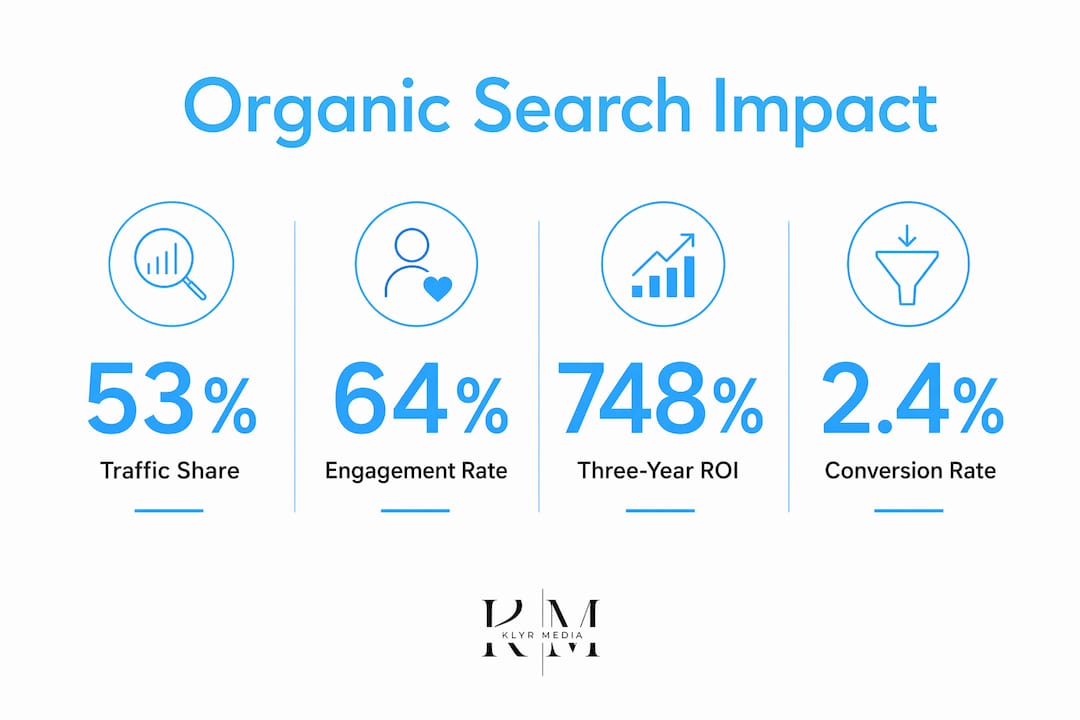
Organic search is the unpaid, earned visibility your healthcare website earns on search engines like Google, and it is the single most important channel for attracting high-intent patients. Understanding why organic search matters is not optional for healthcare marketers in 2026. Organic search drives 53% of all website traffic overall and climbs to 64% in B2B healthcare and professional services. That number tells you where your patients are looking before they ever call your clinic or walk through your door. SEO leads also close at a 14.6% rate, compared to just 1.7% for outbound methods like cold calls or direct mail. The gap is not small. It is the difference between a waiting room that fills itself and one that stays empty.
Why organic search matters more than any other channel
Organic search consistently outperforms paid advertising and social media when it comes to converting browsers into patients. The average organic conversion rate sits at 2.4%, compared to 1.3% for paid search and 0.7% for social media. That means organic visitors are nearly twice as likely to book an appointment or fill a prescription as someone who clicked a paid ad.
The compounding effect is what makes organic search genuinely different from every other channel. Content published today continues to attract patients two to three years from now, without additional spend. A well-written article about managing Type 2 diabetes or understanding prior authorization keeps pulling traffic long after you hit publish. Paid ads stop the moment your budget runs out.
The return on investment reflects this. Organic search delivers 748% ROI over a three-year period. That figure accounts for the real costs of content creation, technical SEO, and ongoing optimization. It is not free traffic. It is earned traffic, and the earnings compound.

Here is a quick comparison of channel performance for healthcare marketers:
| Channel | Avg. Conversion Rate | Traffic Longevity |
|---|---|---|
| Organic search | 2.4% | 2–3 years per piece |
| Paid search | 1.3% | Ends with budget |
| Social media | 0.7% | Days to weeks |
- Organic search captures both problem-aware patients (“what causes chest pain”) and solution-aware patients (“cardiologist near me”).
- Paid search captures only solution-aware patients who are already ready to act.
- Social media rarely captures either with high intent.
Pro Tip: Build your organic content around patient questions, not clinical terminology. “How long does a cortisone shot last?” gets searched far more than “corticosteroid injection duration.”
What does AI mean for organic search in healthcare?
AI is reshaping how patients find health information, and the change is significant. Google’s AI Overviews now appear at the top of many health-related search results, summarizing answers before a patient ever clicks a link. Organic click-through rates drop 61% on queries where AI Overviews appear, falling from 1.76% to 0.61%.
That sounds alarming. Here is the part most healthcare marketers miss: the brands cited inside those AI Overviews see a 35% lift in click-through rate and a 4.4x higher conversion rate. Being cited is now more valuable than ranking first in a traditional list of blue links.
“Healthcare brands must build high-authority content to be cited in AI Overviews, protecting against AI hallucinations and reputation risk. Modern SEO includes optimizing for AI citations and omnichannel visibility, integrating with traditional rankings.” MarTech
This creates a new priority for healthcare marketers. You are no longer just competing for the top organic position. You are competing to be the source that Google’s AI trusts enough to quote. That requires a different kind of content: authoritative, well-structured, and backed by credible sources.
- Write content that directly answers specific patient questions in clear, plain language.
- Use structured data markup so search engines can parse your content accurately.
- Cite clinical guidelines, government health agencies, and peer-reviewed sources within your content.
- Publish original data or patient education resources that no other local practice offers.
- Monitor which of your pages appear in AI-generated answers using AI Overview tracking methods.
Pro Tip: Generative Engine Optimization (GEO) is the emerging practice of structuring content specifically to earn citations in AI-generated answers. Think of it as SEO for the AI layer of search, and start treating it as a separate but parallel discipline.
How do you measure organic search impact beyond traffic?
Raw traffic numbers no longer tell the full story of organic search performance. Organic search visibility and AI citation frequency are now more meaningful indicators than session counts alone, especially as zero-click searches grow.
Healthcare marketers need to track a broader set of metrics. Here is a practical framework:
- Organic visibility score. This measures how often your site appears in search results for your target keywords, regardless of whether someone clicks. High visibility builds brand familiarity even when patients do not visit your site that day.
- Share of voice. This compares your visibility to competitors across a defined keyword set. If you own 40% of the search real estate for “independent pharmacy in [your city],” you are the default choice in patients’ minds.
- AI citation frequency. Track how often your content appears as a cited source in AI Overviews or large language model responses. Being visible in AI responses generates more brand influence than classic rankings alone.
- Brand mention volume. Unlinked mentions of your practice name across the web signal authority to both search engines and AI systems. More mentions mean more trust signals.
- Assisted conversions. Organic search often touches a patient’s decision multiple times before they book. Attribution models that credit only the last click undercount organic’s real contribution.
These metrics connect directly to long-term patient acquisition. A patient who sees your pharmacy mentioned in an AI Overview, then finds your blog answering their medication question, then sees your Google Business Profile, is far more likely to choose you. That multi-touch path starts with organic search visibility at the top.
Healthcare practices that invest in local search optimization build this kind of omnipresence across AI citations, featured snippets, and map results simultaneously. That is the new standard for organic search success.
How can healthcare marketers use organic search for patient acquisition?
Organic search strategy in 2026 requires sustained investment across three areas: content quality, technical SEO, and authoritative sourcing. Treating it as a one-time project is the most common and costly mistake healthcare marketers make.
Organic content marketing in healthcare supports patient education and creates a funnel from discovery through brand recall to conversion. A patient searching “what is a DIR fee” is not ready to switch pharmacies yet. A patient searching “independent pharmacy vs. chain pharmacy near me” is. Your content needs to serve both.
Compliance is non-negotiable in healthcare organic content. Every page must align with HIPAA guidelines, avoid making unsubstantiated medical claims, and reflect accurate, up-to-date clinical information. A single compliance misstep can damage both your reputation and your search rankings. Google’s Quality Rater Guidelines specifically evaluate healthcare content under the “Your Money or Your Life” standard, which demands the highest levels of expertise, authoritativeness, and trustworthiness.
Organic search insights also feed your other marketing channels. The keywords patients use to find you reveal what they worry about, what questions they have, and what language resonates with them. That intelligence sharpens your paid campaigns, your email sequences, and your in-practice patient communications. Understanding patient outcomes strategies alongside your SEO data gives you a fuller picture of what drives patient decisions.
- Publish at least two to four pieces of patient-focused content per month, consistently.
- Conduct a technical SEO audit every six months to catch crawl errors, slow page speeds, and broken links.
- Build citations on healthcare-specific directories like Healthgrades, Zocdoc, and the NPI registry.
- Use schema markup for medical organizations, FAQs, and local business information.
- Track organic-assisted conversions in Google Analytics 4 using multi-touch attribution models.
Pro Tip: Use tools like Google Search Console and Semrush to identify which of your pages already appear near AI Overviews. Those pages are your best candidates for GEO optimization. Strengthen their authority first.
Key Takeaways
Organic search is the highest-ROI, longest-lasting patient acquisition channel available to healthcare marketers, and its value grows as AI reshapes how patients discover and trust health information.
| Point | Details |
|---|---|
| Organic search dominates traffic | Organic drives 53% of all website traffic and 64% in B2B healthcare, making it the primary patient discovery channel. |
| Conversion rates beat paid channels | Organic converts at 2.4% vs. 1.3% for paid search, delivering more patients per visitor at lower long-term cost. |
| AI citations are the new ranking | Brands cited in AI Overviews see a 4.4x conversion lift, making citation eligibility a core SEO goal in 2026. |
| Visibility beats raw traffic | Share of voice, AI citation frequency, and brand mentions now predict patient acquisition better than session counts alone. |
| Compliance protects rankings | HIPAA-aligned, authoritative content satisfies both Google’s quality standards and patient trust requirements simultaneously. |
Organic search is not a tactic. It is your practice’s reputation.
Here is what I have seen working with healthcare businesses: most of them treat organic search like a light switch. They turn it on, wait a few months, and expect patients to flood in. When that does not happen fast enough, they cut the budget and run more paid ads. Then they wonder why they are paying more per patient every year.
The practices that win long-term think about organic search the way they think about their clinical reputation. You do not build a reputation in three months. You build it by showing up consistently, saying accurate things, and being the source people trust when they are scared or confused about their health. That is exactly what good organic content does.
The AI shift makes this even more urgent. Google is now deciding which healthcare sources to quote in its AI answers. If your content is thin, generic, or outdated, you will not be cited. You will be invisible. And the practice down the street with better content will be the one patients trust before they ever contact anyone.
The healthcare marketers I respect most have stopped asking “how do we rank number one?” They ask “how do we become the most trusted source in our market?” That question leads to better content, stronger technical foundations, and a brand that AI systems want to cite. That is the shift worth making.
— Opinly
How Klyrmedia supports your organic search foundation
Your organic search strategy is only as strong as the website behind it. A slow, non-compliant, or poorly structured site cancels out even the best content.
Klyrmedia builds HIPAA-compliant healthcare websites designed from the ground up to support organic visibility and patient trust. Every site includes technical SEO foundations, secure patient data handling, and structured content architecture that search engines and AI systems can read clearly. For independent pharmacies, medical clinics, and healthcare practices competing against large chains, that foundation is not optional. It is what keeps you visible and credible when patients are searching. Klyrmedia’s healthcare-specific approach means your site works for both Google and your patients at the same time.
FAQ
What is organic search in healthcare marketing?
Organic search is the unpaid visibility a healthcare website earns on search engines through SEO. It drives the majority of high-intent patient traffic without ongoing ad spend.
Why does organic search matter more than paid ads for patient acquisition?
Organic search converts at 2.4% compared to 1.3% for paid search, and its traffic compounds over two to three years. SEO leads also close at 14.6% versus 1.7% for outbound methods.
How does AI change organic search for healthcare providers?
AI Overviews reduce overall click-through rates by 61% on affected queries, but brands cited inside those overviews see a 4.4x conversion rate increase. Being cited by AI is now a primary organic search goal.
What metrics should healthcare marketers track for organic search?
Track organic visibility score, share of voice, AI citation frequency, brand mention volume, and assisted conversions. Session counts alone no longer reflect organic search’s full impact on patient acquisition.
How long does it take for organic search to produce results?
Organic search typically shows meaningful traffic growth within six to twelve months of consistent investment. The compounding effect means results strengthen significantly over a two to three year period.

