

Why Online Reviews Matter in Healthcare: 2026 Guide

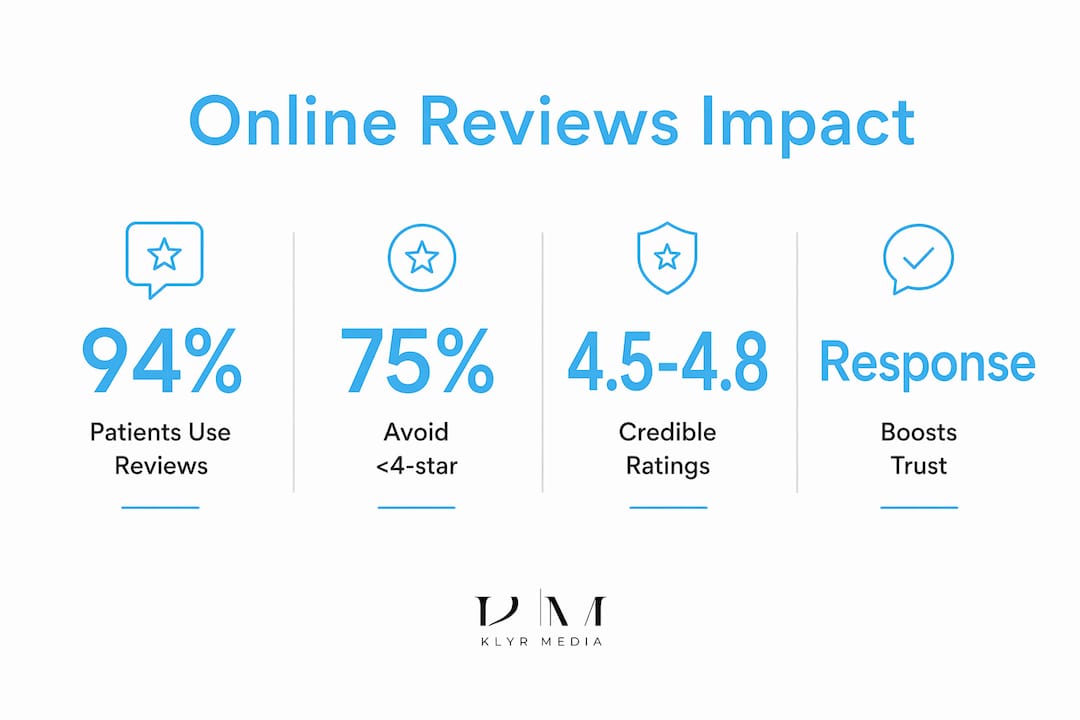
Online reviews are the single most influential factor patients use to select a healthcare provider before ever stepping through the door. 94% of patients use online reviews to evaluate providers, and 77% start their search with reviews before anything else. That is not a trend. That is the new standard for how patients make healthcare choices. Understanding why online reviews matter in healthcare means understanding that your next appointment decision is already being shaped by what strangers wrote online.
How do online reviews influence patient decisions in healthcare?
Patient decisions in healthcare are driven by trust, and online reviews have become the fastest way patients build or break that trust. The numbers tell a clear story.
- 75% of patients refuse to book appointments with providers rated below 4.0 stars. That threshold acts as a hard filter. Providers below it lose patients before a single conversation happens.
- 55% of patients have avoided or canceled appointments because of negative reviews. This is not passive browsing. Patients act on what they read.
- Patients treat reviews as proxies for empathy and safety, not just clinical skill. They are asking: “Will this provider listen to me? Will I feel respected?”
- Recent reviews carry more weight. Patients prioritize recent feedback over older reviews to judge whether a practice is still operating at the same standard.
The emotional logic here is real. Choosing a doctor is not like buying a product. The stakes feel personal. Reviews reduce that anxiety by giving patients a window into what the experience actually looks like, from wait times to how staff treat people at the front desk.
Pro Tip: When reading reviews, pay attention to the dates. A clinic with 200 reviews from three years ago tells you less than one with 40 reviews from the last six months.
Patients also use review volume as a signal. A provider with two reviews and a perfect score feels less trustworthy than one with 150 reviews and a 4.6. The volume itself communicates consistency. That is a psychological reality providers cannot afford to ignore.
What information do patients find most valuable in online reviews?
The content of reviews matters as much as the star rating. Patients are not just counting stars. They are reading for specific signals.

The most cited factors in patient reviews focus on non-clinical attributes. Online reviews often highlight bedside manner, wait times, scheduling ease, and staff communication far more than clinical outcomes. That makes sense. Patients rarely have the expertise to evaluate a diagnosis. They can absolutely evaluate whether a doctor made eye contact or whether the office kept them waiting 45 minutes without explanation.
Here is what patients consistently look for in review content:
- Bedside manner and communication. Does the provider listen? Do they explain things clearly? This shows up in reviews more than any other factor.
- Wait times and scheduling. Long waits and difficult booking processes generate negative reviews at a high rate. Patients notice operational friction.
- Staff attitude. Front desk and nursing staff behavior appears frequently. A great doctor with a rude receptionist still gets one-star reviews.
- Review volume as social proof. Review volume reduces perceived risk by suggesting consistent care quality. More reviews signal that a practice is active and established.
- Provider responses. How a provider responds to a review tells patients a lot about the practice culture.
Pro Tip: A balanced review profile with a 4.5 to 4.8 star average often reads as more credible than a perfect 5.0. Patients know perfection is rare. A slight mix of feedback, handled well, signals authenticity.
Balanced review profiles in the 4.5 to 4.8 range are perceived as more authentic than a flawless score. A perfect 5.0 can actually raise skepticism. Patients wonder if reviews are filtered or fake. A thoughtful negative review, paired with a professional provider response, often builds more trust than silence.
How do healthcare providers use online reviews strategically?
Reviews are not just a reputation score. For providers who pay attention, they are a real-time feedback system and a patient acquisition tool.
Here is how providers who take reviews seriously use them:
- Monitor review platforms consistently. Providers who check platforms like Google, Healthgrades, and Zocdoc regularly catch problems early. A spike in complaints about wait times, for example, is an operational warning before it becomes a crisis.
- Respond to every review, especially negative ones. Responding to negative reviews publicly demonstrates accountability and builds patient trust. Silence reads as indifference.
- Use feedback to improve operations. Reviews reveal patterns that internal surveys miss. If five separate patients mention the same billing confusion, that is a process problem worth fixing.
- Build search visibility through review activity. Active review profiles improve local search rankings. Patients searching for “primary care near me” are more likely to find providers with recent, frequent reviews.
“Negative reviews, when responded to thoughtfully, can increase trust more than ignoring them.” — Press Ganey, 2026
The shift here is significant. Providers who treat reviews as a passive score miss the point. Reviews are a live conversation with your patient base. Engaging with them, even when the feedback stings, signals that the practice cares. 66% of patients say a provider’s response to reviews influences their trust, up 24 points from the previous year. That jump is not a coincidence. Patients are watching how providers handle criticism.
Reviews also feed into the broader digital marketing trends shaping how healthcare practices compete for local patients in 2026. Practices that ignore their review profile are effectively handing patients to competitors who do not.
What are best practices for patients interpreting online healthcare reviews?
Reading reviews well is a skill. Most patients scan star ratings and move on. That approach misses most of the useful information.
- Check the date of reviews first. Recent reviews reflect the current state of the practice. A clinic that was excellent two years ago may have changed staff, ownership, or procedures. Prioritize recent feedback to assess current quality.
- Read the text, not just the stars. A three-star review that says “great doctor, terrible parking” tells you something very different from one that says “felt rushed and dismissed.” The words carry the real information.
- Look at review volume. Ten reviews and a 5.0 rating is far less meaningful than 300 reviews and a 4.6. Volume signals consistency over time.
- Evaluate how the provider responds. A provider who replies to negative reviews with empathy and a solution is showing you exactly how they handle problems. That matters more than the complaint itself.
- Recognize what reviews measure. Reviews capture the patient experience, not clinical outcomes. Use them to assess communication, access, and culture. Use other sources, like board certifications or hospital affiliations, to assess clinical quality.
The goal is to use reviews as one informed input, not the only one. A provider with strong reviews and a board certification in their specialty is a much safer bet than either signal alone. Reviews and clinical credentials together give you a fuller picture.
Key takeaways
Online reviews are the primary filter patients use to evaluate healthcare providers, and providers who engage with feedback actively build measurably more trust than those who do not.
| Point | Details |
|---|---|
| Reviews drive appointment decisions | 75% of patients refuse to book with providers rated below 4.0 stars. |
| Non-clinical factors dominate reviews | Patients rate bedside manner, wait times, and communication more than clinical outcomes. |
| Review volume builds trust | Higher review counts signal consistent care quality and reduce patient anxiety. |
| Provider responses matter significantly | 66% of patients say how a provider responds to reviews influences their trust. |
| Balanced profiles read as authentic | A 4.5 to 4.8 star average is perceived as more credible than a perfect 5.0 score. |
The uncomfortable truth about healthcare reviews most patients miss
Here is what I have seen working in healthcare digital marketing: most patients read reviews the wrong way, and most providers manage them the wrong way. Both groups are leaving value on the table.
Patients fixate on the star average and skip the text. That is backwards. The text is where the real signal lives. A provider with a 4.2 and 200 detailed, recent reviews describing attentive care is a far better choice than a 4.8 with 12 vague reviews from three years ago. Volume and recency beat a polished average every time.
On the provider side, the instinct to ignore or dispute negative reviews is understandable but costly. A thoughtful public response to a complaint does more for your reputation than ten positive reviews. It shows future patients that you take feedback seriously. That is the kind of accountability patients are actively looking for, especially when choosing someone they are trusting with their health.
The other thing worth saying plainly: reviews reflect experience, not expertise. A brilliant surgeon with a cold bedside manner will collect negative reviews. A warm, communicative provider with average clinical skills will collect glowing ones. Neither picture is complete. Use reviews to assess the experience. Use credentials, referrals, and direct conversations to assess the clinical side. Both matter. Neither alone is enough.
— Opinly
How Klyrmedia helps healthcare practices build trust online
Healthcare practices that take their online reputation seriously attract more patients and retain them longer. Klyrmedia works specifically with independent pharmacies, medical clinics, and healthcare practices across the United States to build the kind of digital presence that earns patient trust before the first appointment.

Klyrmedia’s HIPAA-compliant web design gives practices a secure, professional foundation that patients trust on first contact. The marketing automation services handle patient follow-up, review solicitation, and response workflows so nothing falls through the cracks. For practices ready to compete with larger chains on local search, Klyrmedia’s approach to boosting online presence covers everything from review management to local SEO. The result is a practice that shows up, looks credible, and converts searches into booked appointments.
FAQ
Why do online reviews matter so much in healthcare?
94% of patients use reviews to evaluate providers, making them the most common first step in choosing care. Reviews signal trust, communication quality, and overall patient experience before a single appointment is booked.
What star rating do patients require before booking an appointment?
75% of patients will not book with a provider rated below 4.0 stars. Falling below that threshold effectively removes a practice from consideration for the majority of patients searching online.
Do negative reviews always hurt a healthcare provider?
Not always. Thoughtfully responding to negative reviews can actually increase patient trust more than ignoring them. A professional, empathetic response demonstrates accountability, which patients value highly.
What should patients look for beyond the star rating?
Patients should read review text for specific mentions of wait times, staff communication, and scheduling ease. They should also check how recently reviews were posted and whether the provider responds to feedback.
How do provider responses to reviews affect patient trust?
66% of patients say a provider’s response to reviews influences their trust, a figure that rose 24 points in a single year. Responding to reviews, especially critical ones, is now one of the most visible trust signals a practice can send.

