

Why Medical Clinics Need Websites: A 2026 Guide

A medical clinic’s website is core digital infrastructure, not an optional marketing add-on. It determines whether patients find you, trust you, book with you, and stay with you. In 2026, the question is no longer if your clinic needs a website. The real question is whether yours is doing the job. This guide breaks down why medical clinics need websites, what those sites must do, and what happens when they fall short on compliance, patient trust, or operational efficiency.
Why medical clinics need websites for patient trust and engagement
Over 77% of patients search online before booking an appointment. That number alone should settle the debate. If a patient can’t find your clinic online, or finds a site that looks like it was built in 2009, they move on to someone else.
The trust factor is real and measurable. 60% of patients say a provider’s website directly influences whether they trust that practice. Your site is often the first clinical impression you make, and patients treat it like a waiting room. If it’s cluttered, slow, or confusing, they assume the same about your care.

Design quality carries serious weight. 75% of users judge a company’s credibility based on website design alone. For a medical clinic, that credibility gap can translate directly into lost appointments and patients choosing a competitor down the street.
Here’s what a well-built clinic site does for patient engagement:
- Displays credentials and specialties clearly so patients know they’re in the right place before they even call
- Publishes service pages that answer common questions and reduce phone volume
- Features patient testimonials and reviews that build social proof without requiring staff time
- Includes educational content like blog posts or FAQs that position your providers as trusted authorities
- Offers mobile-optimized design so the experience works on any device, any time
That last point matters more than most clinics realize. Mobile-first architecture is now a baseline requirement for healthcare websites, not a premium feature. More than half of all health-related searches happen on a smartphone. A site that doesn’t load cleanly on mobile is a site that’s losing patients before they read a single word.
Pro Tip: Add a “Meet Our Providers” page with photos, credentials, and a short bio for each clinician. Patients who feel they know their doctor before the first visit are more likely to book and less likely to cancel.
How do websites protect clinics from compliance and legal risk?
HIPAA compliance is not optional for any website that touches patient health information. That includes contact forms, appointment request tools, patient portals, and even live chat widgets. Many clinics don’t realize their existing site is already out of compliance.
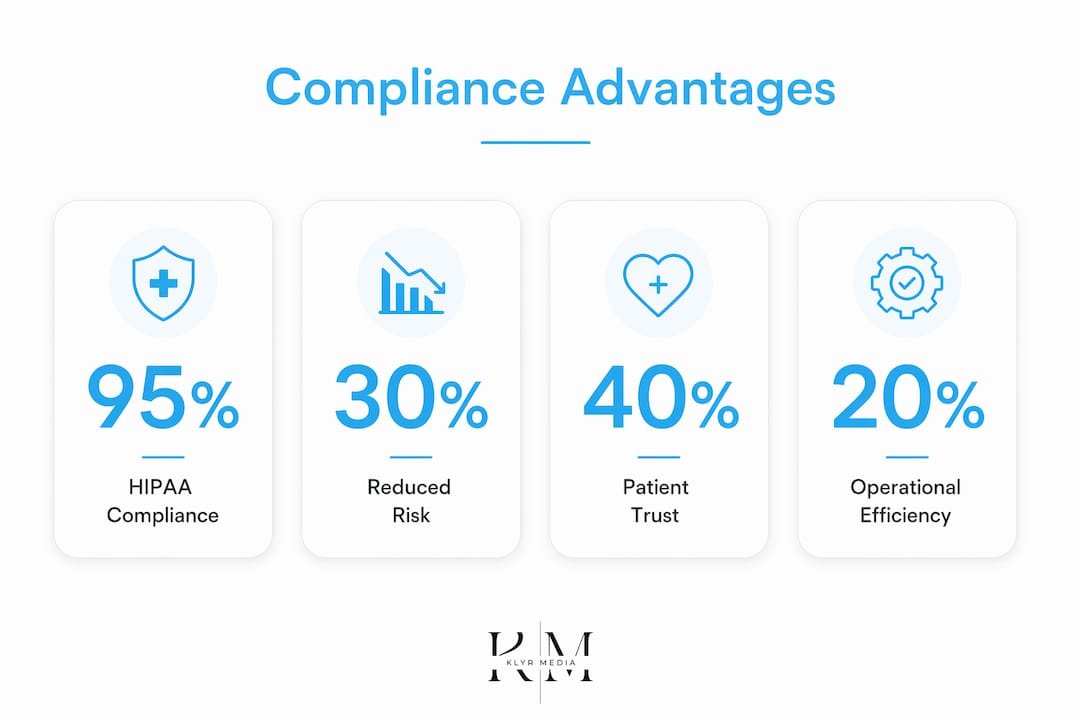
The financial exposure is significant. HIPAA violations tied to unsecured websites can result in fines between $100 and $50,000 per violation. A single improperly secured contact form, a non-compliant third-party plugin, or unencrypted data transmission can trigger a penalty that wipes out months of revenue.
Building a compliant site requires attention to specific technical and operational features:
- Encrypted data transmission (SSL/TLS): Every page must run on HTTPS. No exceptions.
- HIPAA-compliant contact forms: Standard form builders like basic WordPress plugins do not meet HIPAA standards. You need a solution with a Business Associate Agreement (BAA) in place.
- Secure patient portals: Any area where patients access test results, request prescriptions, or message providers must be built on a compliant platform.
- Compliant third-party tools: Analytics, chat tools, and scheduling software must all have signed BAAs with your practice.
- Access controls and audit logs: Your site’s backend should track who accesses patient data and when.
The good news is that a properly built site turns compliance from a liability into a competitive advantage. Patients increasingly ask about data security. A clinic that can point to a HIPAA-compliant website with a secure portal signals professionalism that generic practices can’t match.
Pro Tip: Before your next site update, audit every third-party tool embedded on your site. If you don’t have a signed BAA with that vendor, remove the tool or replace it with a compliant alternative.
In what ways do websites improve operational efficiency?
Phone calls are expensive. Every call your front desk takes to answer a question that’s already on your website, confirm an appointment, or collect intake information is time your staff isn’t spending on higher-value work. A well-built clinic website eliminates a significant portion of that volume.
A compliant medical website automates appointment booking, patient intake, and EHR integration. That’s not a future-state vision. Clinics using online scheduling tools report measurable reductions in no-shows and administrative overhead. Patients who book online also tend to complete pre-visit intake forms digitally, which means your team has the information they need before the patient walks in the door.
The operational benefits stack up quickly:
- Online scheduling tools let patients book 24 hours a day without staff involvement
- Digital intake forms replace paper, reduce data entry errors, and speed up check-in
- Patient portals give patients direct access to test results, reducing callback volume
- Prescription refill requests handled through the portal free up phone lines for urgent calls
- EHR integration means data entered online flows directly into your clinical system, no double entry
A connected digital ecosystem anchored by the website helps clinics manage compliance, intake, SEO, and patient experience as one coordinated system rather than a collection of disconnected tools. That’s the difference between a website that costs you money and one that saves it.
How do websites drive patient acquisition through SEO and digital marketing?
Your website is the hub of every digital marketing effort your clinic runs. Google Ads, local SEO, social media, and reputation management all point back to it. Without a strong site at the center, those channels leak patients instead of converting them.
Local SEO and Google Business Profile optimization directly increase visibility and patient bookings. When someone searches “urgent care near me” or “family doctor in [your city],” Google’s algorithm evaluates your website’s content, speed, and structure to decide where you rank. Dedicated service pages, fast load times, and location-specific content all contribute to that ranking.
The table below shows how a clinic website compares to social media as a patient acquisition channel:
| Factor | Clinic website | Social media profile |
|---|---|---|
| Search visibility | High (Google indexes pages) | Low (profiles rarely rank for medical searches) |
| HIPAA compliance control | Full control | Limited, platform-dependent |
| Appointment conversion | Direct (booking tools on-site) | Indirect (requires redirect) |
| Content longevity | Permanent (pages stay indexed) | Short (posts disappear in feeds) |
| SEO authority building | Yes (accumulates over time) | No |
| Patient data ownership | Clinic owns all data | Platform owns the data |
Social media has a role in awareness and community building. But it cannot replace a website as the foundation of digital marketing for clinics. A Facebook page can be deleted, restricted, or de-prioritized by an algorithm change overnight. Your website is yours.
The website as a central hub for SEO, Google Ads, and reputation management is how clinics build long-term patient acquisition that doesn’t depend on ad spend alone. Content that targets relevant search terms, like “what to expect at your first cardiology appointment” or “pediatric urgent care vs. emergency room,” builds authority over months and years. That’s revenue that compounds. For a deeper look at how this works in practice, the healthcare SEO guide from Klyrmedia walks through the full strategy.
Key takeaways
A medical clinic’s website is the single most important digital asset for patient trust, regulatory compliance, and long-term growth.
| Point | Details |
|---|---|
| Patient trust depends on design | 75% of users judge credibility by website design, making quality non-negotiable for clinics. |
| HIPAA compliance is a legal requirement | Unsecured forms and non-compliant plugins can trigger fines up to $50,000 per violation. |
| Websites reduce operational costs | Online scheduling, digital intake, and patient portals cut administrative workload significantly. |
| SEO requires a strong website foundation | Local search rankings, Google Ads, and reputation management all depend on your site’s quality. |
| Social media cannot replace a website | Only your website gives you full data ownership, SEO authority, and direct booking capability. |
The brochure trap is costing clinics real patients
I’ve worked with enough healthcare providers to spot a pattern. Most clinics that struggle with patient acquisition have the same problem. Their website exists, but it doesn’t work. It lists services, shows a phone number, maybe has a stock photo of a smiling doctor. And that’s it.
That’s a brochure. Brochures don’t book appointments at 11pm. They don’t answer patient questions about insurance before the visit. They don’t collect intake forms or send appointment reminders. And they definitely don’t rank on Google for the searches your future patients are running right now.
The clinics I’ve seen grow consistently treat their website the way they treat their EHR: as infrastructure that the whole practice depends on. They invest in it, maintain it, and update it when regulations or patient expectations change. Advanced medical websites now integrate AI-driven patient intake and analytics securely, which means the gap between a functional site and a high-performing one is only getting wider.
My honest advice: stop asking whether your clinic needs a website and start asking whether your current site is actually earning its place. If patients can’t book online, if your forms aren’t HIPAA-compliant, or if your site isn’t showing up in local searches, you’re not just missing a marketing opportunity. You’re losing patients to competitors who figured this out already. The top healthcare website features worth prioritizing are well-documented. The harder part is committing to the investment.
Choose a development partner who understands healthcare specifically. Generic web agencies don’t know what a BAA is. They won’t ask about your EHR integration. And they won’t build a site that holds up when a HIPAA auditor comes knocking.
— Opinly
How Klyrmedia builds clinic websites that actually work
If your clinic’s website isn’t booking appointments, protecting patient data, and showing up in local search results, it’s not doing its job. Klyrmedia specializes in HIPAA-compliant website design built specifically for medical clinics and healthcare practices across the United States.
Every site Klyrmedia builds includes secure patient intake, appointment scheduling integration, and local SEO architecture from day one. There’s no retrofitting compliance after the fact. The team understands healthcare workflows, EHR systems, and the regulatory requirements that generic agencies miss. If you’re ready to treat your website as the infrastructure your clinic actually needs, Klyrmedia’s clinic solutions are built for exactly that.
FAQ
Why do medical clinics need websites in 2026?
A clinic website is the primary way patients find, evaluate, and book with a provider. With 77% of patients researching online before their first appointment, a clinic without a strong website is effectively invisible to a majority of potential patients.
Does a clinic website need to be HIPAA-compliant?
Yes. Any website that collects patient information through contact forms, scheduling tools, or portals must meet HIPAA standards. Non-compliant sites risk fines up to $50,000 per violation.
Can social media replace a clinic website?
No. Social media builds awareness but cannot replicate a website’s SEO authority, data ownership, direct booking capability, or compliance controls. A website is the only channel your clinic fully owns and controls.
How does a website improve clinic efficiency?
Online scheduling, digital intake forms, and patient portals reduce phone volume, cut administrative workload, and speed up the check-in process. These tools free staff to focus on in-clinic patient care rather than routine administrative tasks.
What makes a medical website different from a standard business website?
Medical websites require HIPAA-compliant data handling, secure patient portals, EHR integration capability, and healthcare-specific content strategy. Standard business website templates and generic agencies typically lack the technical and regulatory knowledge to build them correctly.

