

Why Independent Pharmacies Need Digital Marketing

Independent pharmacies that skip digital marketing are handing patients directly to CVS, Walgreens, and Amazon Pharmacy. Digital marketing, known in healthcare as local patient acquisition strategy, is the system that puts your pharmacy in front of patients at the exact moment they search for help. The data is clear: proximity alone does not win patients anymore. A 2026 study found that only 70% of residents visit the pharmacy closest to them, even though nearly 98% have one within five kilometers. That gap is where digital marketing either wins or loses you patients every single day.
Why independent pharmacies need digital marketing in 2026
The core reason is simple. Patients now discover, evaluate, and choose pharmacies online before they ever walk through the door. If your pharmacy is invisible on Google, you do not exist for that patient. The importance of digital marketing for independent pharmacies goes beyond running ads. It covers your Google Business Profile, your reviews, your local search rankings, and increasingly, how AI-powered tools like ChatGPT and Perplexity recommend local businesses to users.
Chain pharmacies spend millions on national brand awareness. You cannot match that budget. What you can do is own your neighborhood digitally. Local SEO and reputation management are the tools that let a single-location independent pharmacy outrank a CVS in local search results. That is not a theory. That is what happens when you execute the right digital strategies consistently.
How does google business profile drive patient discovery?
Your Google Business Profile (GBP) is the single most important free digital asset you have. Most patients who find you on Google are not searching your pharmacy’s name. They are searching “pharmacy near me” or “flu shots near me.” 84% of GBP views come from discovery searches, not direct name searches. That means your profile needs to be optimized for what patients are looking for, not just who you are.
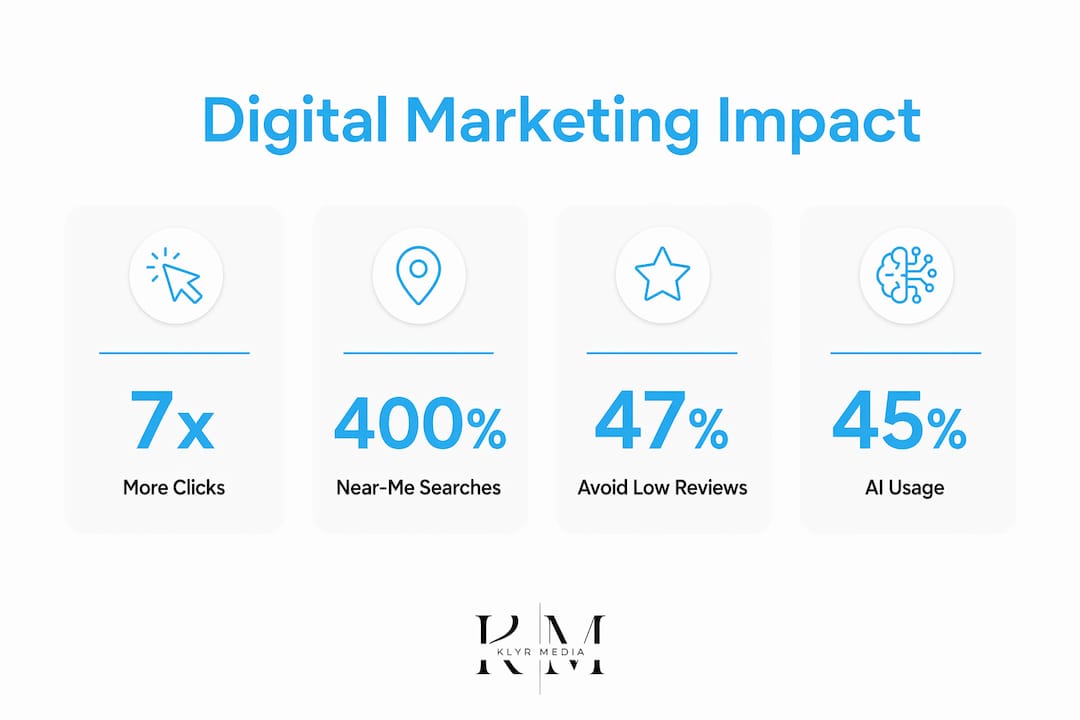
The difference between a basic profile and a fully built-out one is dramatic. A fully optimized GBP generates 7x more clicks and 70% more in-store visits than a bare-bones listing. That is not a marginal improvement. That is the difference between a slow Tuesday and a full appointment book.
Here is what a high-performing pharmacy GBP looks like:
- Complete service categories: List immunizations, medication therapy management, blister packaging, and specialty compounding if you offer them.
- 750+ character description: Profiles with descriptions of 750+ characters get 2.5x more impressions. Write for the patient, not for yourself.
- Updated hours and holiday schedules: Patients who show up to a closed pharmacy do not come back.
- Messaging enabled: Patients increasingly prefer to text before they call.
- Recent photos: Real photos of your staff and storefront build trust before a patient ever arrives.
| GBP Element | Impact |
|---|---|
| Fully completed profile | 7x more clicks vs. basic profile |
| 750+ character description | 2.5x more impressions |
| Discovery search optimization | 84% of all profile views |
| Local 3-pack ranking | 126% more traffic vs. ranks 4–10 |
Pro Tip: Link your GBP directly to a service-specific landing page, not just your homepage. A patient searching “travel vaccines near me” should land on your travel health page, not a generic welcome screen.
For a step-by-step walkthrough, Klyrmedia has a detailed guide on optimizing your pharmacy GBP that covers categories, attributes, and post strategy.
Do online reviews actually affect patient decisions?
Yes, and more than most pharmacy owners realize. 97% of consumers read reviews for local businesses. That number alone should stop you in your tracks. Your reviews are not a nice-to-have. They are a primary decision factor for nearly every new patient who considers your pharmacy.
The details get more specific from there:
- 47% of patients will not use a business with fewer than 20 reviews. If your pharmacy has eight reviews from 2022, a significant portion of potential patients are already walking away.
- 74% of consumers focus on reviews from the last three months. Old reviews, even five-star ones, carry less weight than recent ones. Recency matters as much as volume.
- 80% of consumers prefer businesses that respond to all reviews. Responding is not just polite. It is a conversion signal.
- 42% actively avoid businesses that never respond. Silence reads as indifference.
Businesses that respond to reviews earn 35% more revenue on average than those that do not. Review engagement is not a soft metric. It is a direct revenue driver.
The practical implication here is that review generation and response must be treated as an ongoing system, not a one-time push. Build a workflow: ask every satisfied patient for a review at the point of pickup or checkout, respond to every review within 48 hours, and monitor Google, Yelp, and Healthgrades consistently. That consistency compounds over time into a reputation that new patients trust on sight.
Pro Tip: Train your pharmacy techs to mention reviews naturally at checkout. A simple “If you have a moment, a Google review really helps us” converts far better than a follow-up email sent three days later.
Why local SEO beats generic brand awareness for independents
National chains buy brand awareness at scale. You win on relevance and proximity. Local SEO, which is the practice of optimizing your digital presence to appear in geographically relevant searches, is the highest-return digital strategy available to an independent pharmacy. It does not require a massive budget. It requires consistency and specificity.
The numbers back this up. Near-me searches have increased 400% since 2020, and 28% of those searches lead directly to a purchase. Patients are not browsing. They are ready to act. Pharmacies that rank for those searches capture patients at peak intent.
Ranking in Google’s local 3-pack is the goal. Businesses in the local 3-pack receive 126% more traffic and 93% more calls and clicks compared to positions 4 through 10. The gap between third place and fourth place is enormous.
Here is where independent pharmacies have a real structural advantage:
- Service-specific pages: Build dedicated pages for immunizations, medication synchronization, blister packaging, and diabetes management. Chains rarely do this at the local level.
- Neighborhood-specific content: Write about your community. Mention local events, schools, and neighborhoods you serve. Google rewards geographic relevance.
- NAP consistency: Your name, address, and phone number must be identical across your website, GBP, Yelp, Healthgrades, and every directory listing. Inconsistency kills local rankings.
- Healthcare SEO fundamentals: Understanding healthcare-specific SEO means optimizing for patient intent queries, not just general keywords.
| Strategy | Chain Pharmacy | Independent Pharmacy |
|---|---|---|
| National brand spend | High budget advantage | Cannot compete directly |
| Local 3-pack ranking | Generic location pages | Service-specific pages win |
| Neighborhood trust signals | Minimal local content | Strong community connection |
| Review recency | Inconsistent management | Systematic approach wins |
How is AI changing the way patients find pharmacies?
This is the shift most pharmacy owners have not caught up to yet. The share of consumers using AI for local business recommendations jumped from 6% in 2025 to 45% in 2026. That is not a gradual trend. That is a structural change in how patients discover local healthcare providers.
When a patient asks ChatGPT or Perplexity “what’s the best independent pharmacy near me for compounding,” those tools pull from your reviews, your GBP data, your website content, and third-party directories. They cross-reference multiple sources to build a recommendation. And 88% of consumers fact-check the reviews that AI tools cite. Accuracy and legitimacy are not optional.
What this means practically:
- Consistent profiles across platforms: AI tools do not rely on just Google. They pull from Yelp, Healthgrades, WebMD, and pharmacy-specific directories. Every profile needs to be current and complete.
- Verifiable review volume: Thin review profiles get deprioritized. AI tools favor businesses with substantial, recent, and diverse review histories.
- Accurate service descriptions: If your GBP says you offer compounding but your website does not mention it, that inconsistency creates doubt in both AI systems and patients.
- HIPAA-compliant web presence: AI tools increasingly surface websites. A site that loads slowly, lacks HTTPS, or looks outdated signals low credibility.
For pharmacies thinking about AI in healthcare content, the core principle is the same as it is for human patients: trust is built through consistency, accuracy, and responsiveness.
Key takeaways
Independent pharmacies that build consistent, optimized digital presences win more local patients than those relying on proximity alone.
| Point | Details |
|---|---|
| GBP optimization is foundational | A fully completed profile generates 7x more clicks and 70% more in-store visits. |
| Reviews require a system, not a one-time push | 47% of patients reject businesses with fewer than 20 reviews; recency and response rate matter equally. |
| Local SEO targets peak patient intent | Near-me searches are up 400% since 2020, and local 3-pack ranking drives 126% more traffic. |
| AI discovery is now a real channel | 45% of consumers used AI for local recommendations in 2026; consistent profiles across platforms are required. |
| Proximity does not guarantee patronage | Only 70% of patients visit their closest pharmacy, meaning digital differentiation directly drives choice. |
What most pharmacy owners get wrong about digital marketing
Here is the uncomfortable truth I keep seeing: most independent pharmacy owners know they need a digital presence, but they treat it like a checkbox. Get a website. Claim the Google listing. Done. That mindset is exactly why so many good pharmacies are invisible online while mediocre ones with better profiles are pulling in new patients every week.
The mistake is treating digital marketing as a one-time setup rather than an ongoing operation. Your GBP needs fresh photos and posts. Your reviews need responses within 48 hours. Your service pages need to reflect what you actually offer today, not what you offered when you launched the site three years ago. Patients are not static, and neither is the algorithm that decides whether they find you.
The other trap I see is over-relying on word-of-mouth and assuming loyal patients will carry the business. They will not carry it forever. Patients move, change insurance, or get ghosted by their own habits. New patient acquisition requires digital visibility, full stop. The pharmacies that grow in 2026 are the ones treating their Google presence with the same seriousness they give their inventory management.
If you are not sure where to start, the GBP and reviews are the highest-leverage moves. Get those right before you spend a dollar on paid advertising. Build the foundation, then scale.
— Opinly
How Klyrmedia helps independent pharmacies compete digitally
Running a pharmacy is already a full-time job. Managing PBM audits, DIR fees, Prior Auth requests, and staffing leaves almost no bandwidth for digital marketing. That is exactly the gap Klyrmedia fills.
Klyrmedia builds HIPAA-compliant pharmacy websites designed specifically for independent pharmacies, with local SEO architecture built in from the start. Beyond the website, Klyrmedia offers patient retention automation systems that keep existing patients engaged through refill reminders, follow-up sequences, and loyalty touchpoints. Every service is built for healthcare compliance and local patient growth, not generic marketing templates. If you want to compete with the chains without matching their budget, Klyrmedia is the partner built for exactly that.
FAQ
Why does digital marketing matter more than location for pharmacies?
Only 70% of patients visit the pharmacy closest to them, even when one is nearby. Digital presence, reviews, and search visibility directly influence which pharmacy a patient chooses.
How many google reviews does an independent pharmacy need?
47% of consumers will not use a business with fewer than 20 reviews. Aim for at least 20 recent reviews, with new ones added consistently every month.
What is the fastest way to improve local search rankings?
Fully complete your Google Business Profile with service categories, a 750+ character description, updated hours, and recent photos. This alone produces measurable improvements in local visibility within weeks.
How does AI search affect pharmacy patient acquisition?
45% of consumers used AI tools to find local businesses in 2026. Pharmacies with consistent profiles, strong review volume, and accurate service descriptions across multiple platforms are the ones AI tools recommend.
Should independent pharmacies run paid ads or focus on SEO first?
Build your local SEO foundation first. Ranking in the local 3-pack drives 126% more traffic than positions 4 through 10, and that traffic costs nothing per click. Paid ads amplify a strong organic presence but cannot replace it.

