

What Is PPC Advertising for Healthcare Providers

Most healthcare business owners hear “PPC advertising” and think it just means paying Google to show up at the top of search results. That’s part of it. But what is PPC advertising at its core? It’s a paid digital strategy where you only pay when someone clicks your ad. For a medical clinic or independent pharmacy, that means you’re putting your budget directly in front of patients who are actively searching for the care you provide. This article breaks down how PPC works, where your ads can appear, why it outperforms organic-only strategies for fast patient acquisition, and how to manage campaigns that actually convert.
Table of Contents
- Key takeaways
- What PPC advertising really means
- Where your PPC ads can appear
- Why PPC works specifically for healthcare
- Managing PPC campaigns that actually convert
- My honest take on PPC in healthcare
- How Klyrmedia helps healthcare providers get PPC right
- FAQ
Key takeaways
| Point | Details |
|---|---|
| PPC charges per click, not per view | You only spend money when a motivated patient actually clicks your ad and visits your page. |
| Auction systems reward relevance | A high-quality ad and landing page can lower your actual cost per click, even against bigger-budget competitors. |
| Healthcare PPC needs conversion tracking | Measuring appointment requests and calls, not just clicks, tells you whether your budget is working. |
| PPC and SEO work better together | PPC delivers immediate patient traffic while SEO builds long-term authority for sustained growth. |
| Ongoing optimization is non-negotiable | Set-and-forget campaigns bleed budget fast. Regular bid, keyword, and landing page reviews protect your ROI. |
What PPC advertising really means
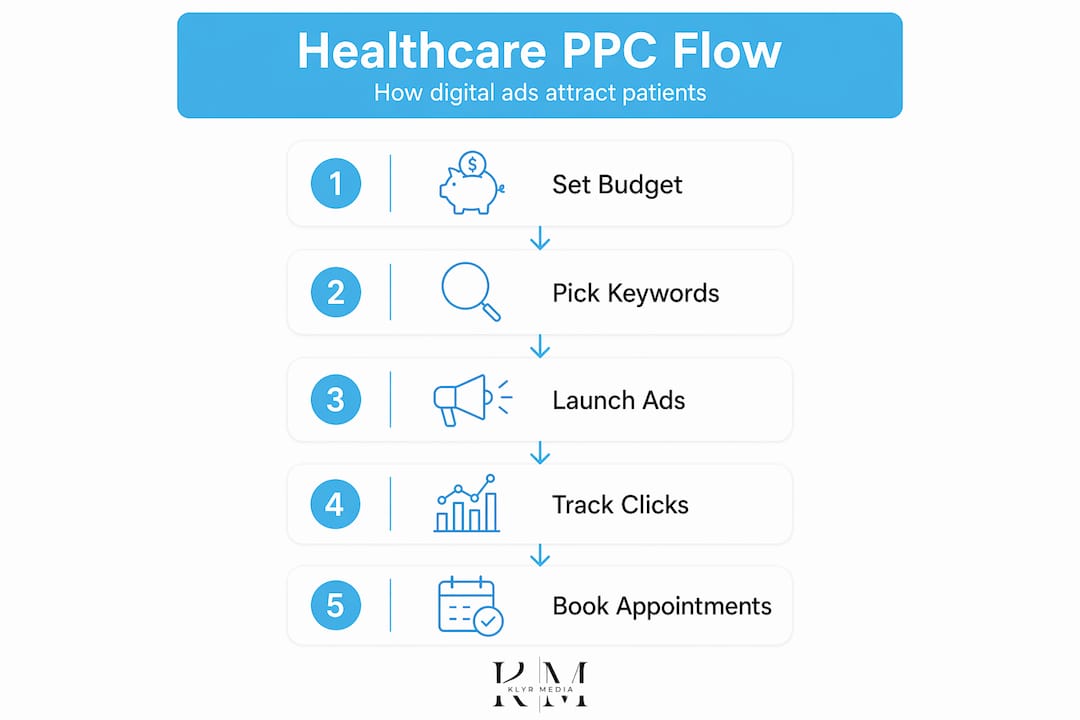
At its simplest, PPC is a paid model where you select your targeting and budget, and you pay only when someone clicks. No click, no charge. That’s a meaningfully different financial model than, say, a billboard or a local radio spot where you pay for exposure regardless of results.
PPC sits inside the broader category of search engine marketing, or SEM. SEM covers all paid strategies to appear in search results. PPC is the specific mechanism that powers those ads. When you run a Google Ads campaign for “urgent care near me” and a patient clicks it, that click has a price. That price is called the cost-per-click, or CPC.
Here’s how the auction works in practice. Every time a patient types a search query, platforms like Google run an ad auction in real time. Advertisers bid on keywords. The winner isn’t purely whoever bids the most. Google also weighs ad relevance and landing page quality. This matters a lot for your bottom line.
Key terms you’ll encounter when running PPC campaigns:
- CPC (Cost-Per-Click): What you pay each time someone clicks your ad. Average CPC across industries is $4.66, though healthcare often skews higher.
- Quality Score: Google’s internal rating of your ad relevance, expected click-through rate, and landing page experience.
- Daily Budget: The maximum you’re willing to spend per day. Google Ads requires no minimum, so you can start small.
- Impression: Every time your ad is displayed, whether or not it’s clicked.
- Conversion: A specific patient action you define, like booking an appointment or calling your office.
Pro Tip: Start with a tightly focused keyword list instead of a broad one. A pharmacy running ads for “compounding pharmacy [your city]” will almost always outperform one bidding on the generic term “pharmacy.”
PPC differs from SEO in one critical way: speed. SEO builds authority over months. PPC can put you in front of patients tomorrow. For a clinic opening a new location or a pharmacy losing patients to a chain, that immediacy is real revenue, not just visibility.

Where your PPC ads can appear
PPC is not limited to Google search results. The channel you choose shapes everything, including who sees your ads, how they’re priced, and what action you can reasonably expect them to take.
Here’s a breakdown of the main platforms relevant to healthcare providers:
- Google Search Ads: These appear at the top of search results when patients are actively looking for care. High intent is the defining feature here. Someone typing “pediatric clinic accepting new patients” is ready to book. This is where most healthcare PPC budgets should start.
- Bing Ads (Microsoft Advertising): Smaller audience than Google, but search ads target high-intent users just the same. Bing’s demographic skews slightly older, which can work in favor of practices treating Medicare-age patients.
- Social Media Ads (Meta, LinkedIn): These platforms often use CPM pricing, meaning you pay per thousand impressions rather than per click. Intent is lower here because patients aren’t actively searching. But social PPC works well for building awareness, promoting seasonal services like flu shots, or retargeting website visitors.
- Display Ads: Banner and image ads that appear across websites in Google’s Display Network. Useful for retargeting. If a patient visited your clinic’s website but didn’t book, a display ad can bring them back.
Choosing the right channel comes down to one question: where is your patient in their decision process? If they’re ready to book, Google Search is your channel. If you’re building brand recognition or nurturing a warm audience, display and social ads support that goal. Most healthcare providers benefit from starting with search and layering in other channels as budget allows.
Why PPC works specifically for healthcare
This is where PPC advertising benefits become concrete for your practice. Organic search is valuable. But it takes time, and your patients are searching right now.
-
You reach patients at the moment of intent. Healthcare PPC targets high-intent users who are actively seeking care. These aren’t passive browsers. They’re people with a need and a search query that proves it.
-
Visibility is immediate. A new clinic can appear on page one of Google on day one of a campaign. That’s not realistic with SEO alone.
-
Targeting is precise. You can target by keyword, geography (down to zip code), device, day of week, and even hour of day. A walk-in clinic can turn ads on Monday mornings and off on weekends.
-
Budget control is real. You set daily caps. You decide what you spend. There’s no surprise invoice at the end of the month.
-
Results are measurable. Unlike a print ad, you know exactly how many people saw your ad, clicked it, and took a patient action.
“PPC provides immediate visibility and measurable ROI, making it ideal for healthcare providers who need patient engagement quickly rather than waiting months for organic traction.”
On the PPC vs SEO question, the honest answer is that you need both. PPC and SEO aligned strategies yield better patient acquisition outcomes than either approach alone. PPC gives you fast traffic while your SEO authority builds. SEO insights, particularly which organic keywords convert patients, feed directly into your PPC keyword targeting. They compound each other.
Managing PPC campaigns that actually convert
Running a PPC campaign is easy. Running one that fills your appointment calendar is a different challenge. Here’s where most healthcare providers leave money on the table.
Keyword selection starts with patient language
Patients don’t search the way providers think. They search “back pain doctor near me,” not “orthopedic specialist accepting PPO.” Your healthcare keyword selection should be built from actual patient search behavior, not internal clinical terminology.
Use a mix of keyword match types. Broad match captures volume but wastes spend. Exact match is precise but limits reach. Phrase match hits the middle ground well for most healthcare campaigns.
Ad copy and landing pages must match
This is the single biggest source of wasted PPC budget in healthcare. A patient clicks an ad about “same-day dental appointments” and lands on your general homepage. They don’t see what they came for. They leave. You paid for that click.
| Element | Weak approach | Stronger approach |
|---|---|---|
| Ad headline | “City Dental Clinic” | “Same-Day Dental Appointments Available” |
| Landing page | General homepage | Dedicated page for same-day service |
| Call to action | “Learn More” | “Book Your Appointment Today” |
| Phone number | Footer only | Prominently displayed above the fold |
A high-quality ad and landing page can actually reduce your CPC because Google’s Quality Score rewards relevance. You spend less and rank higher. That’s the efficiency gain most providers never realize.
Track conversions, not just clicks
Tracking real conversions like appointment requests rather than clicks is what separates a productive PPC campaign from an expensive traffic generator. Set up conversion tracking for phone calls, appointment form submissions, and live chat interactions. Those are the patient actions that become revenue.
Start small, then scale
Initial PPC budgets should be conservative, letting you gather data before committing larger spend. A small daily budget over two to three weeks tells you which keywords convert, which ads get ignored, and which landing pages work. You scale what works. You cut what doesn’t.
Pro Tip: If you’re just getting started, the Google Ads setup guide for medical practices is a practical resource that walks through campaign structure specific to healthcare providers.
My honest take on PPC in healthcare
I’ve seen a lot of healthcare providers dip into PPC, spend a few hundred dollars, see no results, and walk away convinced it doesn’t work. In almost every case, the problem wasn’t PPC. It was execution.
The most common mistake is treating PPC as a one-time setup. You launch the campaign, set a budget, and wait. What actually happens is your competitors adjust their bids, patient search behavior shifts with the season, and your ad relevance slowly drifts out of alignment. Continuous optimization is what maintains ROI. Campaigns that aren’t actively managed don’t hold. They decay.
The second mistake is measuring the wrong thing. Clicks are vanity. Appointment bookings are the metric that actually pays the bills. Conversion tracking tied to real patient actions is non-negotiable if you want to know whether your ad spend is generating revenue or just traffic.
What I’ve found works: tight keyword lists, dedicated landing pages for each service line, and weekly review of spend and conversion data in the first 60 days. After that, monthly reviews sustain performance. The providers who pair PPC with a solid SEO foundation end up with the most durable patient acquisition systems. One channel feeds the other.
The expectations piece also matters. PPC is not a magic fix. It’s a paid acquisition channel that rewards attention and punishes neglect. Set realistic goals, track the right numbers, and give campaigns time to optimize before drawing conclusions.
— Opinly
How Klyrmedia helps healthcare providers get PPC right
Running PPC well in healthcare isn’t just a marketing problem. It’s a compliance problem too. Your ads drive traffic to a website that needs to handle patient inquiries safely and within HIPAA guidelines.
Klyrmedia builds the full infrastructure healthcare providers need to turn PPC clicks into actual patients. That starts with HIPAA-compliant website design that converts traffic without exposing patient data. It extends into PPC campaign management built specifically for pharmacies, clinics, and medical practices. And it includes patient retention automation that keeps the patients you worked hard to acquire. If you’re a healthcare provider who’s ready to stop guessing at digital advertising and start building a real patient acquisition system, Klyrmedia is worth a conversation.
FAQ
What is pay per click advertising in simple terms?
Pay per click advertising is a digital ad model where you only pay when someone clicks your ad. You set a budget and target keywords, and your ad appears when patients search for relevant services.
How does PPC work for healthcare providers?
Healthcare PPC runs through an auction system where you bid on patient search terms like “urgent care near me.” When your ad wins the auction and a patient clicks it, you pay the agreed cost per click and the patient lands on your chosen page.
What is the difference between PPC and SEO?
PPC delivers paid, immediate visibility in search results while SEO builds unpaid, organic rankings over time. Most healthcare providers benefit from using both together for fast and sustainable patient acquisition.
How much does PPC advertising cost for a medical practice?
There’s no fixed cost. Average CPC across industries is $4.66, but healthcare keywords can cost more. Starting with a small daily budget and scaling based on conversion data is the recommended approach.
What makes a healthcare PPC campaign successful?
Aligning keyword intent with ad copy and landing pages drives the highest conversion rates. Tracking appointment bookings and calls, not just clicks, tells you whether your campaign is actually working.

