

What Is Omnichannel Healthcare Marketing in 2026?

If you’ve been treating omnichannel healthcare marketing as a fancier term for multichannel presence, you’re leaving patients on the table. The concept, more precisely known as unified patient engagement marketing in industry circles, is about one thing: making every touchpoint a continuation of the same conversation. No repeated intake forms. No disconnected emails. No ads promoting a service your clinic can’t currently book. This guide breaks down what it actually means, what it takes to do it right, and why healthcare marketers who get it right are pulling ahead fast.
Key Takeaways
| Point | Details |
|---|---|
| Omnichannel is not multichannel | True omnichannel connects channels with shared data, not just parallel presence across platforms. |
| HIPAA compliance is non-negotiable | Server-side tracking replaces risky third-party pixels to measure ROI without regulatory exposure. |
| Clinical capacity must drive ad spend | Syncing marketing with actual provider availability prevents wasted budget and unfulfilled bookings. |
| Physician-led content builds trust | Authentic, clinician-produced content outperforms generic creative and resists AI commoditization. |
| Retention beats acquisition costs | Brands with strong omnichannel engagement retain far more patients than fragmented competitors. |
What is omnichannel healthcare marketing, really?
At its core, omnichannel healthcare marketing means seamlessly integrating patient touchpoints across digital and physical channels into one unified, data-driven experience. A patient searches your clinic on Google, visits your website, books via a chatbot, gets a reminder text, walks in for their appointment, and receives a follow-up email. At every step, the system knows who they are and where they left off.

That is fundamentally different from multichannel marketing. Multichannel just means you exist on multiple platforms. Omnichannel means those platforms talk to each other.
Here is a quick breakdown of where the two approaches diverge:
| Factor | Multichannel | Omnichannel |
|---|---|---|
| Channel data | Siloed per platform | Unified across all touchpoints |
| Patient experience | Fragmented, repetitive | Continuous, personalized |
| Campaign coordination | Channel-by-channel | Orchestrated centrally |
| Attribution | Hard to measure | Clear, cross-channel tracking |
| Clinical integration | Rarely considered | Built into campaign logic |
In healthcare, the gap between the two matters more than in any other industry. A patient who has to repeat their medical history three times does not feel cared for. They feel like an entry in a database. Omnichannel fixes that. The patient journey becomes coherent, and your brand becomes trustworthy by default.
Pro Tip: Map your current patient touchpoints before anything else. You likely have 7 to 12 contact points per patient acquisition cycle. If data is not flowing between at least half of them, you have fragmentation problems to solve before any campaign work makes sense.
The key components powering it
Getting omnichannel right in healthcare requires more than a CRM and a social media schedule. It relies on a specific stack of capabilities working together.
- Unified patient profiles: Every interaction, from a Google search to a post-visit survey, feeds a single patient record. This powers personalization and eliminates the “start from scratch” experience patients hate.
- Marketing automation platforms: These coordinate campaigns across email, SMS, paid ads, and in-app messaging based on patient behavior, not just calendar triggers.
- HIPAA-compliant server-side tracking: Traditional third-party pixels are both insufficient and risky. Server-side tracking is now essential for measuring ROI without exposing your practice to regulatory fines. This is not optional in 2026.
- AI-driven personalization: Machine learning models can predict which patients are likely to lapse, what content will convert a specific segment, and when to send a re-engagement message.
- Answer Engine Optimization (AEO): Patients are increasingly querying AI models instead of search engines. Content optimized for AI discovery now determines whether your practice gets recommended in those conversations.
- Clinical capacity integration: Your marketing should know when your providers are actually available. Syncing ad spend with real availability is one of the most underused tactics in healthcare marketing, and one of the most impactful.
- Physician-led content: Authentic, clinician-produced video and written content is the strongest trust signal for patients in 2026. It is also the one thing AI cannot replicate.
Pro Tip: Do not implement all of this at once. Start with unified patient profiles and server-side tracking. Every other capability depends on clean, compliant data flowing into a single source of truth.
The measurable benefits of getting it right
The case for omnichannel patient engagement is not philosophical. The numbers are concrete. Brands with strong omnichannel strategies retain 89% of customers compared to just 33% for those with weak omnichannel execution. In healthcare, where patient lifetime value is high and acquisition costs are rising, that gap is significant.
The benefits break down across several dimensions:
- Higher appointment volume: A frictionless digital front door, from search to booking, converts more visitors into scheduled patients. Optimizing your website for this flow is one of the fastest wins available.
- Reduced patient leakage: When channels share data, patients do not fall through the gaps between referral, reminder, and booking.
- Lower paid ad dependency: Organic search improvements from omnichannel visibility create a self-feeding growth cycle that reduces your reliance on expensive paid campaigns over time.
- Better attribution: When you know which touchpoints led to a booked appointment, you stop guessing about budget allocation.
- Stronger brand trust: Coordinated messaging across channels reinforces a consistent brand identity that patients remember and refer.
A real-world signal of where this is heading: Swoop’s acquisition of Nimble combined audience intelligence, omnichannel activation, and pharmacy fulfillment in one system. The result was measurable improvement in patient adherence and care delivery. That is what happens when marketing and clinical operations stop being separate conversations.
Omnichannel versus legacy approaches
Most independent practices and clinics are still running what amounts to legacy healthcare marketing. Social posts here. A Google ad there. Maybe a newsletter nobody opens. Each channel managed by a different vendor or staff member with no shared logic or data.
That is not a strategy. That is a collection of tactics that happen to coexist.
| Approach | Brand consistency | Data flow | Patient experience | ROI visibility |
|---|---|---|---|---|
| Legacy/siloed | Low | None | Fragmented | Near zero |
| Multichannel | Medium | Minimal | Inconsistent | Difficult |
| Omnichannel | High | Real-time | Continuous | Clear |
The practical failure of legacy marketing shows up in the day-to-day. A patient sees a Facebook ad for flu shots, clicks through to your website, and discovers the next available appointment is six weeks out. You just burned your ad budget on an unfulfilled promise. That is patient leakage with a marketing receipt attached.
Omnichannel solves this by treating the practice as a living system integrating intelligence, experience, and brand across every patient interaction. Your digital and clinical operations inform each other. That is the operational shift, not just the marketing shift, that separates modern healthcare practices from ones still fighting over Google review stars.
How to implement omnichannel in your practice
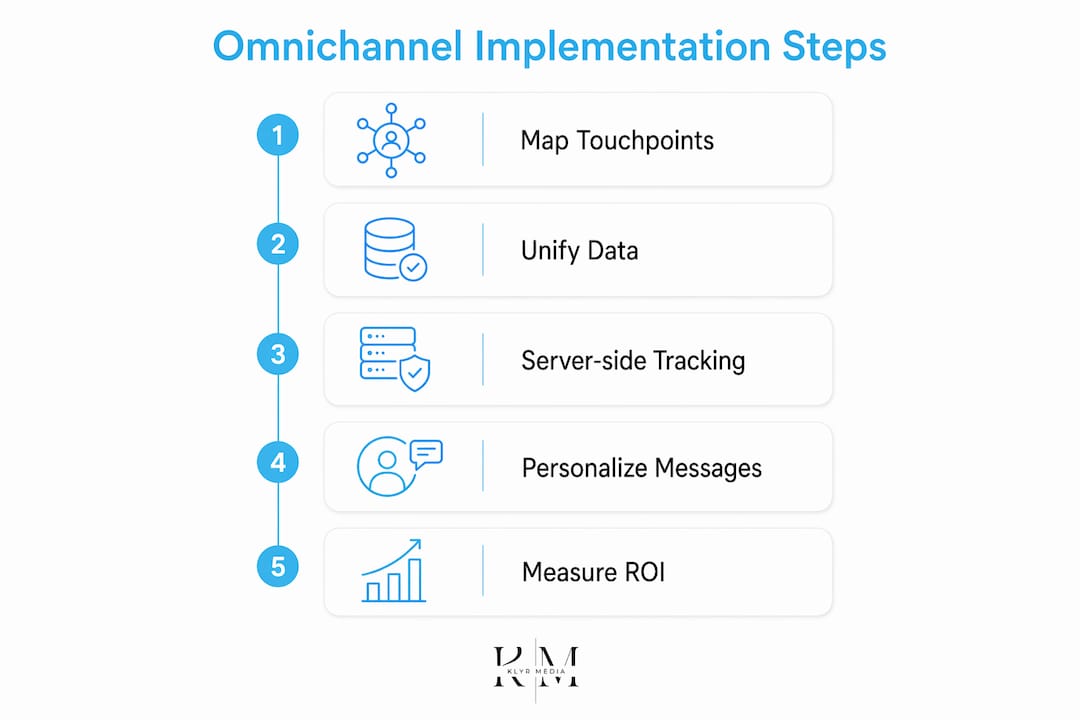
You do not need to overhaul everything at once. Here is a practical sequence that works:
-
Audit your clinical capacity first. Before you run a single campaign, know what your providers can actually take on. Capacity-aware marketing prevents the embarrassing mismatch between ad promises and booking reality.
-
Build unified patient profiles. Pull together data from your EHR, website, CRM, and booking platform. Even a basic unified view changes how you target and personalize.
-
Implement HIPAA-compliant tracking. Swap third-party pixels for server-side analytics. This is the foundation of financial accountability for every campaign you run.
-
Create physician-led content. Task your clinical staff with short video answers to common patient questions. This content works harder than anything your marketing team produces alone. Check out how content builds clinical trust across the patient journey.
-
Optimize your digital front door. Your website needs to convert, not just inform. Fast load times, mobile-first design, and frictionless booking are table stakes now.
-
Layer in AEO tactics. Structure your content in formats that AI answer engines can extract and recommend. FAQ sections, structured headers, and concise clinical summaries are a good start.
-
Measure continuously. Set up cross-channel attribution from day one. Monthly reporting is too slow. You need weekly signals at minimum.
Pro Tip: For independent pharmacies especially, healthcare marketing strategy that ties digital campaigns to in-store fulfillment capability is one of the most under-explored advantages you have over large chains. Use it.
My take: what most teams get wrong
I’ve watched healthcare marketing teams chase the latest channel, the newest ad format, the freshest social platform, while their intake form still asks patients for information they submitted three visits ago. That is the actual problem. Not the channel mix.
What I’ve learned is that omnichannel is not a campaign. It is an operating model. It requires your marketing team, your clinical operations, and your data infrastructure to be aligned around the same patient journey. Most organizations are not built that way, and no amount of ad spend fixes a structural misalignment.
The HIPAA piece is where I see the most dangerous blind spots. Teams still running pixel-based tracking do not realize they are one audit away from a serious compliance exposure. This is not a technicality. It is a liability that sits quietly until it does not.
The other thing that I think gets underestimated: physician-led content is not a nice-to-have. It is becoming the primary moat against commoditization. When AI can generate generic health content at scale, the only content that cuts through is the kind that carries a real clinician’s voice, experience, and opinion. Build that into your content calendar now, before your competitors do.
And if you are still not thinking about Answer Engine Optimization, you are already behind. Patients asking an AI model “where should I get my flu shot” will not find you through a keyword stuffed blog post. They will find whoever structured their content for AI discovery first.
— Opinly
How Klyrmedia helps you build this right
Klyrmedia was built specifically for practices like yours. Independent pharmacies, medical clinics, and specialty practices that cannot afford to experiment with generic marketing agencies that do not understand HIPAA, clinical workflows, or what patient retention actually costs. Klyrmedia’s HIPAA-compliant web design services provide the compliant, conversion-optimized digital front door your omnichannel strategy needs. Their healthcare SEO services are built for local patient discovery, not just traffic metrics. And their marketing automation and AI-powered tools connect your channels into a system that tracks, attributes, and improves over time. If you are ready to stop running disconnected campaigns and start building a patient engagement system that compounds, Klyrmedia is worth a conversation.
FAQ
What is the difference between omnichannel and multichannel healthcare marketing?
Multichannel marketing means you exist on multiple platforms. Omnichannel means those platforms share real-time data, creating one continuous patient experience instead of parallel but disconnected ones.
Why does HIPAA compliance matter in omnichannel marketing?
Standard third-party tracking pixels create regulatory exposure in healthcare. HIPAA-compliant, server-side tracking is required to measure campaign ROI legally and accurately across all patient touchpoints.
How does omnichannel marketing improve patient retention?
Brands with strong omnichannel engagement retain up to 89% of patients compared to 33% for fragmented approaches, primarily because consistent, personalized experiences build long-term trust.
What is Answer Engine Optimization in healthcare marketing?
AEO structures your content so AI-powered search tools can recommend your practice when patients query AI models for health information or provider recommendations, replacing traditional keyword-only SEO tactics.
Where should a healthcare practice start with omnichannel?
Start with a clinical capacity audit and unified patient profiles before any campaign work. Clean, compliant data across your touchpoints is the foundation everything else depends on.

