
What Is Medical Marketing? a Guide for Healthcare Providers
Discover what is medical marketing and how it can transform your healthcare practice. Learn strategies to attract and retain patients effectively.

What Is Medical Marketing? a Guide for Healthcare Providers

Medical marketing is not just putting your clinic’s name on a billboard or running a Facebook ad. It’s a specialized discipline that shapes how patients find you, trust you, and choose you over every other option in their area. What is medical marketing, exactly? It’s the strategic use of communication channels, patient education, reputation management, and compliant digital tactics to grow a healthcare practice. And if you’re running a clinic, an independent pharmacy, or any kind of medical facility, understanding this distinction is the difference between a waiting room that’s full and one that isn’t.
Table of Contents
- Key Takeaways
- What medical marketing actually means
- Why medical marketing matters more than you think
- Challenges that make medical marketing uniquely hard
- Effective medical advertising techniques for 2026
- Measuring what’s actually working
- My honest take on what most clinics get wrong
- How Klyrmedia helps you grow without the guesswork
- FAQ
Key Takeaways
| Point | Details |
|---|---|
| Medical marketing is specialized | It differs from general advertising due to compliance, trust-building, and patient-centered strategy. |
| Digital channels now dominate | Digital formats are projected to claim 82% of healthcare ad budgets by 2027. |
| Compliance shapes every decision | HIPAA and FTC rules affect how you track, target, and message patients. |
| Trust drives patient acquisition | E-E-A-T content and online reputation directly influence whether a patient books with you. |
| Measurement needs a longer lens | Patient lifetime value, not just acquisition cost, should guide your ROI decisions. |
What medical marketing actually means
Medical marketing encompasses every effort a healthcare provider makes to attract new patients, retain existing ones, and build a recognizable, trusted brand in their community. That includes digital marketing for physicians, reputation management, content creation, email outreach, and paid advertising. But it also includes how your website looks, how fast it loads, and whether someone can find you when they search “urgent care near me” at 10 p.m.
The channels involved span both digital and traditional methods:
- SEO and local search: Getting found on Google when patients have symptoms or are searching for specialists in your area
- Social media: Building authentic relationships with your community, not just posting appointment reminders
- Email campaigns: Staying in front of existing patients for preventive care, seasonal services, and follow-ups
- Content marketing: Publishing articles, videos, and FAQs that answer the questions your patients are actually asking
- Paid advertising: Running Google Ads or social campaigns that target by geography, condition awareness, or demographic
- Traditional channels: Direct mail, community events, and referral programs still play a real role in certain markets
What separates medical marketing from general consumer advertising is the compliance layer sitting on top of all of it. You can’t just retarget someone who visited your cardiology page. You can’t make unsubstantiated claims about outcomes. And you can’t use patient testimonials without specific disclosures. Every tactic gets filtered through a regulatory lens that general marketers simply don’t deal with.
Pro Tip: Before launching any digital campaign, document your HIPAA compliance review process. A simple checklist reviewed quarterly protects you legally and keeps your messaging honest.
Why medical marketing matters more than you think
The healthcare marketing sector grew from $24.55 billion in 2025 to $26.52 billion in 2026 and is on track to reach $43.26 billion by 2032. That’s not an accident. It reflects how much patient behavior has shifted online and how much competition has intensified for independent practices.
The benefits of medical marketing go far beyond getting your name out there. When you do it right, you’re building a pipeline of patients who already trust you before they walk through your door. That trust comes from your online reviews, your educational content, your website experience, and your responsiveness. Patients no longer just take a referral. They Google you, read your reviews on Healthgrades and ZocDoc, and check your social media before they ever call.
“Trust is the currency of healthcare. Marketing must prioritize E-E-A-T — Expertise, Experience, Authoritativeness, and Trustworthiness — because patients are making high-stakes decisions, not buying a product they can easily return.”
The importance of reputation in online spaces cannot be overstated. Patient reviews on Google, Yelp, and condition-specific platforms have become the first point of contact between you and a prospective patient. A practice with 4.8 stars and 200 reviews simply wins more new patients than one with 3.9 stars and 12 reviews, even if the clinical care is identical.
There’s also a real financial case for investing here. Specialty practices often spend $500 or more per new patient in acquisition costs. When you factor in that a loyal patient returns for years and refers family members, the lifetime value of a well-acquired patient dwarfs that upfront spend. That’s the framing that changes how you budget for marketing.

Challenges that make medical marketing uniquely hard
Medical marketing is not a plug-and-play situation. The regulatory environment is one of the most complex of any industry, and that complexity shapes every single tactical decision you make.
Here are the main compliance challenges you’re dealing with:
-
HIPAA and data tracking restrictions. Standard cookie-based tracking is essentially off the table for healthcare. You can’t use the same pixel-based retargeting that an e-commerce brand uses. Server-side tracking and aggregate reporting are the compliant workarounds, but they require technical setup and expertise most clinics don’t have in-house.
-
Advertising claim restrictions. You cannot promise outcomes. You cannot say “we cure” or “guaranteed results.” Every claim needs to be accurate, substantiated, and often reviewed by counsel before it goes live.
-
Patient testimonial rules. Using a real patient’s name, face, or story requires written authorization and specific disclosures. Even then, the FTC has guidelines about what’s misleading. Most practices avoid testimonials entirely, which leaves a major trust signal on the table.
-
Attribution complexity. A patient might see your Google Ad in January, read your blog post in March, and finally call in May. Standard analytics won’t connect those dots. The patient journey is long and non-linear, which makes measuring what’s actually working genuinely difficult.
Pro Tip: Build your compliance marketing approach before you build your campaigns. Fixing a HIPAA violation after the fact costs far more than preventing it.
Effective medical advertising techniques for 2026
So what actually works? Here’s how the best practices in medical marketing are evolving right now.
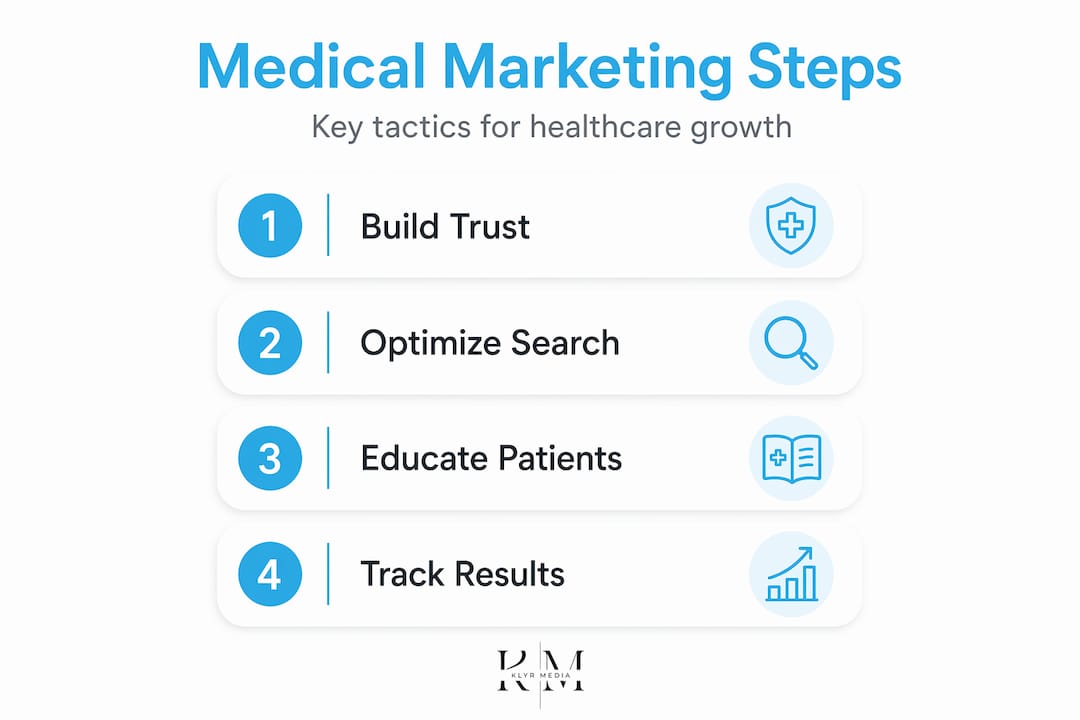
Local SEO and Google Business Profile
Your Google Business Profile is not optional. It’s the first thing patients see in local search, and an optimized profile with accurate hours, photos, services, and regular updates directly drives call volume and appointment bookings. Pair this with healthcare SEO targeting condition-specific and location-specific keywords and you get compounding, durable traffic that paid ads can’t buy.
SEO leads convert at 14.6%, compared to outbound leads at just 1.7%. That gap is enormous, and it makes SEO one of the highest-ROI channels in healthcare marketing.
Content that educates, not just promotes
Patients making healthcare decisions want information, not sales pitches. A dermatology clinic that publishes a clear, honest article on “what to expect during your first Mohs surgery” will build more trust with prospective patients than any promotional ad. This is the core of E-E-A-T content strategy, and it signals expertise to both patients and search engines.
Channel comparison for medical advertising
| Channel | Best use case | Compliance complexity | ROI timeline |
|---|---|---|---|
| Local SEO | Ongoing patient acquisition | Low to moderate | Long term |
| Google Ads (PPC) | Immediate volume for specific services | Moderate | Short term |
| Social media | Community trust and brand presence | Low | Medium term |
| Email marketing | Patient retention and reactivation | Low | Short to medium |
| Telehealth marketing | Converting hesitant prospects | Moderate | Medium term |
Phone call tracking (the most overlooked tactic)
Most clinics track website visits. Almost none track what happens when someone calls. Phone calls convert to 10x to 15x more revenue than web form submissions, yet practices routinely miss this data. Call tracking software lets you know which campaigns drive calls, how those calls are handled, and where patients drop off in the booking process.
Telehealth as a front door
The telehealth market is projected to reach $286.22 billion by 2030. Marketing virtual visits as an entry point lowers the barrier for hesitant prospects. A patient who books a telehealth consultation is far more likely to become a long-term in-person patient than someone who never engages at all.
- Promote telehealth availability prominently on your website and Google profile
- Run condition-specific campaigns pointing to virtual consultation booking
- Use telehealth visit follow-ups as a retention trigger for in-person scheduling
Measuring what’s actually working
Attribution in healthcare is hard. A patient acquired today might not generate their first appointment for months. That’s why patient lifetime value is the metric that actually matters, not cost per click or even cost per lead.
Here’s what measurement should look like in practice:
- Use server-side tracking instead of client-side pixels to stay HIPAA-compliant while still capturing meaningful conversion data
- Segment by service line, not just by channel, so you know which treatments are actually being driven by which campaigns
- Track call conversions separately from form submissions and weigh them more heavily in your ROI calculations
- Set a 90-day attribution window minimum because patient decisions take time and short windows dramatically undercount your marketing’s contribution
- Review by lifetime value cohorts to understand which acquisition sources bring patients who stay versus those who churn after one visit
The traditional media plan is obsolete for healthcare. What replaces it is a dynamic system that reads clinical intent signals in real time and adjusts spend, messaging, and targeting accordingly. AI-powered tools are making this more accessible for independent practices, but only when the underlying data infrastructure is built correctly from the start.
Pro Tip: Integrate your patient engagement analytics with your practice management software so you can tie marketing spend directly to appointment volume and patient revenue.
My honest take on what most clinics get wrong
I’ve worked with enough healthcare providers to say this directly: most clinics fail at medical marketing not because they don’t try, but because they try the wrong things in the wrong order.
They spend money on Google Ads before their website converts. They post on social media without a strategy for what happens when someone actually reaches out. They ignore their Google Business Profile for six months and then wonder why a competitor with half their clinical reputation is getting all the local visibility.
The strategy must match local nuances and patient psychology. A suburban family practice has a completely different patient acquisition model than an urban specialty clinic. Generic templates don’t account for that, and they produce generic results.
What I’ve seen work consistently is this: lead with trust, build the infrastructure before the campaigns, and measure what actually matters. Content that educates your community builds credibility that paid ads can’t manufacture. A well-managed Google profile compounds over years. An email marketing program that keeps past patients engaged costs a fraction of acquiring new ones.
The future of medical marketing belongs to practices that treat it like a system, not a series of one-off tactics. That means investing in measurement, iterating based on real data, and accepting that the payoff horizon is longer than most people expect. Patience and precision beat volume and noise every time.
— Opinly
How Klyrmedia helps you grow without the guesswork
If you’re a clinic owner or practice manager who just spent this article nodding along and thinking “we’re not doing most of this,” you’re not alone. Most independent practices are underserved by generic agencies that don’t understand HIPAA, don’t know healthcare patient journeys, and don’t build for long-term retention.
Klyrmedia is built specifically for healthcare. From HIPAA-compliant website design to local SEO, paid campaigns, and AI-powered marketing automation that keeps patients engaged between visits, the platform gives you a real system rather than a patchwork of tools. If you’re ready to stop guessing and start growing, explore Klyrmedia’s healthcare solutions to see what a purpose-built approach looks like for practices like yours.
FAQ
What is medical marketing in simple terms?
Medical marketing is the process healthcare providers use to attract new patients, retain existing ones, and build trust through strategic communication across digital and traditional channels. It differs from general marketing due to strict regulatory requirements and the high-stakes nature of patient decisions.
What are the main benefits of medical marketing?
The core benefits include increased patient acquisition, stronger online reputation, higher patient retention, and measurable practice growth. When done correctly, it converts marketing spend into long-term patient relationships rather than one-time visits.
What makes medical marketing different from regular advertising?
Medical marketing operates under HIPAA, FTC regulations, and professional ethics standards that restrict how you track users, make claims, and use patient stories. These constraints require specialized strategies that general advertising agencies rarely understand.
Which digital marketing channels work best for physicians?
Local SEO, Google Business Profile optimization, and content marketing consistently deliver the highest ROI for physicians. Phone call tracking is also critical since calls convert to significantly more revenue than web leads.
How do you measure medical marketing ROI?
Measure ROI using patient lifetime value as the primary metric rather than cost per lead alone. Use compliant server-side tracking, a minimum 90-day attribution window, and segment results by service line to get an accurate picture of what’s actually driving revenue.

