

What Is Healthcare Remarketing? A 2026 Strategy Guide

Healthcare remarketing is the practice of reconnecting with users who previously engaged with your healthcare website, content, or ads through targeted follow-up messages designed to convert them into booked patients. Unlike standard retail retargeting, it operates under strict HIPAA regulations, longer patient decision cycles, and platform restrictions that demand a completely different playbook. The industry term you’ll see in compliance literature is “healthcare retargeting,” but remarketing is the broader, more accurate label when email and multi-channel follow-up are included. Done right, HIPAA-aware AI-driven systems can cut patient acquisition costs by 19% and lift appointment conversions by 27%.
What is healthcare remarketing and how does it work?
Healthcare remarketing is a targeted advertising technique that serves ads or sends messages to people who already visited your clinic’s website, watched a health video, or opened a patient education email but did not book an appointment. The industry recognizes this as a subset of healthcare digital marketing, sitting at the intersection of behavioral data, ad technology, and patient communication.
Here is what separates it from a generic ad campaign. A first-time ad reaches cold audiences who have never heard of your practice. A remarketing campaign reaches warm audiences who already showed intent. That intent signal is the asset you are working with.
The mechanics work through pixel-based or server-side tracking. A user visits your orthopedic clinic’s “knee replacement consultation” page. A privacy-compliant tracking system logs that visit without capturing any protected health information (PHI). That user then sees a follow-up ad on Google or Meta reminding them to schedule their consultation. The message is relevant because it matches what they were already researching.

What makes healthcare remarketing genuinely different from patient remarketing in a narrow sense is the scope. Patient remarketing typically refers to re-engaging existing patients through email or SMS. Healthcare remarketing is broader. It covers prospective patients who never converted, lapsed patients who stopped engaging, and even caregivers researching options for a family member.
How healthcare remarketing differs from retail retargeting
Retail retargeting is built for speed and urgency. Someone abandons a shopping cart, and within minutes they see an ad with a discount code. That model does not translate to healthcare. At all.
Healthcare consumer decisions require 8 or more touchpoints across channels before a patient books. That means your remarketing window is not 24 hours. It is 30 to 90 days, depending on the service. A patient researching bariatric surgery is not going to convert after one reminder ad. They need time, information, and trust.
The key differences worth knowing before you build any campaign:
- Decision timelines. Retail converts in hours. Healthcare converts in weeks or months. Your campaign duration and frequency caps must reflect that reality.
- Platform restrictions. Google and Meta both restrict healthcare advertisers from using certain audience signals. Custom intent audiences, for example, cannot be built around sensitive health conditions on Meta. You work around this with broader interest categories and first-party data.
- Messaging tone. Educational, trust-building content outperforms urgency-driven messages in healthcare. Discounts and countdown timers reduce perceived clinical credibility. Social proof and clinical outcomes do the opposite.
- Compliance overhead. HIPAA, FTC advertising rules, and state-level privacy laws add a compliance layer that retail marketers never deal with. Every pixel, every audience list, and every data transfer needs review.
Pro Tip: Run a content audit before launching any remarketing campaign. If your landing pages contain appointment forms, symptom checkers, or condition-specific content, those pages are PHI-adjacent. Pixels on those pages require middleware or server-side solutions, not standard Google Tag Manager setups.
The targeted healthcare advertising approach that works is sequential and patient-centered. It respects the fact that healthcare decisions carry real emotional and financial weight. Patients are not buying shoes. They are deciding who to trust with their health.
How to maintain HIPAA compliance in healthcare remarketing
HIPAA’s Privacy Rule prohibits using PHI for marketing without explicit patient authorization. That sounds straightforward until you realize that standard tracking pixels on appointment pages can and do expose PHI to ad platforms. The Office for Civil Rights (OCR) has issued enforcement actions and settlements specifically tied to improperly deployed tracking pixels on PHI-adjacent pages.
Here is a practical compliance framework for 2026:
- Audit every pixel on every page. Map which pages contain PHI-adjacent content, including condition pages, patient portals, and booking confirmation pages. Standard Google Analytics and Meta Pixel tags on these pages are a liability.
- Deploy privacy-first middleware. Tools that de-identify user data before it reaches ad platforms allow you to build audiences based on general brand interest rather than health-specific behavior. This is the architectural solution, not a workaround.
- Enforce IAM segregation. Marketing inference systems must be architecturally separated from clinical systems. PHI firewalls via IAM controls prevent marketing data pipelines from ever touching clinical records.
- Document your data flows. OCR expects covered entities to demonstrate that marketing data workflows segment PHI away from marketing platforms. Written documentation of your tech stack is not optional.
- Communicate with patients. Transparency about how general browsing data is used for follow-up communications builds trust and reduces opt-out rates. A simple privacy notice on your website goes further than most marketers expect.
Pro Tip: Treating privacy as a strategic feature rather than a legal burden actually improves campaign performance. Organizations that adopt Privacy by Design outperform competitors relying on invasive tracking and face fewer operational disruptions when regulations tighten.
The patient engagement compliance practices that hold up over time are the ones built on architecture, not just policy. Policy can be ignored. Architecture cannot.
What does a multi-channel healthcare remarketing strategy look like?
The most effective healthcare remarketing strategy runs across Google Ads, Meta, and email in a coordinated sequence. Each channel plays a specific role, and the sequence matters more than any individual ad.
Here is how the channel roles break down:
| Channel | Role in sequence | Optimal use case |
|---|---|---|
| Google Display | Awareness and education | Serving condition-specific content to warm audiences |
| Meta (Facebook/Instagram) | Social proof and trust | Testimonials, provider spotlights, patient stories |
| Direct conversion | Appointment reminders, follow-up offers, scheduling links | |
| YouTube | Education and credibility | Procedure explainers, provider introductions |
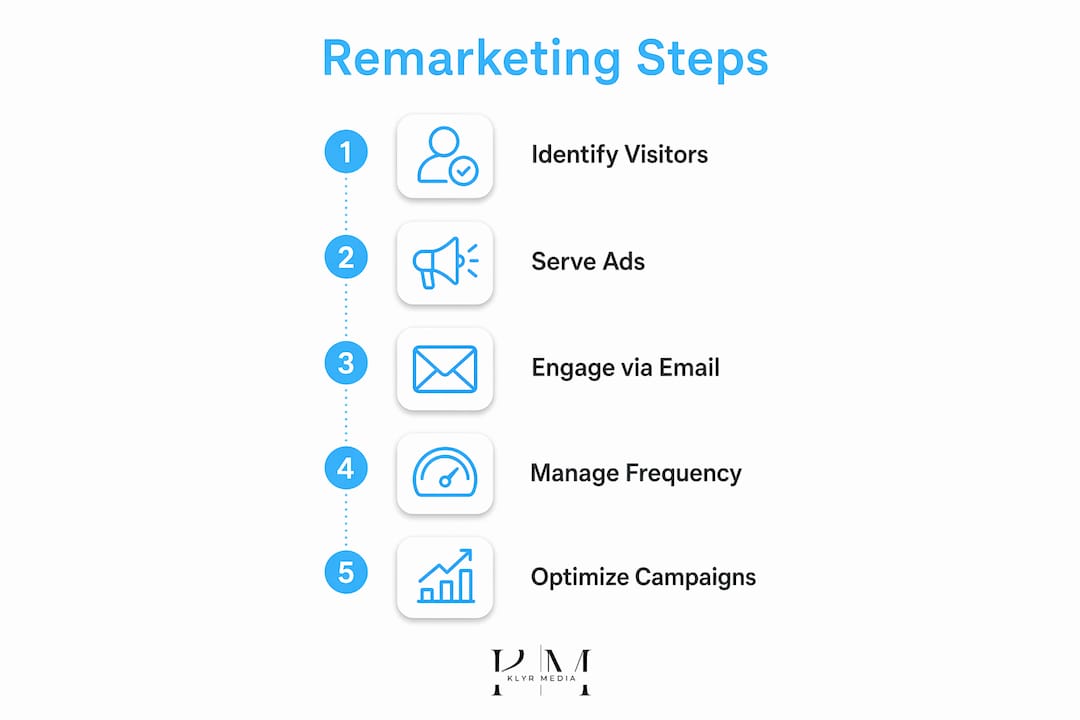
The sequencing principle is straightforward. Run 3 to 5 educational exposures before you ever serve a conversion-focused ad. A patient who has seen your orthopedic surgeon explain knee replacement recovery in a 90-second video is far more likely to book a consultation than someone who only saw a “Schedule Now” banner.
Frequency management is where most healthcare campaigns fail. Capping ad exposure at 3 to 7 impressions over 30 days prevents fatigue and protects your brand perception. This coordinated multi-channel approach improves digital spend efficiency by up to 72%. That is not a small number. It means you are getting significantly more appointments per dollar spent.
Timing is the other critical variable. The first hour after a user abandons a healthcare booking page is the highest-value recovery window. Automated real-time trigger systems, not manual list uploads, are required to capture that window. This single tactic lifts appointment conversion by 25 to 32%.
AI-driven scheduling handoffs are now part of the equation in 2026. Agentic AI systems can identify when a remarketed user clicks through to a scheduling page and trigger a real-time handoff to a live scheduler or chatbot without ever accessing PHI. The result is faster conversion at lower cost.
How do you measure healthcare remarketing performance?
Measurement in healthcare remarketing requires a different reporting framework than standard digital marketing. You cannot use individual-level behavioral data tied to health conditions. You work with aggregate and de-identified reporting instead.
The metrics that matter most:
- Conversion rate lift. Compare appointment booking rates among remarketed audiences versus cold traffic. A meaningful lift confirms your sequencing and messaging are working.
- Patient acquisition cost (PAC). Track cost per booked appointment across channels. This tells you which channel is carrying the most weight in your mix.
- Engagement touchpoints before conversion. How many ad exposures did a converted patient receive before booking? This informs your frequency caps and sequence length.
- Abandonment recovery rate. What percentage of users who abandoned a booking page were recovered through your first-hour trigger campaigns?
The role of agentic AI in measurement is growing fast. AI systems can generate predictive insights about which audience segments are most likely to convert without ever exposing PHI. They analyze patterns in de-identified engagement data and surface optimization recommendations that a human analyst would take days to produce.
Avoid the trap of over-optimizing for impressions or clicks. A healthcare remarketing campaign that generates 10,000 impressions but zero appointments is not performing. Tie every metric back to booked appointments and patient acquisition cost. Everything else is a leading indicator, not the outcome.
The healthcare digital marketing checklist that Klyrmedia uses with clients always starts with measurement architecture before any campaign goes live. You cannot optimize what you cannot measure, and in healthcare, you cannot measure what you cannot de-identify.
Key takeaways
Healthcare remarketing converts warm, previously engaged audiences into booked patients through compliant, sequenced, multi-channel campaigns that respect both HIPAA regulations and the longer emotional decision cycles unique to healthcare.
| Point | Details |
|---|---|
| Definition is specific | Healthcare remarketing targets prior website visitors and content engagers, not cold audiences, using PHI-safe tracking. |
| Compliance is architectural | HIPAA-safe remarketing requires middleware, IAM segregation, and PHI firewalls, not just policy documents. |
| Sequencing drives results | Run 3 to 5 educational ad exposures before any conversion-focused message to match healthcare decision timelines. |
| Timing is a lever | Automated first-hour abandonment recovery lifts appointment conversion by 25 to 32%. |
| Measurement must be de-identified | Use aggregate reporting and AI-driven predictive insights to optimize without exposing PHI. |
Why privacy-first design is the real competitive advantage
I have worked with enough healthcare marketing teams to say this plainly: the ones who treat HIPAA compliance as a checkbox are the ones who get burned. Not just by OCR enforcement. By patients who stop trusting them.
The campaigns I have seen perform best are the ones built around a simple idea. Privacy is a feature, not a constraint. When a patient sees a follow-up ad that feels relevant but not invasive, they do not feel tracked. They feel understood. That distinction is everything in healthcare.
The conventional wisdom says you need aggressive retargeting to compete with large health systems and national chains. I disagree. Independent clinics and pharmacies that invest in education-first sequencing and transparent communication consistently outperform the spray-and-pray approach that big budgets enable. 79% of consumers trust online reviews as much as personal recommendations. That means your social proof assets, patient testimonials, and provider spotlights are remarketing fuel. Use them.
The future of this space is agentic AI handling the real-time trigger logic while human marketers focus on message quality and compliance architecture. That combination, fast automation with thoughtful human oversight, is where the best patient acquisition results will come from in the next few years. The practices that build that infrastructure now will have a durable advantage over those that wait.
— Opinly
How Klyrmedia builds HIPAA-compliant remarketing systems
If you are a healthcare marketer or clinic operator who has read this far, you already know that getting remarketing right in healthcare is not a DIY project. The compliance architecture alone requires expertise that most general marketing agencies do not have.
Klyrmedia specializes exclusively in healthcare digital marketing for independent pharmacies, medical clinics, and healthcare practices across the United States. Every campaign Klyrmedia builds starts with HIPAA-compliant web design and a privacy-first data architecture before a single ad goes live. From Google Ads and Meta remarketing to automated patient follow-up systems, Klyrmedia’s team handles the compliance complexity so your team can focus on patient care. If you want remarketing that actually converts without putting your practice at legal risk, talk to Klyrmedia about building your strategy.
FAQ
What is the difference between healthcare remarketing and retargeting?
Remarketing is the broader term covering all follow-up channels including email, SMS, and ads. Retargeting specifically refers to pixel-based or cookie-based ad delivery to prior website visitors. In healthcare, both require HIPAA-compliant data handling.
Can healthcare providers use Meta or Google for remarketing?
Yes, but with restrictions. Both platforms prohibit building custom audiences based on sensitive health conditions. Healthcare marketers use first-party data, general interest categories, and privacy-compliant middleware to run compliant campaigns on both platforms.
How many ad impressions should a healthcare remarketing campaign use?
Capping exposure at 3 to 7 impressions over a 30-day window prevents ad fatigue and protects brand trust. Multi-channel coordination within those caps improves digital spend efficiency by up to 72%.
What happens if a healthcare marketer violates HIPAA with tracking pixels?
OCR has issued enforcement actions and financial settlements against healthcare organizations that deployed standard tracking pixels on PHI-adjacent pages. Violations can result in significant fines and reputational damage to the practice.
How long should a healthcare remarketing campaign run?
Most healthcare remarketing campaigns run 30 to 90 days, reflecting the longer patient decision window. Services with higher emotional or financial stakes, such as elective surgery or specialty care, typically require the longer end of that range.

