

What Is Healthcare PPC? A 2026 Guide for Providers

Healthcare PPC, formally known as healthcare paid search advertising, is a digital marketing model where healthcare providers pay for ad placements on platforms like Google Ads and Meta every time a potential patient clicks on their ad. Unlike general PPC, healthcare paid search operates under strict regulatory constraints, including HIPAA compliance, platform certification requirements, and tight restrictions on how patient data is collected and used. If you run a medical clinic, independent pharmacy, or healthcare practice and you want patients to find you before they find your competitors, understanding how healthcare PPC advertising works is not optional. It is the foundation of any serious patient acquisition strategy in 2026.
What is healthcare PPC and how does it differ from general PPC?
Healthcare PPC is pay-per-click advertising built specifically around patient intent, not just consumer intent. When someone searches “urgent care near me” or “pharmacy that accepts Medicaid,” they are not browsing. They need help now. That urgency is exactly what healthcare paid search is designed to capture.

General PPC campaigns can target almost any audience segment with broad demographic data, behavioral signals, and aggressive remarketing. Healthcare PPC cannot. The moment your ads touch on medical conditions, treatment options, or patient behavior, you enter a compliance zone that general advertisers never have to think about. That changes everything from your keyword list to your landing page copy to how you measure a conversion.
Here is what makes healthcare PPC structurally different from standard paid search:
- Sensitive keyword restrictions. Terms related to prescription drugs, addiction treatment, and unapproved medical claims trigger platform reviews or outright disapprovals on Google Ads.
- Remarketing limitations. Remarketing using health data tied to specific conditions or treatment-seeking behavior is prohibited by both Google and Meta. You can remarket to broad website visitors, but not to users flagged by health intent.
- Certification requirements. Pharmacies, telemedicine providers, and addiction treatment centers must obtain platform-specific certifications before their ads run at all.
- Conversion tracking constraints. Standard pixel-based tracking can inadvertently capture Protected Health Information (PHI), which creates HIPAA exposure. Healthcare advertisers need a different architecture entirely.
- Ad copy compliance. Claims like “guaranteed results” or references to specific diagnoses are grounds for disapproval. Every word in your ad must be defensible.
Pro Tip: Before you write a single ad, audit your keyword list against Google’s healthcare ad policies. Remove any terms tied to prescription drugs or speculative treatments. One disapproval can delay an entire campaign launch by days.
What are the compliance and regulatory requirements for healthcare PPC?
Compliance is not a checkbox in healthcare PPC. It is the architecture your entire campaign is built on. Miss it, and you are not just risking ad disapprovals. You are risking HIPAA violations that carry real financial penalties.
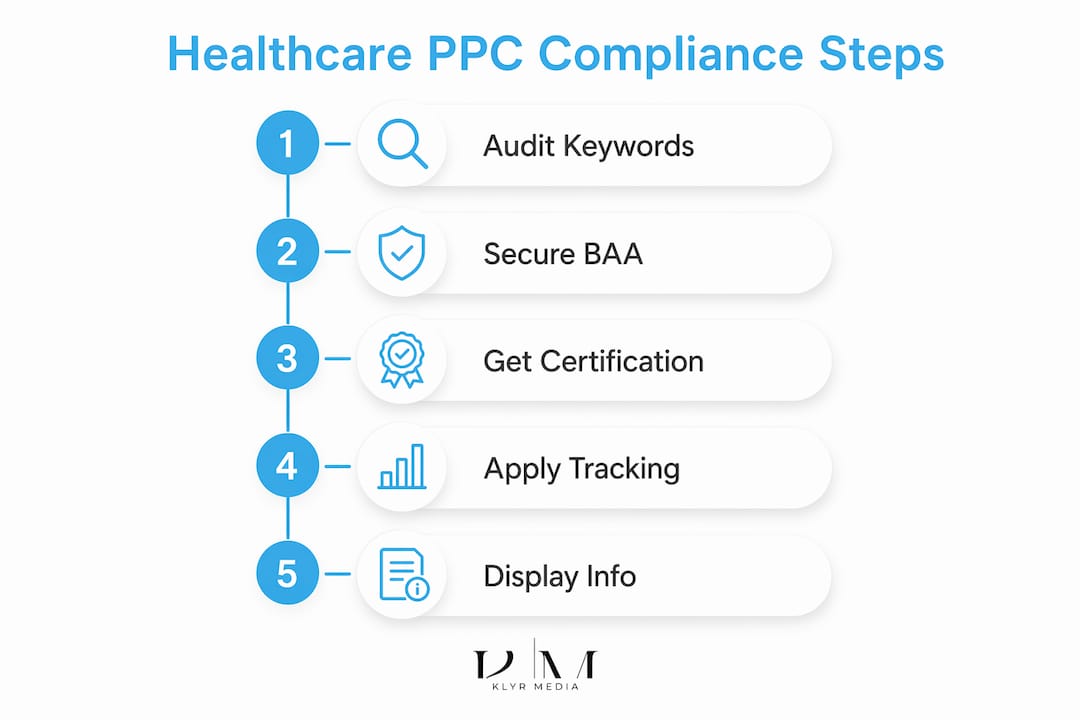
The most critical compliance layer is the Business Associate Agreement (BAA). BAAs are required whenever a vendor handles PHI on your behalf, and that includes ad measurement platforms. If your PPC vendor or analytics tool receives data that could identify a patient’s health condition or treatment-seeking behavior, you need a signed BAA with that vendor. The agreement must specify allowed PHI uses, required safeguards, and breach notification obligations per 45 CFR 164.504(e). Most healthcare marketers skip this step. That is a serious mistake.
On the platform side, Google Ads enforces strict certification requirements for pharmacies, telemedicine providers, and addiction treatment centers. LegitScript certification is mandatory for these categories before any ads go live. LegitScript audits your practice, verifies licensing, and requires ongoing compliance monitoring. It is not a one-time approval. Meta takes a different approach, restricting which conversion events health advertisers can optimize for and limiting data usage tied to patient portals and sensitive health categories.
Here is a quick comparison of platform-specific rules you need to know:
| Platform | Certification required | Remarketing restrictions | Conversion tracking limits |
|---|---|---|---|
| Google Ads | LegitScript for pharmacies, addiction treatment, telemedicine | No health condition-based remarketing | Server-side tracking recommended; PHI must be sanitized |
| Meta Ads | No universal cert, but category-specific limits apply | Sensitive health data excluded from custom audiences | Restricted optimization events for health and wellness |
| Microsoft Ads | Follows similar healthcare ad policies to Google | Restricted for sensitive health categories | Consent management required |
Pro Tip: Use Google Consent Mode alongside server-side tracking to separate what gets sent to ad platforms from what stays in your own data environment. This is the most practical way to run conversion optimization without risking PHI exposure.
Healthcare landing pages must display provider identification, licensing information, a privacy policy, and clear service descriptions. Unsubstantiated claims will get your ads pulled and hurt your Quality Score. Compliance on the landing page is not just a legal requirement. It directly affects how much you pay per click.
What are best practices for setting up a healthcare PPC campaign?
Getting a healthcare PPC campaign off the ground requires more upfront planning than a standard paid search campaign. Here is a practical setup sequence that works for medical clinics, pharmacies, and specialty practices.
- Start with Search campaigns. Display and social can come later. High-intent local keywords like “pediatrician accepting new patients in [city]” or “compounding pharmacy near me” are where patient acquisition actually happens. Start there.
- Build tightly themed ad groups. One service per ad group. Do not mix “flu shots” with “annual physicals.” Tight grouping improves relevance scores and keeps your compliance review cleaner.
- Write compliant ad copy. Avoid superlatives, guarantees, and any language that implies a diagnosis or treatment outcome. Stick to factual service descriptions and clear calls to action like “Book an appointment today.”
- Design fast, privacy-aware landing pages. Page speed directly affects Quality Score. A slow page costs you money on every click. Include your provider credentials, a privacy policy link, and a simple contact form that does not ask for sensitive health details upfront.
- Implement server-side conversion tracking. Server-side tracking with data sanitization prevents PHI from leaking into ad platforms while still giving you the conversion signals you need to optimize bids. This is non-negotiable in healthcare.
- Set up a consent management platform. Tools like OneTrust or Cookiebot handle patient consent signals and feed them into Google Consent Mode, keeping your data collection legally defensible.
- Establish BAAs before launch. Confirm signed BAAs with every vendor in your tracking stack before a single ad goes live. This includes your analytics platform, CRM, and any call tracking software.
- Review and optimize weekly. Healthcare PPC is not a set-and-forget channel. Search term reports will surface irrelevant or non-compliant queries that need to be added as negative keywords regularly.
A well-structured Google Ads campaign for healthcare typically uses local service area targeting, privacy-conscious tracking, and fast landing experiences as its three core pillars. Get those right before you think about scaling budget.
How can healthcare PPC deliver measurable ROI?
Measuring ROI in healthcare PPC is harder than in e-commerce or lead generation. You cannot just fire a standard purchase event and call it a day. Patient data is sensitive, and the moment you start sending appointment details or health condition signals to Google or Meta, you have a compliance problem.
The metrics that matter most in healthcare paid search are clicks, cost per acquisition (CPA), phone call conversions, and appointment form submissions. The challenge is measuring those last two without capturing PHI. Collecting only minimal data and sanitizing it before it reaches ad platforms is the standard best practice. Aggregated or anonymized data lowers compliance risk while still giving your bidding algorithms enough signal to optimize.
Key performance indicators to track in your healthcare PPC campaigns:
- Cost per lead (CPL). What does it cost to generate one appointment request or phone inquiry?
- Click-through rate (CTR). Low CTR signals that your ad copy is not matching patient intent.
- Conversion rate. What percentage of clicks turn into actual patient contacts?
- Quality Score. Google’s internal rating of your ad relevance, landing page experience, and expected CTR. Higher scores mean lower costs per click.
- Return on ad spend (ROAS). Requires offline conversion imports to connect ad clicks to actual patient revenue.
Offline conversion imports are underused in healthcare PPC. If your front desk logs appointment bookings in a CRM, you can upload anonymized conversion data back to Google Ads to close the attribution loop without exposing PHI. This gives your campaigns far better optimization data than a basic form submission event.
What tools and platforms support compliant healthcare PPC?
The right tool stack makes the difference between a campaign that runs clean and one that creates liability. Here are the platforms and tools that matter most for healthcare PPC teams:
- Google Ads. The primary platform for healthcare paid search. Offers local service area targeting, call extensions, and LegitScript certification pathways for regulated healthcare categories.
- Meta Ads Manager. Useful for brand awareness and appointment reminders, but requires careful management of health-related audience restrictions and limited optimization events.
- Google Consent Mode. Adjusts how Google tags behave based on patient consent signals. Pairs with server-side tracking to maintain optimization without PHI exposure.
- OneTrust or Cookiebot. Consent management platforms that handle cookie consent and feed signals into your ad stack legally.
- CallRail (with BAA). Call tracking software that offers a HIPAA-compliant option with a signed BAA, letting you attribute phone calls to specific ad campaigns without capturing sensitive patient details.
- HubSpot or Salesforce Health Cloud. CRM platforms with healthcare-specific privacy configurations for managing patient leads from PPC campaigns.
The 2026 Google Ads policy updates loosened some B2B health brand targeting restrictions while keeping tight rules on consumer health product advertising. Staying current with platform policy changes is not optional. A rule that applied last quarter may have changed.
Key takeaways
Healthcare PPC requires a compliance-first architecture, platform-specific certifications, and server-side tracking to deliver patient acquisition results without HIPAA exposure.
| Point | Details |
|---|---|
| Compliance is structural | BAAs, LegitScript certification, and server-side tracking must be in place before launch. |
| Platform rules vary | Google Ads and Meta have different certification, remarketing, and conversion tracking restrictions. |
| Keyword selection is critical | Avoid prescription drug terms and unapproved medical claims to prevent ad disapprovals. |
| Measurement requires workarounds | Offline conversion imports and aggregated data let you optimize campaigns without exposing PHI. |
| Landing pages affect compliance and cost | Compliant, fast landing pages improve Quality Scores and reduce cost per click. |
What I have learned running healthcare PPC in the real world
Most healthcare marketers I talk to underestimate how fast a campaign can go sideways. Not because of bad strategy. Because of a single pixel firing on a page it should not be on.
The biggest mistake I see consistently is treating healthcare PPC like a standard lead generation campaign with a few extra rules bolted on. It is not. The compliance layer is not cosmetic. It changes your tracking architecture, your keyword strategy, your landing page structure, and your vendor contracts. If your IT team and compliance officer are not involved from day one, you will build something that works for three months and then creates a liability.
The second thing I have noticed is that healthcare marketers tend to over-restrict themselves out of fear. Yes, the rules are strict. But there is a lot of room to run effective, aggressive campaigns within those guardrails. Local service area targeting, call-only ads, and tightly themed ad groups around specific services like “same-day appointments” or “medication therapy management” can drive real patient volume without touching any restricted territory.
Platform policies are also moving faster than most teams can track. Google’s 2026 updates shifted B2B health brand rules in ways that opened up new targeting options many advertisers have not explored yet. The teams winning in healthcare paid search right now are the ones who treat compliance as a competitive advantage, not a burden. When your competitors are getting ads disapproved or accounts suspended, your clean campaign keeps running.
— Opinly
How Klyrmedia helps you run compliant healthcare PPC
Running healthcare PPC without the right infrastructure is like building on a foundation that could crack at any time. Klyrmedia specializes in exactly this problem.
Klyrmedia builds HIPAA-compliant websites and manages PPC campaigns specifically for independent pharmacies, medical clinics, and healthcare practices across the United States. That means compliant landing pages, server-side tracking setups, BAA-covered vendor stacks, and ad copy that clears platform review. If you want to start running healthcare PPC advertising without the compliance guesswork, Klyrmedia is built for that. No generic marketing playbooks. Just healthcare-specific strategy that actually holds up.
FAQ
What is healthcare PPC in simple terms?
Healthcare PPC is paid digital advertising where healthcare providers pay each time a potential patient clicks on their ad. It targets people actively searching for medical services on platforms like Google Ads and Meta.
Why does healthcare PPC require special compliance steps?
Healthcare PPC involves patient data that falls under HIPAA regulations. Advertisers must use server-side tracking, signed Business Associate Agreements with vendors, and avoid capturing Protected Health Information through standard ad pixels.
Do I need LegitScript certification to run healthcare ads?
LegitScript certification is required for pharmacies, addiction treatment centers, and telemedicine providers before running ads on Google Ads. Other healthcare providers may not need it, but should still follow Google’s healthcare ad policies.
Can healthcare providers use remarketing in PPC campaigns?
Healthcare providers can remarket to broad website visitors, but remarketing based on health conditions or treatment-seeking behavior is prohibited by both Google and Meta. Targeting must stay at the general visitor level to remain compliant.
How do you measure ROI in healthcare PPC without violating HIPAA?
Use offline conversion imports to connect ad clicks to appointment bookings without sending PHI to ad platforms. Aggregated, anonymized data and server-side tracking let you optimize campaigns while keeping patient information protected.

