What Is a Healthcare Chatbot? A 2026 Guide for Clinics
Discover what is a healthcare chatbot. Learn how this AI tool enhances patient engagement, automates inquiries, and optimizes clinic operations.

What Is a Healthcare Chatbot? A 2026 Guide for Clinics

A healthcare chatbot is defined as an AI-powered conversational assistant that delivers instant, medically grounded responses to patient inquiries around the clock. The industry term for these tools is “clinical conversational AI,” though “healthcare chatbot” is the phrase most administrators and clinicians use day to day. These systems handle 70–80% of routine patient inquiries autonomously, which means your front desk staff can focus on tasks that actually require human judgment. With accuracy rates of 85–95% in intent classification, a well-built healthcare chatbot is not a gimmick. It is a patient engagement tool that works while your clinic sleeps.
What is a healthcare chatbot and how does it work?
A healthcare chatbot runs on natural language processing (NLP), which lets it read a patient’s typed or spoken message and figure out what they actually need. That process is called intent classification. The system matches the patient’s question to a category, pulls a response from a clinician-approved knowledge base, and delivers it in plain language.
The safest chatbots use a method called retrieval-augmented generation (RAG). RAG grounds every response in a pre-approved medical content library, and the system issues a forced refusal if no approved answer exists. That single design choice separates a healthcare-grade bot from a general consumer AI tool.
A fully functional clinical chatbot requires multiple layers working together:
- Intent detection: Classifies what the patient is asking before any response is generated.
- Knowledge grounding: Pulls answers only from clinician-reviewed content, not the open internet.
- Triage routing: Identifies urgency and directs patients to the right level of care.
- Safety guardrails: Blocks responses outside the bot’s approved scope.
- Human escalation: Routes emergencies or uncertain cases to a live staff member immediately.
- Audit logging: Records every interaction for compliance review and quality improvement.
HIPAA-compliant, EHR-integrated chatbots pull patient context directly from the electronic health record, making responses more relevant than anything a generic AI platform can offer. That integration is what makes the interaction feel personal rather than robotic.
Pro Tip: Before you build or buy, map out your refusal taxonomy first. Define every question category your chatbot should decline to answer. This single step prevents the most common and most dangerous chatbot failures in clinical settings.

What are the benefits of healthcare chatbots for patient engagement?
Healthcare chatbots provide 24/7 support for routine tasks like symptom checking, appointment scheduling, and medication reminders. That availability matters most at 11 PM on a Sunday, when your front desk is closed and a patient is anxious about a new prescription. A chatbot answers immediately. A voicemail does not.
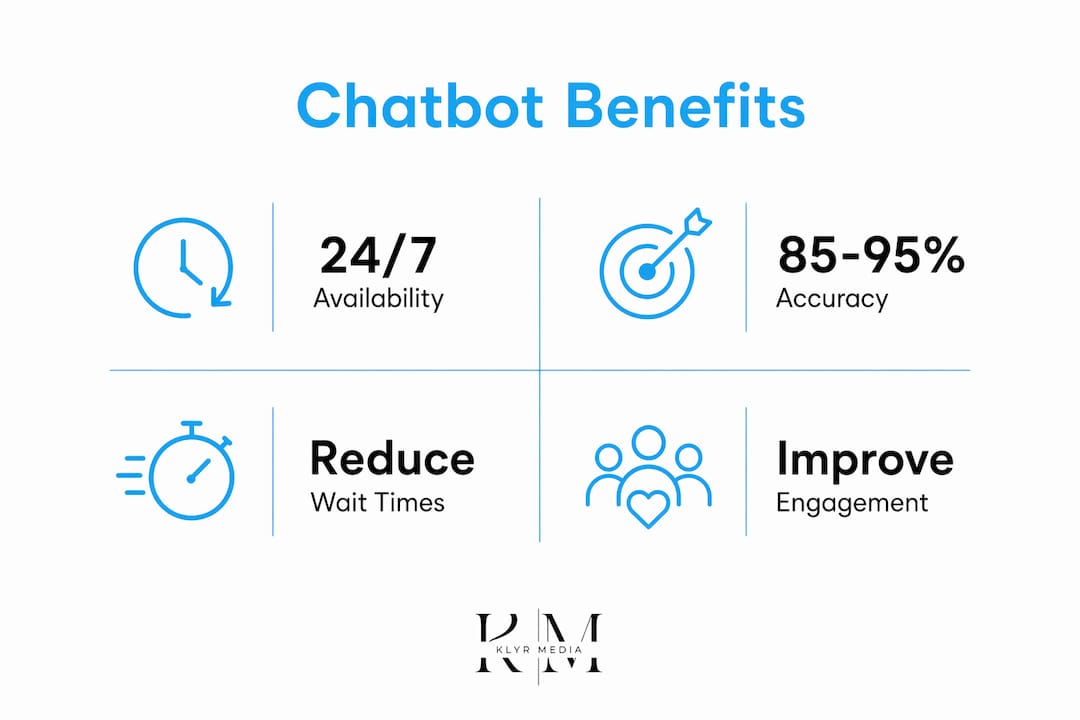
The operational impact is real. Healthcare chatbots increase patient satisfaction by over 40% and contribute to an estimated $3.6 billion in global healthcare savings through reduced administrative burden and improved appointment handling. That is not a rounding error. That is a structural shift in how clinics manage patient volume.
The core benefits break down into four areas:
- Reduced administrative load: Chatbots handle appointment confirmations, insurance FAQs, and intake forms without staff involvement.
- Improved medication adherence: Automated reminders reduce missed doses for patients managing chronic conditions like diabetes or hypertension.
- Faster patient access: Patients get answers in seconds rather than waiting on hold or for a callback.
- Support for telemedicine workflows: Chatbots collect pre-visit data and triage patients before a virtual appointment begins, saving clinician time.
Healthcare chatbots are not a replacement for clinical judgment or professional medical treatment. They are a support layer that handles the repetitive, time-consuming interactions so your clinical team can focus on the work only they can do.
That distinction matters. A chatbot that oversteps into diagnosis territory creates liability. One that stays in its lane creates efficiency.
What are real examples of healthcare chatbot use cases?
The functions of healthcare chatbots become clearest when you look at specific scenarios. Abstract descriptions of “AI-powered engagement” mean nothing. Concrete use cases do.
Chatbots assist with appointment scheduling, symptom checking, medication reminders, patient education, and intake data collection. Each of these replaces a task that currently eats staff time or falls through the cracks entirely.
- Symptom triage: A patient describes chest tightness. The chatbot asks structured follow-up questions, classifies urgency, and either books a same-day appointment or routes the patient to emergency services.
- Appointment scheduling: The bot checks real-time availability, books the slot, and sends a confirmation. No phone tag required.
- Medication reminders: Patients with complex regimens receive timed push notifications. The bot logs acknowledgment and flags non-responses for follow-up.
- Medical report explanation: After a lab result is released, the chatbot explains what the numbers mean in plain language and prompts the patient to schedule a follow-up if needed.
- Behavioral health check-ins: The bot sends brief daily mood check-ins to patients in mental health programs, flagging concerning patterns for the care team.
- Pre-visit intake: Patients complete their health history, current medications, and chief complaint through the chatbot before the appointment. The clinician walks in already informed.
The most effective clinical intake bots are strictly scoped. They collect data and free providers for higher-level work. They do not attempt to diagnose or advise on treatment. That scope discipline is what makes them trustworthy.
How do you develop and implement a healthcare chatbot?
Building a focused, HIPAA-compliant chatbot MVP takes 2–4 weeks and costs between $15,000 and $60,000 depending on complexity. That range reflects the difference between a simple FAQ bot and a fully integrated triage assistant connected to your EHR.
The cost and timeline are only part of the picture. The harder work is clinical validation. Clinicians must review and validate every chatbot pathway before it goes live. A workflow that looks logical to a developer may contradict standard triage protocol. Active medical staff need to sign off on every decision tree.
| Development phase | Key requirement | Risk if skipped |
|---|---|---|
| Scope definition | Define refusal taxonomy and approved use cases | Bot answers questions it should not |
| Knowledge base build | Clinician-reviewed content only | Inaccurate or unsafe responses |
| Integration | HIPAA-compliant EHR and API connections | Privacy violations and data gaps |
| Clinical validation | Active staff review of all pathways | Misaligned triage and liability exposure |
| Safety testing | Simulate edge cases and emergency scenarios | Escalation failures in real emergencies |
A human-in-the-loop escalation strategy is non-negotiable. Every chatbot needs a clear trigger for when it hands off to a live person. Emergencies must route to staff immediately. Uncertain cases must fail gracefully, meaning the bot acknowledges its limits and connects the patient to help rather than guessing.
Pro Tip: Use a three-tier question framework during design. Green-light questions (general health information) are safe for the bot to answer. Yellow-light questions (condition-specific guidance) require careful scoping. Red-light questions (treatment decisions) must always route to a clinician.
This framework comes directly from Harvard Health’s guidance on AI in clinical settings. It is one of the clearest practical filters available for healthcare chatbot scope decisions.
For clinics exploring healthcare marketing automation, chatbot integration fits naturally into a broader patient engagement system that includes follow-up messaging, recall campaigns, and appointment reminders.
Key Takeaways
Healthcare chatbots deliver measurable patient engagement and operational gains only when they are clinically validated, strictly scoped, and built with HIPAA-compliant infrastructure from day one.
| Point | Details |
|---|---|
| Accuracy and capacity | Well-built chatbots classify intent with 85–95% accuracy and handle 70–80% of routine inquiries. |
| Safety by design | Refusal taxonomy and RAG grounding prevent unsafe or out-of-scope responses before they reach patients. |
| Real operational savings | Chatbots contribute to over 40% higher patient satisfaction and billions in global healthcare cost reduction. |
| Clinical validation is mandatory | Active clinicians must review every pathway before deployment to align with current medical practice. |
| Development is accessible | A HIPAA-compliant chatbot MVP can be built in 2–4 weeks for $15,000–$60,000 depending on scope. |
The part most clinics get wrong about chatbots
Most healthcare administrators I talk to approach chatbot adoption one of two ways. Either they are skeptical because a previous tech rollout failed, or they are overconfident because a vendor demo looked impressive. Both reactions miss the real issue.
The chatbots that fail in clinical settings almost always fail for the same reason: nobody defined what the bot should refuse to do before they built it. Scope creep happens quietly. A bot designed for appointment scheduling starts answering drug interaction questions because nobody blocked that pathway. Then a patient acts on a bad answer. That is not an AI problem. That is a governance problem.
The chatbots that work are boring in the best possible way. They do three or four things extremely well. They hand off everything else to a human. They never pretend to know more than they do. Clinics that treat chatbot deployment as a patient engagement and compliance decision rather than a technology decision get far better outcomes.
The future of clinical AI is not a chatbot that replaces your care team. It is a system that removes the friction between patients and the care they need, so your team spends less time on hold music and more time on medicine. That future is already available. The question is whether you build it carefully or rush it.
— Opinly
How Klyrmedia supports secure healthcare chatbot deployment
Healthcare chatbots only work safely when they live on a platform built for clinical environments. A consumer website builder is not that platform.
Klyrmedia builds HIPAA-compliant healthcare websites designed to host AI-powered patient engagement tools securely and in full regulatory compliance. From secure API integrations to encrypted patient data handling, every technical layer meets the standards your practice requires. Klyrmedia also offers AI-powered marketing automation services that connect chatbot interactions to appointment follow-ups, recall campaigns, and patient retention workflows. If your clinic is ready to move from manual patient communication to a system that works around the clock, Klyrmedia has the healthcare-specific expertise to get you there without the guesswork.
FAQ
What is a healthcare chatbot, exactly?
A healthcare chatbot is an AI-powered conversational assistant that handles patient inquiries, appointment scheduling, symptom triage, and medication reminders automatically. It uses natural language processing to understand patient messages and deliver clinician-approved responses.
Are healthcare chatbots HIPAA compliant?
Healthcare-grade chatbots are built with HIPAA-compliant infrastructure, including encrypted data storage and secure EHR integrations. Consumer AI platforms are not designed to meet these standards and should not be used for patient interactions.
Can a chatbot replace a doctor?
A healthcare chatbot cannot replace clinical judgment or professional medical treatment. It handles routine, informational tasks and escalates clinical decisions to licensed providers.
How long does it take to build a healthcare chatbot?
A focused, HIPAA-compliant chatbot MVP typically takes 2–4 weeks to build and costs between $15,000 and $60,000 depending on the complexity of integrations and clinical pathways required.
What types of questions should a healthcare chatbot answer?
Chatbots are best suited for general health information, scheduling, and administrative tasks. They should avoid condition-specific clinical guidance and must never support final treatment decisions, routing those questions to a clinician instead.

