
Medical Website Maintenance Cost: What to Budget in 2026
What medical website maintenance costs a practice or pharmacy in 2026, what the monthly fee should cover, and what pushes the price up. Includes HIPAA upkeep.

Medical Website Maintenance Cost: What to Budget in 2026

There is no single price for keeping a medical website running, and anyone quoting you one number without asking questions is guessing. What you pay depends on what the site does: a five-page brochure site costs far less to maintain than a site with online scheduling, a patient portal link, forms that collect health details and several locations. For a practice or pharmacy, the bill also has to cover the part generic price guides skip: security and compliance upkeep that protects patient information.
This guide shows you how to budget for it. You will see what belongs in a maintenance plan, what usually costs extra, which factors move the price, and how to read a quote. We build and manage healthcare sites for independent pharmacies and clinics, so we use the same checklist when we scope a site ourselves.
TL;DR
- Maintenance pricing follows complexity, not page count. Forms, scheduling, patient data and multiple locations are what raise it.
- A healthcare plan should include security patching, backups, uptime monitoring, and the safeguards a HIPAA risk assessment looks at, not just plugin updates.
- Accessibility is now a budget line. HHS set Section 504 web accessibility deadlines for covered recipients, with WCAG 2.1 AA as the standard.
- Content edits, SEO, ads and redesigns are usually separate from “maintenance.” Ask for the line items in writing.
- The cheapest plan that skips security work can cost you the most if patient data is exposed.
Table of Contents
- Why medical website maintenance costs more than a regular small business site
- What a medical website maintenance plan should include
- What a plan typically doesn’t cover
- What drives the price up or down
- How to budget without a made-up number
- Questions to ask before you sign
- Why upkeep works better with a team that does healthcare only
- Perspective
- Put a number on your own site
- FAQ
- Sources
Why medical website maintenance costs more than a regular small business site
A plumber’s website that goes down for a day loses some calls. A pharmacy website that leaks a refill request form, or a clinic site whose scheduling tool quietly stops working, creates a different kind of problem. Patients ghost you, and if health information was involved, you may have a reporting obligation.
That is why healthcare upkeep carries three layers that most general guides don’t price:
- Technical upkeep. Updates, backups, hosting, uptime and speed.
- Security and compliance upkeep. Patching, access controls, risk assessment, and documentation.
- Accessibility upkeep. Keeping pages, documents and third-party tools usable by people with disabilities.
Generic website maintenance articles ranking for this topic mostly describe ecommerce stores or small business brochure sites. Those numbers don’t tell you what a practice handling appointment requests should expect. Treat them as a floor, not a forecast.
What a medical website maintenance plan should include
Think of the plan as a list of recurring jobs. If a quote doesn’t name them, you can’t tell what you’re buying.
The technical basics
- Core, theme and plugin updates. Outdated software is the most common way sites get broken into. Updates need testing, because a bad plugin update can take down your scheduling form.
- Backups you can restore. Daily or more frequent backups, stored away from the web server, with a restore actually tested now and then.
- Uptime monitoring. Someone gets alerted when the site goes down, and it is fixed, not just logged.
- Speed and mobile checks. Most patients find you on a phone. A slow page loses them before they read your hours.
- Hosting. Sometimes bundled, sometimes billed separately. Make sure you know which.
The security and compliance layer
The HIPAA Security Rule expects covered entities to use administrative, physical and technical safeguards, and HHS’s own audit protocol says a periodic risk assessment of risks and vulnerabilities to electronic protected health information (ePHI) is part of that. HHS OCR’s audit protocol also says organizations should identify the systems that contain, process or transmit ePHI and keep the risk-assessment process current as their environment changes.
For your website, that translates into recurring work:
- Knowing which forms, scripts and third-party tools touch patient information.
- Reviewing those systems whenever you add a scheduler, chat widget, payment tool or tracking pixel.
- Fixing identified weaknesses promptly instead of letting them pile up.
A federal audit gives a useful picture of what “maintained” looks like. In a July 2025 HHS Office of Inspector General audit of a hospital, the recommendations included periodic security assessments of internet-accessible systems, timely correction of flaws, secure configurations, updated authentication controls, and secure coding, testing and maintenance practices for web applications. You’re not a hospital, but the same habits scale down: scan, fix, configure securely, control logins, test before you deploy.
If you want the deeper version of this layer, our medical website security guide walks through it for practices.
The accessibility layer
Accessibility used to be a nice-to-have in many budgets. It is now a compliance task for many healthcare organizations. According to McDermott Will & Schulte’s summary, HHS OCR extended the Section 504 web and mobile accessibility deadline to May 11, 2027 for HHS-funded recipients with 15 or more employees, and May 10, 2028 for those with fewer than 15. The standard is WCAG 2.1 Level A and AA, and it reaches third-party tools such as schedulers and patient portals.
Whether the rule applies to you depends on whether you receive HHS funding, so confirm that with your compliance adviser or attorney. If it does, accessibility checks belong in your recurring plan: new pages, new PDFs and new plugins all need to be reviewed. We cover the standard in plain terms in our guide to WCAG for medical websites and in the healthcare website accessibility compliance guide.
What a plan typically doesn’t cover
This is where surprise invoices come from. Ask whether each of these is included, billed hourly, or not offered:
| Item | Usually in maintenance? | Why it matters |
|---|---|---|
| Updates, backups, monitoring | Yes | The core of any plan |
| Security patching and scans | Often | Essential for sites that collect patient details |
| Content edits (hours, providers, services) | Sometimes, with a monthly cap | Providers join and leave, hours change |
| New pages and service lines | Usually extra | Treated as small projects |
| Local SEO and Google Business Profile work | Separate service | Maintenance keeps the site healthy, SEO brings patients |
| Paid ads management | Separate service | Ongoing ad spend plus management |
| Redesign or migration | Project work | Priced as a build |
| Accessibility remediation | Varies | Fixing old issues is different from preventing new ones |
| Hosting and domain renewals | Varies | Sometimes billed directly by the provider |
The line between maintenance and growth work matters. A maintained site that nobody finds is stable, not productive. That is why we scope upkeep and healthcare SEO as separate pieces, even when one team runs both.
What drives the price up or down
When you request quotes, expect the number to move based on these factors.
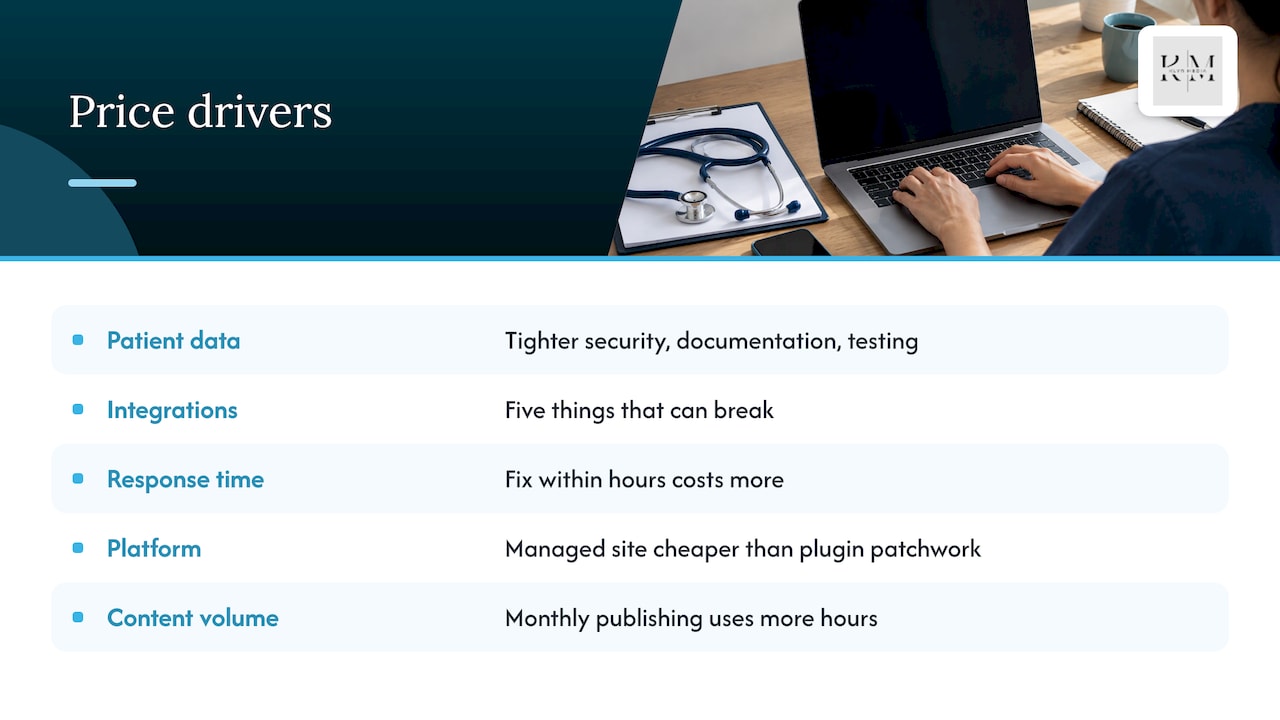
1. Whether the site handles patient information. A static informational site has a small attack surface. A site with intake forms, refill requests, secure messaging or a portal link needs tighter security work, documentation and more careful testing after each update.
2. Third-party tools. Every scheduler, chat widget, payment processor and analytics script is something to update, test and review for privacy and accessibility. Five integrations means five things that can break.
3. Number of locations and providers. Multi-location clinics need location pages, provider bios and listings kept consistent. That is steady, small work that adds up.
4. Platform and how it was built. A well-built site on a managed platform is cheaper to maintain than a patchwork of plugins stacked over years. Technical debt is a maintenance cost you pay monthly.
5. Response time. A plan that promises a fix within hours costs more than one with next-business-day turnaround. For a pharmacy that takes refill requests online, the faster tier often pays for itself.
6. Compliance documentation. If you need the work logged in a form your compliance officer can use during a risk assessment, that takes time and should be priced in.
7. Content volume. A practice that publishes monthly health content and updates provider pages is using more hours than one that edits twice a year.
How to budget without a made-up number
Published price ranges for this topic vary widely, because they mix ecommerce stores, brochure sites, hosting-only plans and full retainers. Rather than anchor on a range that may not match your site, build your own figure in four steps.
- Inventory your site. List the number of pages, forms, integrations, locations and who edits content.
- Mark what touches patient data. Forms, scheduling, chat, call tracking, pixels. This is your compliance scope.
- Split the budget into three buckets. Technical upkeep, security and compliance, and accessibility. Add a fourth for content edits if you want a cap of hours each month.
- Get quotes against the same list. Give each provider the inventory. Compare line items, not the headline monthly fee.
For context on the other end of the budget, the build, our breakdown of U.S. healthcare website costs by practice type shows how scope changes the price of a new site, and the build decisions you make there set how expensive upkeep becomes later.
A worked example of how to read a quote
Suppose a two-provider clinic with one location, an online scheduler and a contact form receives two quotes. The first is a low monthly fee that lists “updates and backups.” The second costs more and lists updates, backups, uptime monitoring, security scanning, a quarterly review of third-party tools, a set number of content-edit hours, and accessibility checks on new pages.
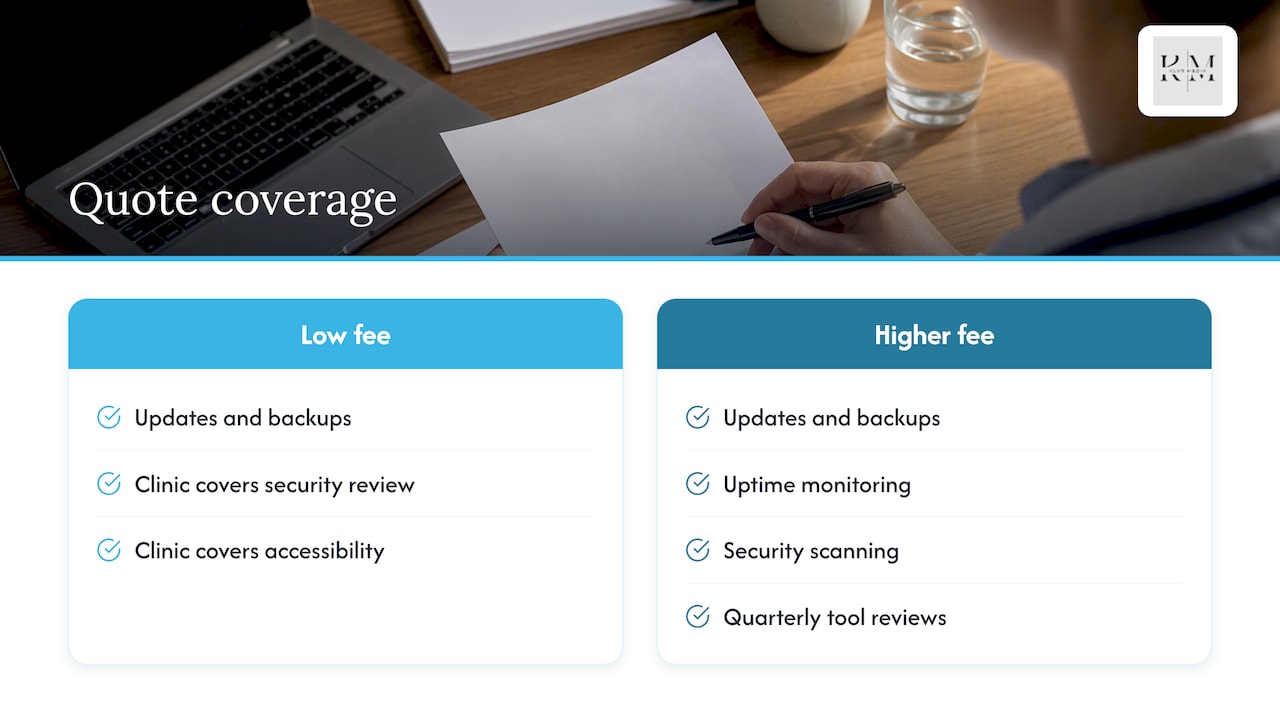
The second is not simply more expensive. It prices the work the clinic is already responsible for. The first leaves the clinic to cover security review and accessibility itself, which means either extra hours later or nothing getting done. When you compare, ask what is missing from the cheaper one, then price that gap.
Questions to ask before you sign
- Which systems on our site touch patient information, and how do you handle them?
- Do you sign a business associate agreement where one is required? (Confirm with your attorney which vendors need one.)
- What is the response time when the site is down or a form stops working?
- How many content-edit hours are included, and what happens above that?
- Who owns the domain, hosting account and site files if we part ways?
- How are backups stored, and when was a restore last tested?
- How do you handle accessibility on new pages, PDFs and plugins?
- Will we get a monthly report we can show our compliance officer or office manager?
A provider that works in healthcare every day answers these without hesitation. A generic provider often has to look them up.
Why upkeep works better with a team that does healthcare only
Most of the cost in this topic is not the hours. It is the cost of mistakes: a form that breaks quietly for three weeks, a plugin update nobody tested, a tracking script added by a well-meaning marketer without anyone asking whether it touches patient data. Those mistakes happen when the person maintaining the site doesn’t know what your obligations look like.
KLYR Media specializes exclusively in healthcare, with HIPAA-compliant systems tailored to pharmacies and clinics and compliance built in from day one. That means the site is designed with upkeep in mind, rather than patched into compliance later. A site built that way is also cheaper to keep running, because it isn’t held together by workarounds.
Perspective
We talk to independent pharmacy owners and practice managers all the time, and the pattern is the same. The website gets built, everybody moves on, and then it sits. Nobody owns it. The phone is still ringing, the staff are underwater, and the site is the one thing that isn’t going to complain until it breaks.
Here’s our view. Maintenance isn’t a cost you minimize. It’s the thing that keeps the revenue you already earned from leaking out. A refill form that fails, a scheduler that stops syncing, a page that loads slowly on a phone: that’s revenue that never walked in.
Because we work only with healthcare providers, we build sites so that compliance is part of the structure, not a layer added later. Security, accessibility and tracking decisions get made with patient information in mind from the first page. That makes ongoing care simpler and the monthly work more predictable.
Our advice: stop asking “what’s the cheapest plan?” Ask what is on your site that touches patients, who is responsible for it, and how fast it gets fixed. Then pick the team that can answer in plain English.
Opinly
Put a number on your own site
If you’d like a maintenance scope written against your actual site, our HIPAA web design service covers sites built for pharmacies, clinics and practices, and our team can help you map what touches patient data and what ongoing care it needs.

If your site also needs to bring in patients, not just stay online, we handle healthcare SEO and patient retention automation for the same kinds of practices. Our main site lists the full range.
FAQ
How much does website maintenance cost for a medical practice?
It depends on what the site does. A simple informational site costs less to maintain than one with scheduling, patient forms and several locations. Price the work in three parts: technical upkeep, security and compliance, and accessibility, then compare quotes against the same list.
Is website maintenance included when a site is built?
Usually not. Builds are priced as projects, and ongoing updates, backups, monitoring and security work are billed monthly or annually. Confirm in writing whether hosting, content edits and security scans are included before you sign.
Does my website need HIPAA-related maintenance if it only has a contact form?
If the form can collect health-related details, treat it as part of your ePHI risk review. HHS’s audit protocol points to identifying systems that contain, process or transmit ePHI and keeping the risk assessment current. Ask your compliance adviser or attorney how that applies to your forms.
Does accessibility count as maintenance?
For many healthcare organizations it should. HHS’s Section 504 rule sets WCAG 2.1 AA as the standard for covered recipients, with deadlines in 2027 and 2028 depending on size. New pages, documents and third-party tools all need checking, so the work recurs.
What is the difference between maintenance and SEO?
Maintenance keeps the site secure, fast and working. SEO is the ongoing work that helps patients find it. Both matter, and they are normally scoped and priced separately.
Sources
- HHS OCR HIPAA Audit Protocol
- HHS OIG audit of a large Northeastern hospital, July 2025
- McDermott Will & Schulte: HHS accessibility standards for health websites

