

Types of Healthcare Marketing: Your 2026 Strategy Guide

Healthcare is one of the most regulated industries on the planet, and its marketing reflects that complexity. The types of healthcare marketing available to you in 2026 span from traditional print campaigns to AI-powered patient acquisition systems, and choosing the wrong channel can cost you more than just budget. It can cost you a compliance violation. If you’re running a clinic, independent pharmacy, or medical practice, understanding your full range of options is the difference between a patient pipeline that works and one that leaks.
Table of Contents
- Key takeaways
- Types of healthcare marketing: how to evaluate your options
- 1. Print advertising
- 2. Direct mail
- 3. Community events and sponsorships
- 4. Telemarketing and phone outreach
- 5. Search engine optimization (SEO)
- 6. Pay-per-click advertising (PPC)
- 7. Content marketing
- 8. Social media marketing
- 9. Email marketing
- 10. Reputation management
- 11. AI-driven marketing and automation
- 12. Video marketing
- Comparing healthcare marketing types at a glance
- My take: stop treating compliance as an obstacle
- Ready to build a compliant, high-performing marketing system?
- FAQ
Key takeaways
| Point | Details |
|---|---|
| Compliance shapes every choice | HIPAA, FDA, and CMS regulations directly limit which marketing tactics you can legally use and how. |
| Digital marketing leads in ROI | SEO, email, and paid ads consistently outperform traditional methods in patient acquisition cost and measurable returns. |
| AI can lift conversions significantly | HIPAA-compliant AI triage systems can lift appointment conversions by 27% while lowering acquisition cost by 19%. |
| Traditional marketing still has a place | Direct mail and community events build local trust in ways that digital channels still struggle to replicate. |
| PHI segregation is non-negotiable | Tracking pixels and analytics tools on patient-facing pages require BAAs or architectural separation to stay compliant. |
Types of healthcare marketing: how to evaluate your options
Before you pick a single channel, you need a framework. Not every marketing type fits every healthcare organization, and that gap between what works generically and what works for you is where most practices lose money.
Here is what actually matters when evaluating your options:
- Regulatory compliance. Every marketing channel has compliance implications. FDA promotional labeling rules require prescription drug communications to be truthful and non-misleading. CMS Medicare marketing guidelines require TPMO disclaimers in certain plan promotion materials. HIPAA governs how you handle patient data in personalized campaigns. Know the rules before you spend a dollar.
- Audience fit. Who are you trying to reach? An older Medicare population responds differently than a millennial urgent care patient. Channel selection has to match patient demographics, not just your personal preference.
- Cost and resource intensity. Some channels are cheap to launch and expensive to scale. Others require upfront investment but deliver long-term compounding returns. Be honest about what your team can sustain.
- Measurability and ROI. Can you track conversions? Can you tie a new patient appointment back to a specific campaign? Channels that cannot demonstrate a clear return belong lower on your priority list.
Pro Tip: Build a simple scoring matrix for every marketing channel you consider. Rate each one on compliance complexity, audience reach, cost, and ROI trackability. It takes 20 minutes and saves you from making decisions based on what sounds exciting rather than what actually works.
1. Print advertising
Print ads in local newspapers, health magazines, and community newsletters are one of the oldest types of healthcare marketing strategies, and they are not dead yet. For independent pharmacies and primary care clinics, a well-placed ad in a neighborhood publication still builds name recognition in a way that a Google ad cannot fully replicate.

The limitation is targeting. You are broadcasting to everyone who reads that publication, not just people actively searching for your services. Costs add up quickly, and attribution is nearly impossible. Print works best as a brand awareness tool, not a conversion driver.
2. Direct mail
Direct mail is the one traditional channel that genuinely surprises people with its staying power. A postcard announcing a new flu shot clinic or a reminder about a medication refill program lands in the hands of real patients in your zip code. For pharmacies trying to recover lapsed customers, this is more personal than a social media post.
The compliance angle matters here, though. HIPAA mandates patient authorization for any marketing communication that uses PHI-based personalization. A generic mailer to a neighborhood is fine. A letter that references a specific patient’s condition or medication history without authorization is not.
3. Community events and sponsorships
Health fairs, free screening events, and local sponsorships build the kind of trust that no digital campaign can manufacture overnight. When your pharmacy team runs a blood pressure check at the community center, you become a neighbor, not just a vendor.
This type of marketing is particularly effective for practices entering a new market or competing against large chains. People remember who showed up. The downside is that ROI is nearly impossible to measure directly, and the cost per patient acquired is high. Think of it as a long-term reputation investment, not a short-term revenue driver.
4. Telemarketing and phone outreach
Outbound phone calls to existing patients for appointment reminders, medication refill follow-ups, or wellness check-ins remain a legitimate and effective tool. The key distinction is that this works for existing patients under established care relationships. Cold outreach to non-patients opens you up to Do Not Call Registry violations and patient trust issues.
Used within the right context, phone outreach is one of the highest-conversion retention tools available to independent practices.
5. Search engine optimization (SEO)
SEO is where most of your new patient acquisition starts. When someone searches “pharmacy near me” or “walk-in clinic open Sunday,” your ability to appear on the first page of results is worth more than any print campaign you could run. Healthcare SEO involves optimizing your website, Google Business Profile, and local citations to match what patients are actually searching for.
The long-term payoff is significant. Unlike paid ads, organic rankings compound over time. A well-optimized page that ranks today keeps driving traffic next year without additional spend. This makes SEO one of the highest-ROI types of healthcare marketing strategies for independent practices with limited budgets.
Pro Tip: Focus your SEO efforts on condition-specific and service-specific pages, not just your homepage. A page titled “flu shots in [City Name]” will outperform a generic homepage for that search every time.
6. Pay-per-click advertising (PPC)
PPC lets you appear at the top of search results immediately, before your SEO work has time to compound. Google Ads campaigns targeting terms like “urgent care near me” or “independent pharmacy [city]” can drive appointment calls from day one.
The tradeoff is cost. Healthcare is one of the most competitive PPC categories. Without careful keyword targeting and negative keyword lists, you burn budget fast. But for a new clinic or pharmacy location, PPC can fill the calendar while your organic presence builds.
7. Content marketing
What is content marketing in healthcare? At its core, it is creating and publishing educational content that helps patients understand their health, find answers to their questions, and trust your practice as a credible source. Blog posts, how-to guides, medication FAQs, and condition explainers all qualify.
This is where healthcare content marketing ideas pay dividends that most practice owners underestimate. Providers publishing clinical content that is citation-worthy and written in plain language consistently achieve higher organic search rankings and patient engagement. What is healthcare content marketing if not a way to put your expertise in front of patients before they even call? It builds authority, drives SEO, and positions you as the go-to resource in your community.
8. Social media marketing
Social media is one of the most misused types of online healthcare marketing. Most practices either post too infrequently to matter or post content that does nothing to advance patient trust. Effective social media in healthcare means sharing patient education, behind-the-scenes practice culture, and community involvement content that resonates with your specific audience.
Compliance matters here in ways that catch people off guard. HHS social media policy requires clear sponsorship identification and links back to official sources. You cannot imply endorsements that do not exist, and sponsored content must be clearly labeled. Healthcare social media compliance is not just about what you say. It is about how you say it and who you say it is from.
9. Email marketing
Email remains one of the highest-ROI retention channels available to healthcare providers. A well-structured email sequence can remind patients about annual wellness visits, notify them about new services, and re-engage patients who have gone quiet for six months.
The types of healthcare content marketing that perform best in email are practical and personal: medication reminders, seasonal health tips, and appointment follow-ups. Keep lists segmented by patient type and service interest. Generic blasts to your entire list underperform every time. And always confirm your email platform has a signed Business Associate Agreement in place if any messaging touches patient data.
10. Reputation management
Your Google reviews are your digital word-of-mouth. New patients check them before they ever call you. A practice with 4.8 stars and 200 reviews beats a practice with 3.9 stars and 12 reviews, regardless of clinical quality.
Reputation management as a type of healthcare marketing means actively requesting reviews from satisfied patients, monitoring review platforms, and responding thoughtfully to feedback. Responding to reviews requires careful language to avoid confirming patient status or disclosing any PHI. Standardized response templates reviewed by your legal or compliance team are not optional. They are necessary.
11. AI-driven marketing and automation
This is the frontier where the gap between large health systems and independent practices is either closing or widening, depending on what you do next. AI-powered chatbots, predictive scheduling tools, and automated follow-up sequences can handle the volume of patient communication that small teams simply cannot manage manually.
The compliance architecture matters critically here. Marketing systems must segregate PHI from analytics platforms using strict access controls and HIPAA-safe inference planes. Using tracking pixels or analytics tools on PHI-adjacent pages without Business Associate Agreements risks OCR enforcement under guidance issued in 2022 and reinforced in 2024. The practices using compliant AI marketing tools well are seeing measurable results. Check the 2026 digital marketing trends shaping how forward-thinking providers are building these systems.
12. Video marketing
Video builds trust faster than any other content format. A two-minute explainer from your pharmacist about medication interactions or a walkthrough of your clinic’s intake process removes the anxiety that keeps patients from booking. YouTube, Instagram Reels, and website-embedded videos all serve different patient segments.
Short-form video is particularly effective for reaching younger patients who may not engage with long-form blog content. Patient education videos also double as SEO assets when properly transcribed and embedded on your website. This is one of the healthcare content marketing ideas that most practices overlook, yet it consistently ranks among the highest engagement formats.
Comparing healthcare marketing types at a glance
| Marketing type | Compliance complexity | Patient reach | Cost level | ROI potential | Best for |
|---|---|---|---|---|---|
| Print advertising | Low | Local/broad | Medium | Low | Brand awareness |
| Direct mail | Medium | Targeted local | Medium | Medium | Patient retention |
| Community events | Low | Hyperlocal | Medium-high | Low (long-term) | New market entry |
| SEO | Medium | Regional/national | Low-medium | High | Long-term acquisition |
| PPC advertising | Medium | Targeted | High | High (short-term) | New locations |
| Content marketing | Medium | Broad organic | Low | High | Authority building |
| Social media | High | Broad | Low-medium | Medium | Engagement/trust |
| Email marketing | High | Existing patients | Low | High | Retention |
| Reputation management | High | Local | Low | High | Conversion |
| AI-driven marketing | Very high | Broad/targeted | Medium-high | Very high | Scaling |
| Video marketing | Medium | Broad | Medium | High | Education/trust |
My take: stop treating compliance as an obstacle
I’ve worked with enough healthcare providers to recognize a pattern. The ones who treat HIPAA and FDA regulations as bureaucratic friction tend to either avoid digital marketing entirely or blunder into violations that cost real money. Neither outcome serves your patients or your practice.
Here is what I’ve found actually works: compliance is not a constraint on your marketing. It is the foundation of it. The practices that invest in building HIPAA-safe tracking architecture, get BAAs signed before launching email campaigns, and use standardized review response templates are not playing defense. They are building systems that can scale without blowing up.
I’ve also noticed that the most effective healthcare marketers are not the ones running the most channels. They are the ones running three or four channels very well, with clean data, consistent messaging, and a clear understanding of what each channel is supposed to do. SEO for acquisition. Email for retention. Reviews for conversion. AI for scale. Get those four right and you are ahead of most independent practices in the country.
The healthcare digital marketing checklist I recommend practitioners work through before launching anything new forces exactly that kind of clarity. What is the channel supposed to do? What does compliance require? How will you measure it? Three questions. Most teams skip all three.
— Opinly
Ready to build a compliant, high-performing marketing system?
Understanding the types of healthcare marketing is one thing. Building a system that executes them correctly, stays compliant, and actually brings patients through your door is another challenge entirely.
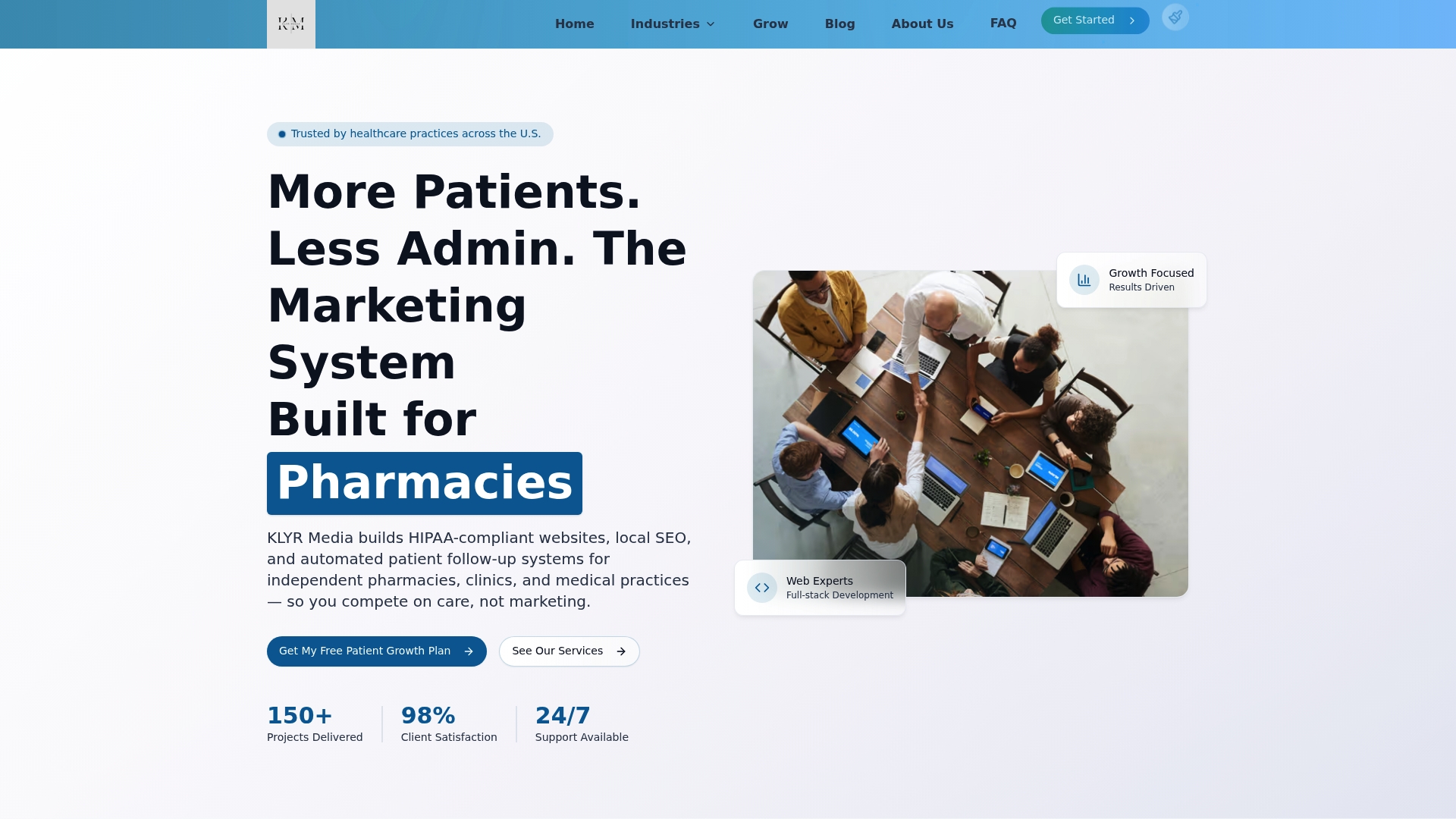
Klyrmedia works exclusively with healthcare providers, including independent pharmacies, medical clinics, and specialty practices across the United States. From HIPAA-compliant website design that keeps your patient data protected to local SEO campaigns that put your practice in front of the right people at the right moment, every solution is built specifically for the healthcare environment you operate in. If you are ready to stop guessing and start running a marketing operation that actually scales, explore general healthcare digital solutions from Klyrmedia and see what a purpose-built system looks like for your practice type.
FAQ
What are the main types of healthcare marketing?
The main types include traditional methods like print ads, direct mail, and community events, plus digital channels such as SEO, PPC, content marketing, social media, email, and emerging tools like AI-driven marketing and reputation management. Each serves a different patient acquisition or retention goal.
What is healthcare content marketing?
Healthcare content marketing means creating educational materials, such as blog posts, videos, and guides, that help patients make informed decisions while positioning your practice as a trusted authority. It drives organic search traffic and builds long-term patient relationships.
How does HIPAA affect healthcare marketing?
HIPAA requires patient authorization for any PHI-based personalization in marketing communications, and it mandates Business Associate Agreements with any third-party platform that may access patient data, including email tools and analytics platforms.
Which type of healthcare marketing has the best ROI?
SEO and email marketing consistently deliver the highest long-term ROI for independent healthcare practices, though AI-driven systems that improve appointment conversion rates are closing the gap fast, especially for practices ready to invest in compliant automation infrastructure.
Do traditional healthcare marketing methods still work in 2026?
Yes, particularly for community trust-building and local brand awareness. Direct mail and community events still convert well for established local practices, but they work best as complements to a digital-first strategy rather than standalone approaches.

