

The Role of Landing Pages for Clinics in 2026

A clinic landing page is a standalone, single-purpose web page built to convert one type of patient visitor into one specific action: booking an appointment. Unlike a homepage, which serves every audience at once, a landing page speaks directly to someone searching for “knee pain specialist near me” or “same-day urgent care.” The role of landing pages for clinics goes far beyond aesthetics. Clinics that send Google Ads traffic to their homepage instead of a dedicated landing page are leaving a significant share of potential patients on the table. The data backs this up, and so does every clinic that has made the switch.
What are effective clinic landing pages and why do they outperform general websites?
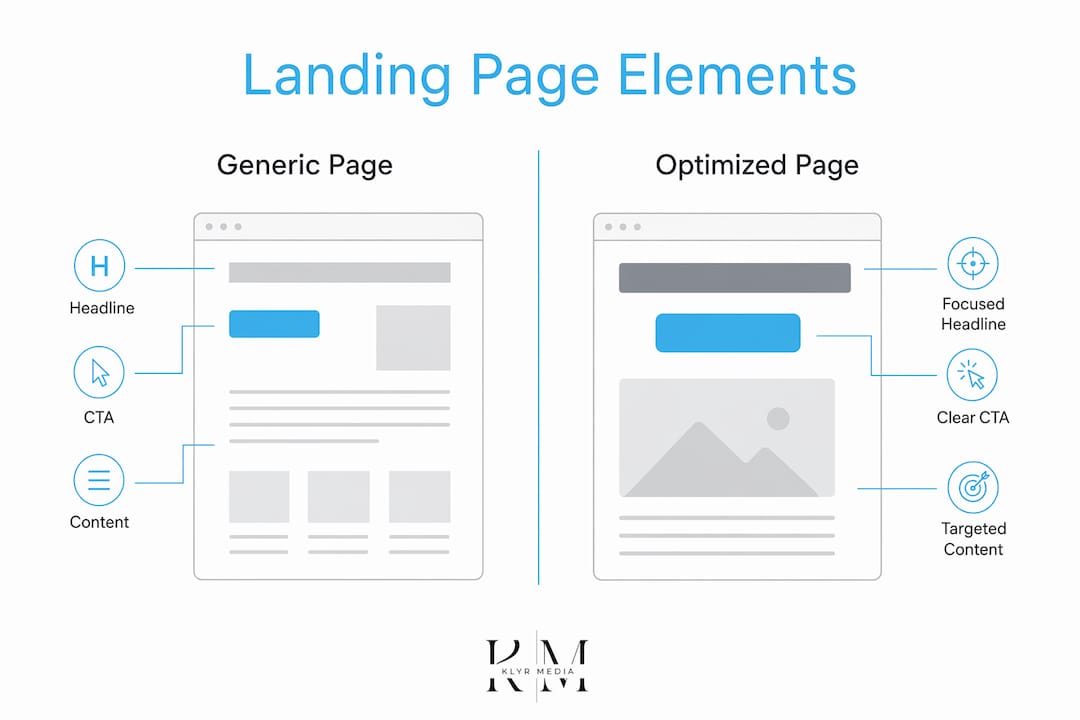
A dedicated clinic landing page is built around a single treatment, service, or patient segment. It has one headline, one call to action, and zero distractions pulling visitors toward unrelated content. That focus is exactly why it works.
General clinic homepages serve multiple audiences simultaneously: new patients, existing patients, job seekers, insurance partners, and curious visitors. That breadth is a liability when you are paying for targeted ad traffic. A visitor who clicked an ad for “botox consultation” and lands on a homepage full of cardiology, pediatrics, and contact forms for billing will bounce. Fast.

Dedicated landing pages convert 3 to 5 times better than general homepages for paid traffic. That is not a marginal improvement. It means a clinic spending $3,000 per month on Google Ads could triple its booked appointments without increasing its budget by a single dollar.
The structural reason is message match. When an ad promises “Free Skin Cancer Screening This Month” and the landing page opens with that exact headline, the visitor’s brain registers consistency and trust. When the ad promise and the page content diverge, trust collapses before the visitor reads a second line.
- Single purpose: One service, one patient type, one conversion goal per page
- No navigation menu: Removing the top nav keeps visitors focused and reduces exit paths
- Ad-to-page consistency: The headline on the page mirrors the promise in the ad
- One primary CTA: “Book Your Free Consultation” appears above the fold and repeats at the bottom
Pro Tip: Build a separate landing page for every paid campaign you run. A Google Ads campaign for “pediatric urgent care” and one for “sports injury clinic” should each have their own page. Sharing one page between campaigns dilutes message match and tanks your Quality Score.
What are the key elements of high-converting clinic landing pages?
The difference between a landing page that books 40 patients a month and one that books 8 comes down to a handful of specific design and copy decisions. Here is what the data says actually moves the needle.
-
Specific, intent-matched headlines. “Book a Free Lip Filler Consultation in Austin” outperforms “Welcome to Our Aesthetic Clinic” every time. The headline should answer the visitor’s implicit question: “Is this the right place for what I need?”
-
Personalized, action-oriented CTAs. Personalized CTAs increase landing page conversions by 202% compared to generic alternatives. “Book Your Free Lip Filler Consultation” converts at more than double the rate of “Contact Us.” The specificity signals that the clinic understands exactly what the patient wants.
-
Trust signals placed near the booking form. Social proof adjacent to CTAs doubles form completion rates. Moving Google reviews and patient testimonials from the footer to directly above or beside the booking form is one of the highest-leverage changes a clinic can make without touching ad spend.
-
Mobile-first design. Mobile traffic accounts for over 60% of healthcare clinic website visits, yet converts 8% lower on average due to poor mobile design. Buttons need to be thumb-friendly, forms need to auto-fill, and the CTA needs to be visible without scrolling.
-
Fast load times. Pages that load in under 2.5 seconds protect conversion rates. Every additional second of load time costs approximately 7% in conversions. A slow page is a leaking funnel, and most clinics have no idea their page is slow until they check.
-
Short, HIPAA-compliant forms. Forms with 5 or fewer fields double completion rates compared to longer intake forms. Ask for name, phone, email, preferred date, and reason for visit. Save insurance details and clinical history for after the appointment is confirmed.
| Element | Generic page | Optimized landing page |
|---|---|---|
| Headline | “Welcome to Our Clinic” | “Book Your Same-Day Knee Pain Consultation” |
| CTA | “Contact Us” | “Reserve My Free Consultation” |
| Trust signals | Footer only | Adjacent to booking form |
| Form length | 10+ fields | 5 fields or fewer |
| Navigation | Full site menu | Removed or minimal |
Pro Tip: Test two versions of your CTA copy using Google Optimize or a similar A/B testing tool. Run each version for at least two weeks with equal traffic before declaring a winner. Small wording changes produce surprisingly large conversion swings in healthcare.
How does HIPAA compliance affect clinic landing page design?
HIPAA compliance is not a reason to build a clunky, friction-heavy landing page. That is the most common misconception clinics bring to their marketing teams, and it costs them patients.
Standard ad tracking pixels cannot be used if they transmit protected health information (PHI). Meta Pixel and Google Tag Manager, in their default configurations, can capture form data that qualifies as PHI under HIPAA. Using them without proper configuration exposes clinics to significant regulatory risk.
The solution is server-side tracking combined with a Business Associate Agreement (BAA) with your analytics or tag management vendor. Server-side tracking processes conversion data on your server before sending anonymized signals to ad platforms, keeping PHI out of third-party systems. This approach preserves your ability to measure campaign performance without violating patient privacy.
“HIPAA compliance and a smooth patient experience are not mutually exclusive. The clinics that treat them as competing priorities are the ones building forms patients abandon.” — Patient Acquisition Funnels for Healthcare
A few practical compliance checkpoints for clinic landing pages:
- Encrypted form submissions: All patient data collected through landing page forms must be transmitted over HTTPS and stored in encrypted systems
- BAA with vendors: Any third-party tool that touches patient data, including your CRM, email platform, or scheduling software, needs a signed BAA
- No auto-population of PHI in URLs: Avoid passing patient details as URL parameters, which can be logged by browsers and third-party scripts
- EHR integration with access controls: When landing page submissions feed directly into an EHR system, role-based access controls limit who can view that data
EHR-integrated patient acquisition funnels enable real-time triage, reduce no-shows, and increase patient satisfaction by giving staff immediate visibility into incoming appointment requests. Compliance and efficiency are not opposites. They reinforce each other when the system is built correctly.
How do clinic landing pages improve patient acquisition and efficiency?
The business case for landing pages goes well beyond conversion rate percentages. The real story is about where patients are disappearing right now and how landing pages stop the bleeding.
Clinics lose 68% of potential patients between initial interest and a scheduled appointment. That is not a marketing problem. That is a funnel problem. A patient searches for a service, clicks an ad, hits a confusing homepage, can’t find a booking option quickly, and leaves. That patient is gone. They book with whoever had the cleaner path to an appointment.
Treatment-specific landing pages address this directly by matching exact patient intent. A dedicated FUE hair transplant page converts significantly better than a general hair restoration services page because the visitor immediately recognizes they are in the right place.
| Business impact | Without optimized landing pages | With optimized landing pages |
|---|---|---|
| Patient drop-off rate | Up to 68% between interest and booking | Significantly reduced with focused funnels |
| Staff time on scheduling | High due to manual follow-up | Reduced by up to 40% with automation |
| Ad spend efficiency | Low: traffic sent to homepage | High: dedicated pages per campaign |
| Patient satisfaction | Lower due to friction and confusion | Higher due to clear next steps |
Automated patient acquisition funnels tied to landing page submissions reduce staff hours by 40% and increase patient conversion by 25%. When a patient submits a form, an automated sequence can confirm the request, send intake instructions, and trigger a staff notification, all without anyone picking up the phone. That is revenue that does not require additional headcount.
What practical steps should clinics take to build landing pages in 2026?
You do not need to rebuild your entire website. Start with one page for your highest-value service and one active paid campaign. Here is how to do it right.
- Match every campaign to its own page. A Google Ads campaign for “dermatology consultation” needs its own landing page. Do not send that traffic to your general services page. Review your healthcare Google Ads strategy to align campaigns with dedicated pages from the start.
- Write headlines that mirror your ad copy. If your ad says “Same-Day Appointments Available,” your landing page headline should say the same thing. Message match is the single highest-leverage conversion factor.
- Place trust signals where they count. Put your Google reviews rating, patient testimonials, and any board certifications directly above or beside your booking form, not buried in the footer.
- Design for mobile first. Test your page on a phone before you launch it. If the CTA button is not visible without scrolling, fix it. If the form is hard to type in on a touchscreen, simplify it.
- Keep forms short and compliant. Five fields maximum for initial capture. Use a HIPAA-compliant form tool with encrypted submissions. Consider digital intake solutions that balance usability with compliance requirements.
- Track everything that matters. Set up conversion tracking for form submissions, phone call clicks, and appointment confirmations. Use server-side tracking to stay compliant. Review your clinic website optimization data monthly to identify drop-off points.
- Test one variable at a time. Change the CTA wording, then measure. Change the headline, then measure. Running multiple changes simultaneously makes it impossible to know what actually worked.
Pro Tip: The 2026 Medical Clinic Marketing Checklist from Klyrmedia includes a landing page audit section that helps you identify which pages need immediate attention based on traffic volume and current conversion rates. Check the clinic marketing checklist before you start building.
Key takeaways
Clinic landing pages are the single most effective tool for converting paid and organic traffic into booked appointments, and every clinic running ads without them is paying for traffic that walks away.
| Point | Details |
|---|---|
| Landing pages vs. homepages | Dedicated pages convert 3 to 5 times better than general clinic homepages for paid traffic. |
| Personalized CTAs | Action-specific CTAs increase conversions by 202% compared to generic “Contact Us” buttons. |
| Trust signal placement | Moving reviews adjacent to the booking form doubles form completion rates. |
| HIPAA compliance | Server-side tracking with a BAA protects patient data while preserving campaign measurement. |
| Automation impact | Integrated funnels reduce staff hours by 40% and increase patient conversion by 25%. |
What I’ve learned from watching clinics get this wrong
Most clinics I see are not failing because their service is bad or their ads are poorly written. They are failing because the page a patient lands on after clicking an ad was never designed to convert anyone. It was designed to look professional. Those are two very different goals.
The clinics that resist building dedicated landing pages usually cite one of two reasons: they think their homepage is “good enough,” or they are worried about HIPAA. Both are solvable. A homepage is not good enough for paid traffic. Full stop. And HIPAA compliance, handled correctly with server-side tracking and proper vendor agreements, does not require you to build a friction-heavy experience that patients abandon.
What I have also seen is that clinics underestimate how much the mobile experience matters. You can have a perfect desktop landing page and still lose the majority of your visitors because the mobile version is slow, cramped, or buries the booking button. Over 60% of your visitors are on a phone. Design for them first.
The clinics winning in 2026 are the ones treating landing pages as a system, not a one-time project. They build a page, measure it, test it, and improve it continuously. They align their ad creative, their landing page copy, and their intake process so the patient experience is consistent from click to confirmed appointment. That alignment is what separates clinics that grow from clinics that wonder why their ad spend is not working.
— Opinly
How Klyrmedia helps clinics build landing pages that actually convert
If you are running ads or investing in SEO without dedicated landing pages, you are funding a leaky funnel. Klyrmedia builds HIPAA-compliant landing pages for medical clinics that are designed from the ground up to convert, comply, and integrate with your existing scheduling and EHR systems.
Beyond the page itself, Klyrmedia’s patient retention automation connects landing page submissions to automated follow-up sequences that confirm appointments, reduce no-shows, and keep patients engaged between visits. The result is a system that works while your staff focuses on care, not chasing leads. If you are ready to stop sending paid traffic to a homepage and start building a patient acquisition system that compounds over time, Klyrmedia is the place to start.
FAQ
What is the role of landing pages for clinics?
A clinic landing page converts visitors searching for a specific treatment or service into booked appointments by providing a focused, distraction-free experience with a single call to action. Unlike a homepage, it is built for one campaign goal and one patient type.
How much better do landing pages convert compared to clinic homepages?
Dedicated clinic landing pages convert 3 to 5 times better than general homepages for paid traffic, meaning the same ad budget produces significantly more booked appointments.
Do HIPAA rules prevent clinics from using tracking on landing pages?
HIPAA restricts standard client-side pixels that can transmit protected health information, but server-side tracking with a signed Business Associate Agreement allows clinics to measure conversions compliantly without exposing patient data.
How many form fields should a clinic landing page include?
Forms with 5 or fewer fields double completion rates compared to longer intake forms. Collect only name, phone, email, preferred date, and reason for visit at the initial stage.
How do automated funnels connect to clinic landing pages?
When a patient submits a landing page form, automated workflows can confirm the request, send intake instructions, and notify staff in real time, reducing manual scheduling work by up to 40% and increasing patient conversion by 25%.

