

The Role of Data Privacy in Healthcare: 2026 Guide

Data privacy in healthcare is defined as the protection and responsible management of sensitive patient information to preserve confidentiality, meet regulatory requirements, and maintain trust in care delivery. The role of data privacy in healthcare has never been more urgent. 171 million patient records were compromised in 2023 across HIPAA-regulated and unregulated sectors combined. That number reflects a system under real pressure. Regulations like HIPAA and the European Health Data Space (EHDS) set the legal floor, but compliance alone does not equal protection. Healthcare professionals and administrators need to understand how privacy, security, and compliance work together as distinct but linked responsibilities.
How do data privacy regulations shape healthcare data management?
Regulatory frameworks define the minimum standards every healthcare organization must meet. HIPAA remains the primary federal law governing protected health information (PHI) in the United States. It covers covered entities like hospitals and clinics, as well as their business associates. Violations carry civil and criminal penalties, and a single breach can trigger federal investigations, class-action litigation, and lasting reputational damage.
The regulatory picture is getting more complex, not simpler. The U.S. still lacks a broad federal privacy law, which means healthcare organizations must navigate a patchwork of state regulations that often conflict with each other. California, Texas, and Washington have each passed health data laws with different definitions, consent requirements, and enforcement mechanisms. Rapid AI adoption makes this even harder to track.
Internationally, the EHDS Regulation entered into force in march 2025 and reaches general application in march 2027. It introduces phased health data governance requirements across EU member states. For U.S. organizations with any European patient data, this creates a parallel compliance obligation that cannot be ignored.
One critical distinction gets missed too often. Compliance, security, and privacy are three separate pillars, not one. Compliance means meeting the legal minimum. Security means protecting systems from attack. Privacy means controlling how data is collected, used, and shared. Treating them as the same thing leaves gaps that attackers and regulators both find.
- Compliance covers regulatory checklists, documentation, and audit readiness
- Security covers technical controls like firewalls, encryption, and access management
- Privacy covers consent, data minimization, purpose limitation, and patient rights
- Cross-jurisdictional conflicts arise when state laws impose stricter consent rules than HIPAA
- Litigation risk increases when organizations cannot demonstrate active privacy governance
Pro Tip: Review your organization’s privacy program against all three pillars separately. A clean HIPAA audit does not mean your privacy posture is strong.
What are the emerging data privacy risks in healthcare technology?
New technology creates new exposure. AI tools, Internet of Medical Things (IoMT) devices, electronic health records (EHRs), and telemedicine platforms all generate and transmit sensitive patient data. Each integration point is a potential vulnerability.
The AI scribe issue is a live example. A class-action lawsuit filed in april 2026 targets healthcare providers for deploying AI scribes without disclosing this to patients. The legal liability sits with the provider, not the software vendor. That is a critical point. Buying a compliant tool does not transfer your responsibility to the vendor. You still own the consent process, the disclosure obligation, and the patient relationship. Klyrmedia’s breakdown of AI in clinical settings covers this shift in more detail.
“Data rights are the missing pillar for modernizing consent in medicine. Patients are not informed participants in the data ecosystems their care generates. Fixing that requires providers to act, not just vendors.” — Nature Medicine, 2026
Insider threats and ransomware remain the most persistent cybersecurity risks in healthcare IT. Weak internal procedures and low staff awareness are the most common entry points. A well-funded firewall does not stop a staff member clicking a phishing link or accessing records they have no reason to view.
Data privacy is also a lifecycle challenge, not a point-in-time problem. Patient data moves from primary care to billing systems, research databases, and AI training sets. Each stage carries its own risk profile. Techniques like differential privacy and synthetic data generation help organizations use data for secondary purposes without exposing individual records. Zero-trust architecture, which requires continuous verification of every user and device, reduces the blast radius when a breach does occur.

For telehealth providers specifically, the telehealth compliance checklist from Chameleon Healthcare offers a practical starting point for auditing your current exposure.
How does data privacy directly impact patient care and outcomes?
Patient trust is a clinical imperative, not just a PR concern. When patients perceive weak data privacy, they delay seeking care, withhold sensitive information, or switch providers entirely. Each of those behaviors directly harms clinical outcomes. A patient who does not disclose a medication they are taking because they fear data exposure creates a real prescribing risk.
Breaches also disrupt clinical workflows in ways that are easy to underestimate. When a hospital system is locked down by ransomware, elective procedures get canceled, lab results get delayed, and staff revert to paper processes. The operational cost is significant. The patient safety risk is real.
Here is what a privacy-centered patient experience looks like in practice:
- Transparent consent processes that explain exactly what data is collected and why, in plain language
- Secure patient portal access that gives patients visibility into their own records and control over sharing
- Privacy by design built into EHR configurations, so the default is minimum necessary access
- Clear breach notification procedures that communicate quickly and honestly when something goes wrong
- Staff training that makes every team member a participant in protecting patient information
Pro Tip: Patients who receive a clear explanation of how their data is protected are more likely to engage fully with care plans. Make privacy communication part of your intake process, not just your legal paperwork.
The connection between patient trust and provider reputation is also measurable. Negative reviews citing privacy concerns spread fast and are hard to reverse. Protecting data protects your practice’s standing in the community.
What best practices can healthcare organizations adopt for data privacy?
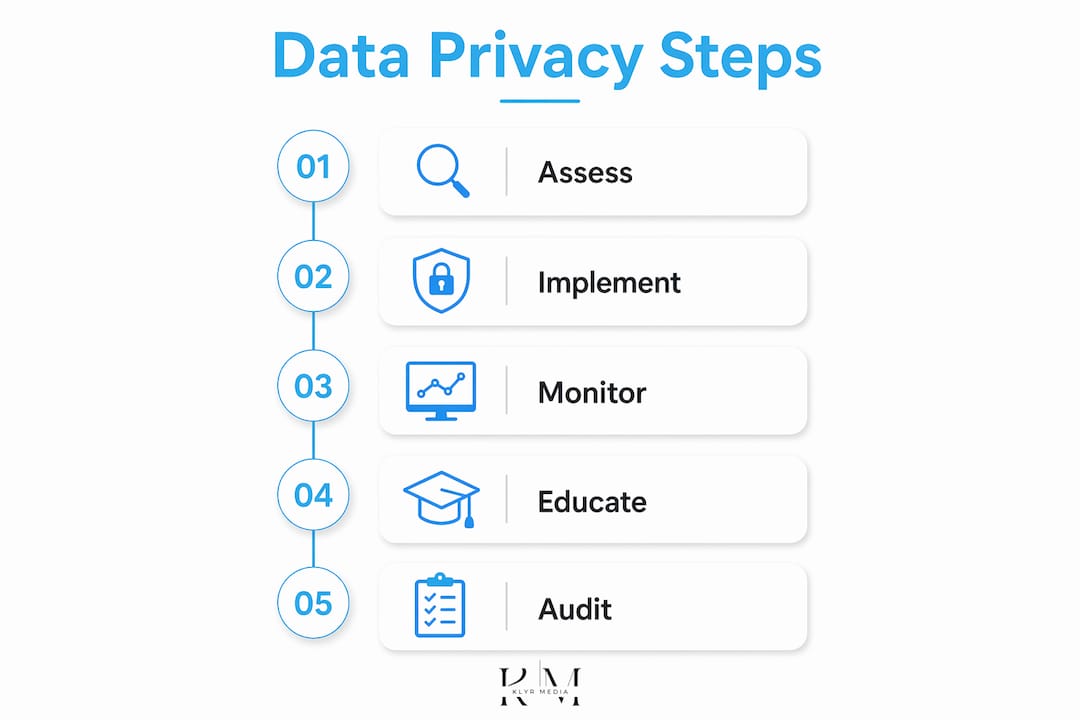
Strong data privacy programs share a common structure. They combine technical controls, administrative policies, and organizational culture. No single layer is enough on its own.
Technical safeguards
Encryption, multi-factor authentication, zero-trust architecture, and continuous monitoring are the non-negotiable technical baseline. Encryption protects data at rest and in transit. Multi-factor authentication (MFA) stops credential theft from becoming a full breach. Audit logging creates a record of who accessed what and when, which is critical for both breach investigation and compliance demonstration.
Administrative and governance controls
Executive ownership of privacy governance matters. When privacy is owned by IT alone, it gets treated as a technical problem. When the C-suite owns it, it becomes an organizational priority. Vendor management is another gap many organizations underestimate. Every third-party vendor with access to PHI needs a current Business Associate Agreement (BAA) and a documented security review.
| Control area | Key action |
|---|---|
| Risk assessment | Conduct annual HIPAA Security Risk Analysis and document findings |
| Staff training | Run role-specific privacy training at onboarding and annually |
| Vendor management | Maintain active BAAs and review vendor security posture regularly |
| Incident response | Test your breach response plan at least once per year |
| Privacy by design | Build minimum-necessary access into system configurations from the start |
- Assign a Privacy Officer with clear authority and a direct line to leadership
- Document all data flows, including secondary uses like research and AI model training
- Review HIPAA-compliant marketing practices before deploying any patient communication tools
- Prepare now for EHDS obligations if your organization handles any EU patient data
- Use the healthcare privacy guide from Chameleon as a supplemental resource for patient-facing privacy communication
Multi-layered defense combining technology, governance, and training is the only approach that holds up over time. Organizations that overinvest in technical tools while neglecting staff training and incident response plans consistently find their weakest link is human, not technical.
Key Takeaways
Strong data privacy in healthcare requires integrating compliance, security, and privacy as three separate but equally critical pillars, supported by technology, governance, and a trained workforce.
| Point | Details |
|---|---|
| Three distinct pillars | Treat compliance, security, and privacy as separate responsibilities to close the gaps between them. |
| Regulatory complexity is growing | HIPAA, state laws, and the EHDS create overlapping obligations that require active monitoring. |
| Patient trust drives clinical outcomes | Patients who distrust data practices withhold information, delay care, and switch providers. |
| AI tools carry provider liability | Deploying AI without patient consent processes exposes the organization, not just the vendor. |
| Multi-layered defense is required | Technology alone is not enough. Training, governance, and incident response must match technical investment. |
The uncomfortable truth about data privacy in healthcare
I have watched healthcare organizations spend significant budgets on security software and then get breached through a phishing email that a trained staff member would have caught. The technology was fine. The culture was not.
The honest reality is that most healthcare organizations treat data privacy as a compliance exercise. They check the HIPAA box, sign the BAA, and move on. That approach worked when the threat landscape was simpler. It does not work now. AI scribes, IoMT devices, and cloud-based EHRs have expanded the attack surface faster than most governance frameworks have adapted.
What I have found actually works is treating privacy as an ongoing operational discipline, not an annual audit. That means regular training that is specific to each staff role, not a generic video everyone clicks through. It means testing your incident response plan before you need it. It means asking hard questions about every new technology before it touches patient data.
The organizations that get this right share one trait. Leadership owns it. Not IT. Not legal. The people running the organization understand that a breach is not just a regulatory problem. It is a patient safety problem and a business survival problem.
— Opinly
Your healthcare website should be as protected as your patient records
Healthcare providers put real effort into protecting data inside their clinical systems. The website is often the weakest link nobody talks about.
Klyrmedia builds HIPAA-compliant websites for independent pharmacies, medical clinics, and healthcare practices across the United States. Every site is designed with patient data confidentiality built in from the start, not added as an afterthought. From secure contact forms to compliant patient communication tools, Klyrmedia’s medical facility solutions are built to meet the regulatory standards your practice depends on. If your digital presence does not reflect the same privacy standards as your clinical operations, that gap is worth closing.
FAQ
What is the role of data privacy in healthcare?
Data privacy in healthcare is the protection and responsible management of patient information to maintain confidentiality, meet regulatory requirements, and support trust in care delivery. It covers how data is collected, stored, used, and shared across clinical and administrative systems.
What regulations govern healthcare data privacy in the U.S.?
HIPAA is the primary federal law governing protected health information. The U.S. also has a growing set of state-level health data laws with varying consent and enforcement requirements that create additional compliance obligations for providers.
How do data breaches affect patient care?
Breaches disrupt clinical workflows, delay procedures, and erode patient trust. Patients who perceive weak privacy protections are more likely to withhold information or delay seeking care, which directly harms clinical outcomes.
What is the difference between compliance, security, and privacy?
Compliance means meeting legal requirements. Security means protecting systems from unauthorized access. Privacy means controlling how data is collected, used, and shared. All three are distinct responsibilities that must be managed separately.
How does AI create new data privacy risks in healthcare?
AI tools like ambient scribes collect and process patient data in ways that may not be disclosed to patients. Legal liability for undisclosed AI use sits with the healthcare provider, not the software vendor, making consent processes and transparency critical.

