
The Role of Custom Website Design for Healthcare
Discover the crucial role of custom website design in healthcare. Ensure compliance, enhance security, and attract patients with a tailored digital presence.

The Role of Custom Website Design for Healthcare

Custom website design is the process of building a website from the ground up, architected specifically around the operational, regulatory, and patient-facing needs of a healthcare organization. For medical clinics, independent pharmacies, and healthcare practices, this distinction matters more than it does for almost any other industry. A generic template cannot account for HIPAA’s technical safeguards, WCAG 2.1 accessibility mandates, or the trust signals patients need before they book an appointment. The role of custom website design in healthcare is to close that gap, giving providers a digital presence that is secure, accessible, and built to convert.
How does custom website design address HIPAA compliance?
HIPAA compliance on a website is less about visual design and more about controlling exactly where protected health information (PHI) is collected, transmitted, and stored. Custom design lets you architect the site around those specific touchpoints, rather than retrofitting a template that was never built with PHI in mind. That distinction is the difference between a compliant site and a liability.
Here is what custom architecture actually enables for HIPAA compliance:
- PHI touchpoint mapping. Every patient-facing feature, from intake forms to appointment requests, gets labeled and treated as a PHI exposure point. Custom development lets you apply encryption, access controls, and audit logging precisely where they are needed.
- Role-based access controls. Patient portals require unique user identification and session management. Custom development implements these controls natively, rather than relying on third-party plugins that may not meet HIPAA’s technical safeguard requirements.
- Segmented data flows. Marketing analytics tools like Google Analytics should never touch PHI. Custom design separates marketing data pipelines from patient data pipelines at the architecture level, not as an afterthought.
- Vendor BAA enforcement. Every third-party tool embedded in your site that touches PHI requires a signed Business Associate Agreement. Custom development gives you the visibility to know which vendors need BAAs, because you control every integration.
- Encrypted data transmission. Custom builds enforce HTTPS and encrypted form submissions across every patient-facing page, not just the checkout or login screen.
Templates force you to work around their limitations. That usually means costly retrofits, plugin stacking, and compliance gaps that only surface during an audit.
Pro Tip: Treat your website build as an information governance project. Map every patient interaction before a single line of code is written. That map dictates your encryption requirements, your access control architecture, and your vendor BAA checklist.
Why accessibility compliance requires custom design in healthcare
Healthcare providers must ensure that all digital health tools including websites, patient portals, telehealth platforms, scheduling links, and kiosks comply with WCAG 2.1 Level AA standards. The compliance deadline for most providers is May 11, 2027. That sounds like plenty of time. It is not, especially if you are starting from a template.
The legal exposure is real. Noncompliance with Section 504 and Section 1557 carries risk of federal investigations and civil rights complaints. The 2027 deadline is an extension, not permission to delay.
Here is where templates consistently fail healthcare accessibility:
- Keyboard navigation. Patients who cannot use a mouse must be able to tab through every interactive element in the correct logical order. Templates often break focus management on dynamic components like date pickers and modal dialogs.
- Screen reader compatibility. ARIA labels, landmark regions, and error messages must be coded correctly. Most template builders generate inconsistent markup that screen readers misinterpret.
- Error recovery in forms. When a patient fills out a scheduling form incorrectly, the error message must identify the specific field and suggest a correction. Generic templates rarely meet this standard out of the box.
- Third-party tool compliance. Embedded scheduling widgets, telehealth launchers, and payment portals are your responsibility under Section 1557, even if a vendor built them. Custom design lets you include accessibility requirements in vendor contracts and test those tools as part of your site.
- Mobile accessibility. Touch targets, zoom behavior, and reflow on small screens require deliberate coding decisions. Templates optimized for desktop often fail mobile accessibility audits.
Pro Tip: Do not test accessibility against a component checklist alone. Run your actual patient workflows, scheduling an appointment, completing an intake form, joining a telehealth visit, using a keyboard and screen reader. That is where real failures hide.
How custom design impacts patient engagement and brand trust
Responsive design, clear information hierarchy, and fast load times directly improve patient satisfaction and search discoverability. Custom design delivers all three intentionally, while templates deliver them inconsistently. For a healthcare practice competing with large hospital systems and online pharmacies, that inconsistency is a real business problem.

Brand trust in healthcare is earned through specificity. A custom site reflects your actual practice, your providers, your patient population, and your clinical philosophy. A template signals that you did not invest in the patient experience before they even walked through the door.
Key design features that drive engagement and trust in healthcare websites:
- Intuitive navigation. Patients looking for a specific service, a provider bio, or a prescription refill request should find it in two clicks or fewer. Custom information architecture is built around how your patients actually think, not how a template vendor organized their demo.
- Mobile-first design. Most patients search for healthcare providers on a phone. A custom build prioritizes the mobile experience from the start rather than scaling down a desktop layout.
- Clear calls to action. “Book an appointment,” “Request a refill,” and “Message your provider” need to be visible and accessible on every page. Custom design places these where conversion data says they belong.
- Provider credibility signals. Photos, credentials, patient reviews, and board certifications build trust. Custom layouts present these in ways that feel authoritative rather than templated.
- Content structured for SEO. Custom design lets you build patient-converting content with proper heading hierarchy, schema markup, and internal linking from day one.
What SEO and performance advantages does custom design offer?
Google’s Core Web Vitals are confirmed ranking signals, and poor performance can prevent even well-written content from reaching its potential ranking position. The good thresholds are mobile LCP under 2.5 seconds, INP under 200 milliseconds, and CLS under 0.1. Custom design gives you the control to hit those numbers. Templates, loaded with unused CSS, JavaScript, and third-party scripts, routinely fail them.
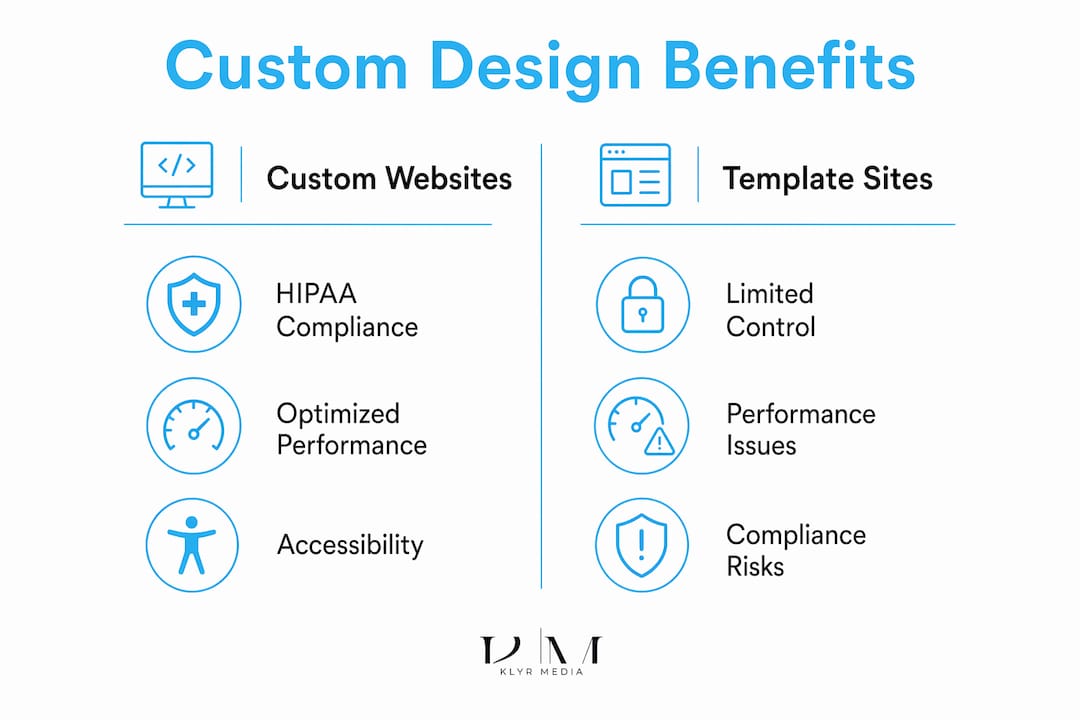
One critical nuance: optimizing only for Lighthouse lab scores can miss issues that show up in real Chrome User Experience Report data. Custom development allows you to tune for real patient conditions, including slow mobile connections and older devices, not just a controlled audit environment.
| Factor | Template websites | Custom websites |
|---|---|---|
| Core Web Vitals control | Limited; depends on theme bloat | Full control over scripts and assets |
| Page load speed | Often slow due to unused code | Optimized for actual patient traffic |
| Mobile performance | Inconsistent across devices | Designed mobile-first from the start |
| Schema markup | Partial or plugin-dependent | Built natively for healthcare content |
| SEO architecture | Generic URL and heading structure | Structured around patient search intent |
| Real-user performance | Hard to tune without source access | Tunable based on Chrome UX Report data |
The business implication is direct. Small delays on high-intent pages, like appointment booking or prescription refill requests, reduce conversions. A patient who waits three seconds for a page to load on a phone is a patient who may not book.
How does custom design integrate specialized healthcare workflows?
Custom development is the only practical path to secure patient portals with role-based access controls, encrypted PHI flows, and session management that meets HIPAA’s technical safeguard requirements. Templates cannot provide this level of control without expensive, compliance-risky plugin stacking.
Here is how custom architecture supports specialized healthcare features:
- EHR and practice management integration. Custom builds connect directly to systems like Epic, Athenahealth, or independent pharmacy management platforms via secure APIs, keeping patient data in controlled environments.
- Appointment scheduling with compliance controls. Scheduling tools built into a custom site can enforce authentication before any PHI is displayed, unlike embedded third-party widgets that may not meet HIPAA standards.
- Telehealth launch points. Custom design integrates telehealth entry points with proper session handling and accessible interface standards, so patients on assistive technology can join visits without barriers.
- Patient portal access management. Role-based permissions mean a front desk staff member sees different data than a provider, and neither sees what they should not. This is an architecture decision, not a settings toggle.
- Custom CMS for clinical content. A custom content management system reduces reliance on third-party platforms that may not sign BAAs or meet your security requirements.
Pro Tip: Build your site with modular architecture from the start. When HIPAA guidance updates, when a new telehealth integration becomes available, or when accessibility standards change, modular code lets you update one component without rebuilding the entire site.
Key takeaways
Custom website design in healthcare is a compliance and patient engagement infrastructure decision, not a cosmetic one.
| Point | Details |
|---|---|
| HIPAA compliance requires custom architecture | Templates cannot reliably control PHI data flows, access controls, or vendor BAA enforcement. |
| Accessibility deadlines are real | WCAG 2.1 Level AA compliance is required for most providers by May 11, 2027, across all patient-facing digital tools. |
| Performance directly affects conversions | Poor Core Web Vitals scores reduce search rankings and patient bookings on high-intent pages. |
| Brand trust is built through specificity | Custom design reflects your actual practice identity, which templates cannot replicate. |
| Modular architecture future-proofs compliance | Building in modules reduces the cost and risk of updating for new regulations or integrations. |
What I have learned from watching healthcare sites get this wrong
Here is the honest version of what I see repeatedly. A clinic or pharmacy invests in a template site because it is fast and affordable. It looks fine. Then a patient tries to schedule an appointment using a screen reader and cannot complete the form. Or an intake form submission routes through a third-party service that has no BAA. Or the site scores a 45 on a Core Web Vitals audit and ranks on page three for searches that should be sending patients directly to that practice.
The problem is not that the template was cheap. The problem is that the decision was made without understanding what a healthcare website actually needs to do. It needs to handle PHI securely. It needs to be accessible to every patient, including those with disabilities. It needs to load fast enough that a patient on a rural mobile connection does not give up. And it needs to reflect the specific trust signals that make a patient choose your practice over the one down the street or the big chain pharmacy.
I have seen well-designed healthcare sites outperform larger competitors in local search simply because they were built with the right architecture from the start. Compliance, accessibility, and performance are not constraints on good design. They are the foundation of it. Start there, and the patient engagement follows.
— Opinly
How Klyrmedia builds custom healthcare websites that actually work
Klyrmedia specializes in HIPAA-compliant custom website design built specifically for independent pharmacies, medical clinics, and healthcare practices across the United States. Every site Klyrmedia builds is architected around your PHI touchpoints, your patient workflows, and your compliance obligations, not adapted from a generic template. Services include WCAG 2.1 accessibility implementation, Core Web Vitals optimization, EHR integration, and patient retention automation that keeps patients engaged after their first visit. If your current site is not doing the work it should be doing, Klyrmedia can show you exactly what is missing and how to fix it.
FAQ
What is the role of custom website design in healthcare?
Custom website design in healthcare creates a site architecture built around HIPAA compliance, patient accessibility, and clinical workflows rather than adapting a generic template. It gives providers direct control over PHI data flows, performance, and patient experience.
Does a healthcare website need to be HIPAA compliant?
A healthcare website must comply with HIPAA when it collects, transmits, or stores PHI through features like intake forms, patient portals, or appointment scheduling. Compliance depends on actual PHI handling, not just the type of organization running the site.
What is the WCAG 2.1 deadline for healthcare providers?
Most healthcare providers must meet WCAG 2.1 Level AA accessibility standards by May 11, 2027, under Section 504 and Section 1557. This applies to websites, patient portals, telehealth platforms, and scheduling tools.
How does custom design improve patient engagement?
Custom design improves patient engagement by building intuitive navigation, mobile-first layouts, and fast load times around actual patient behavior. These factors also improve search rankings, making it easier for new patients to find your practice.
Can a template website be made HIPAA compliant?
A template website can be partially hardened for HIPAA compliance, but the retrofitting is costly and often incomplete. Custom development is the reliable path to implementing access controls, encrypted data flows, and vendor BAA management from the start.

