

The Role of Branding in Medical Practices That Win

Medical practice branding is defined as a system of consistent identity, communication, and patient experience that signals expertise, builds trust, and drives long-term loyalty. The role of branding in medical practices goes far beyond a logo or a color palette. It shapes how patients find you, how they feel in your waiting room, and whether they come back. Research from YARSI Hospital on 388 outpatients confirms that brand image directly predicts patient loyalty, with patient satisfaction as the single strongest driver. Johns Hopkins Medicine operationalizes this through unified brand governance across every department. If you run an independent clinic or medical practice, your brand is either working for you or quietly costing you patients.
How branding influences patient trust in medical practices
Patient trust is not automatic. It is earned through repeated signals that your practice is competent, honest, and genuinely focused on the patient’s wellbeing. Branding is the system that delivers those signals consistently.
A YARSI Hospital study found that brand image significantly affects patient loyalty (β=0.287), while patient satisfaction carries an even stronger effect (β=0.440). This means your brand promise must be backed by the actual experience patients have at every touchpoint, from the first Google search to the follow-up call after an appointment.
The Monigle Healthcare report adds a sobering data point: 28% of consumers distrust their healthcare provider’s decisions. The two biggest culprits are rushed care (23%) and the perception that financial motives outweigh patient interests (18%). These are not marketing problems. They are operational branding failures, where the experience contradicts the promise.
What actually builds trust? A Scientific Reports study of 517 U.S. adults found that trust peaks when sources combine interpersonal communication, transparency, and interactivity. No single element is enough on its own. A practice that has a polished website but cold, rushed staff will still lose patients. The brand must be consistent from the digital front door to the exam room.
Key trust signals patients look for include:
- Demonstrated expertise: Credentials, specialties, and physician bios presented clearly
- Transparency: Honest information about services, pricing, and what to expect
- Interpersonal warmth: Staff communication that feels personal, not scripted
- Interactivity: Easy appointment booking, responsive messaging, and follow-up systems
Pro Tip: Don’t rely on your website alone to build trust. Train your front desk and clinical staff to reinforce the same values your brand communicates online. The gap between digital promise and in-person delivery is where most practices lose patients.
What makes an effective medical practice brand

Strong medical branding is built on three pillars: visual consistency, clear messaging, and an operational experience that matches what you say about yourself.
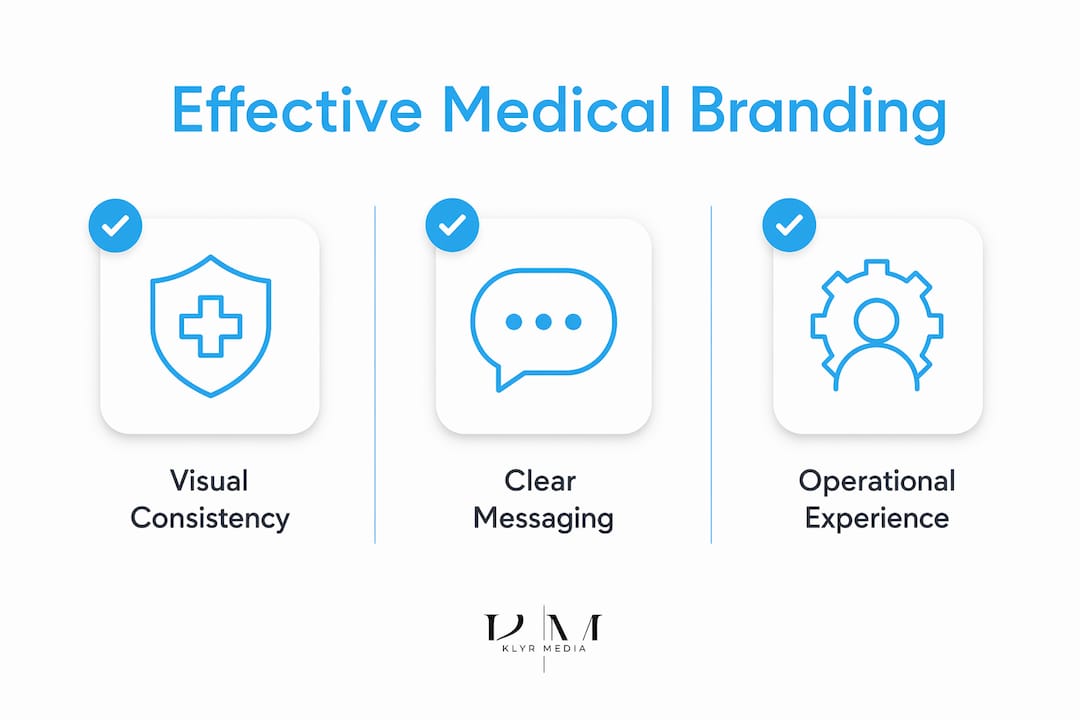
Johns Hopkins Medicine’s branding guidelines are a useful benchmark. They use a unified name and logo across all departments specifically to prevent confusion and protect brand equity. Fragmented identities, where one department looks and sounds completely different from another, dilute the trust you’ve worked to build. For a smaller practice, this means your website, signage, social profiles, and patient communications should all feel like they come from the same place.
Digital presence is now non-negotiable. RACGP research confirms that patients look online for practice values, appointment ease, and website usability before they ever call. Social media and video content are no longer optional extras. They are how patients evaluate whether your practice feels right for them before committing to a visit.
A Pew Research Center survey of 5,111 U.S. adults found that 75% of Americans say it’s very important their health information sources have relevant medical training. Transparency and plain language rank nearly as high. This tells you exactly what your brand content needs to deliver: proof of expertise, honest communication, and information that patients can actually understand.
Practical branding strategies that work for medical practices:
- Clear messaging: Define what your practice stands for in one or two sentences, then use that language everywhere
- Website usability: Fast load times, mobile optimization, and online booking are table stakes in 2026
- Social media engagement: Short videos, patient education posts, and behind-the-scenes content build familiarity and trust
- Consistent visual identity: Same colors, fonts, and tone across all patient-facing materials
- Transparent health content: Blog posts, FAQs, and explainer videos that answer real patient questions without burying the answer in jargon
Pro Tip: Audit every patient touchpoint once a quarter. Print materials, email templates, social profiles, and your Google Business listing should all reflect the same identity. Inconsistency reads as disorganization, and disorganization erodes trust.
Traditional vs. digital branding in healthcare: what’s changed
Traditional healthcare branding focused on logos, print ads, and word-of-mouth referrals. That model assumed patients had limited choices and even more limited information. Neither assumption holds today.
| Dimension | Traditional branding | Digital-era branding |
|---|---|---|
| Primary channel | Print, signage, referrals | Website, social media, search |
| Trust signal | Credentials and reputation | Online reviews, content, and UX |
| Patient interaction | In-person only | Omnichannel, pre and post visit |
| Brand consistency | Controlled by practice | Co-created with patient feedback |
| Measurement | Patient volume | Satisfaction scores, retention, reviews |
The shift matters because patients now conduct their own due diligence before choosing a provider. RACGP commentary highlights that digital presence shapes brand perception before a patient ever walks through your door. A practice with no social presence, a slow website, or outdated information signals neglect, even if the clinical care is excellent.
The Scientific Reports study reinforces this: digital trust requires transparency, expertise signals, and interactive elements working together. A static “About Us” page is not enough. Patients want to see that you respond to reviews, post relevant health content, and make it easy to reach you.
Pro Tip: Use AI-powered tools to personalize patient communications at scale. Automated appointment reminders, post-visit check-ins, and targeted health tips keep your brand present between visits without adding workload to your staff.
How to measure branding success and avoid common pitfalls
Most practices measure branding by counting impressions or social media followers. Those numbers feel good but tell you almost nothing about whether your brand is actually working.
The YARSI Hospital research offers a better framework: connect brand image metrics directly to patient satisfaction scores and loyalty data. If your brand image improves but satisfaction stays flat, something in the operational experience is breaking the promise. That gap is where you focus next.
Here are the most common branding pitfalls in medical practices, and how to avoid them:
- Fragmented identity: Different departments or locations using different logos, colors, or messaging. Fix this with a simple brand style guide that everyone follows.
- Rushed, impersonal care: The Monigle report identifies this as a top driver of patient distrust. Brand promises about patient-centered care must show up in how long staff spend with patients, not just in your tagline.
- Financial misalignment perception: Patients who feel like they’re being upsold or rushed through for billing reasons will leave and tell others. Transparent pricing and honest communication are brand assets.
- Ignoring online reviews: Negative reviews that go unanswered signal indifference. Responding professionally to criticism is one of the most visible trust-building actions a practice can take.
- No feedback loop: Branding without patient input is guesswork. Regular surveys, post-visit follow-ups, and review monitoring give you the data to adjust.
Pro Tip: Set a quarterly review of your top five patient satisfaction metrics alongside your brand touchpoints. If scores dip after a website redesign or a staffing change, you’ve found a branding gap worth fixing.
Practical steps to build a strong medical practice brand
Building a brand that actually retains patients is not a one-time project. It’s an ongoing operational commitment. Here’s a practical sequence that works:
- Define your core values and brand promise. What do you want patients to feel when they interact with your practice? Write it down in plain language. “We make complex health decisions feel manageable” is more useful than “We provide quality care.”
- Develop a consistent visual and verbal identity. Choose a color palette, font set, and tone of voice. Apply them to your website, signage, email templates, and social profiles. Use resources like your healthcare brand building strategies to guide this process.
- Optimize your digital presence. Your website is your most important brand asset. It needs to load fast, work on mobile, and make booking an appointment effortless. Explore website optimization for healthcare to close the gaps.
- Train your staff to deliver on the brand. Every patient interaction is a brand moment. Front desk staff, nurses, and physicians all need to understand what the practice stands for and how that shows up in their daily behavior.
- Use technology to personalize at scale. Automated follow-up systems, AI-powered chatbots, and targeted health content keep your brand active between visits. Patients who hear from you consistently are far less likely to drift to a competitor.
- Measure and adjust. Track patient satisfaction scores, retention rates, and online review sentiment. Tie those numbers back to specific brand initiatives so you know what’s working.
Key takeaways
Strong medical practice branding requires operational consistency, not just visual design, to build patient trust and drive long-term loyalty.
| Point | Details |
|---|---|
| Brand image drives loyalty | YARSI Hospital data shows brand image and satisfaction are the two strongest predictors of patient loyalty. |
| Trust needs multiple signals | Transparency, expertise, and interactivity must work together; one element alone is not enough. |
| Digital presence is non-negotiable | Patients evaluate your practice online before visiting; a weak digital presence loses them before they arrive. |
| Operational gaps break brand promises | Rushed care and perceived financial misalignment are the top reasons patients distrust providers. |
| Measure beyond impressions | Connect brand metrics to satisfaction scores and retention data to identify where the brand is actually working. |
Branding in healthcare is not what most practices think it is
Here’s the honest take after working with healthcare practices across the country: most practice owners think branding is something you do once, when you launch or rebrand. You pick a logo, write a tagline, and move on. That’s not branding. That’s decoration.
Real branding is what happens when a patient calls your office and the person who answers sounds like they actually want to help. It’s the follow-up text that arrives 24 hours after an appointment. It’s the blog post that answers the exact question a patient was too embarrassed to ask in the exam room. These moments are your brand in action, and they matter far more than your color palette.
The practices I’ve seen grow consistently are the ones that treat their brand as an operational standard, not a marketing project. They ask, “Does this interaction reflect what we say we stand for?” at every level of the organization. That question, asked regularly, is worth more than any rebrand.
The research backs this up. Healthcare branding is about giving patients truthful information so they can find the right fit. It’s not manipulation. It’s clarity. And in a market where patient trust is fragile and competition is real, clarity is a competitive advantage.
— Opinly
How Klyrmedia helps medical practices build brands that retain patients
Your brand is only as strong as the digital infrastructure behind it. Klyrmedia specializes in HIPAA-compliant website design and healthcare SEO built specifically for independent clinics and medical practices across the United States. Every service is designed to close the gap between your brand promise and what patients actually experience online.
From fast, mobile-optimized websites to automated patient follow-up systems and local SEO strategies that put your practice in front of the right patients, Klyrmedia builds the digital foundation your brand needs to compete. If your online presence doesn’t reflect the quality of care you deliver, that’s a fixable problem. Klyrmedia fixes it.
FAQ
What is medical practice branding?
Medical practice branding is the system of consistent identity, messaging, and patient experience that communicates your practice’s values and expertise. It covers everything from your logo and website to how staff interact with patients and how you respond to online reviews.
How does branding affect patient trust?
Branding builds patient trust by consistently signaling expertise, transparency, and genuine care across every touchpoint. Research from Scientific Reports confirms that trust peaks when interpersonal communication, transparency, and interactivity work together rather than in isolation.
What are the biggest branding mistakes medical practices make?
The most common mistakes are fragmented visual identities, brand promises that don’t match the actual patient experience, and ignoring online reviews. The Monigle Healthcare report identifies rushed care and perceived financial misalignment as the top drivers of patient distrust.
How do I measure whether my branding is working?
Connect brand image metrics to patient satisfaction scores and retention rates rather than tracking impressions alone. The YARSI Hospital study framework links brand image directly to loyalty data, giving you a measurable signal of whether your branding is translating into real patient behavior.
Why is digital presence so important for medical practice branding?
Patients research practices online before booking an appointment, evaluating your website usability, social content, and reviews to decide if your practice feels right for them. RACGP research confirms that digital presence now shapes brand perception before any in-person interaction occurs.

