

The Role of Social Proof in Healthcare: 2026 Guide

Patient trust in healthcare does not come from reading clinical accuracy reports. It comes from hearing what other patients experienced. Research from the Naveen Jindal School of Management confirms this plainly: when patients receive both algorithm accuracy data and peer acceptance information, peer validation dominates their decisions, even when the AI’s accuracy is objectively high. That finding reframes the entire conversation around healthcare marketing.
The role of social proof in healthcare is to close the gap between what providers know and what patients feel confident enough to act on. For healthcare marketers, administrators, and providers, that gap is where appointments are lost or won.
Social proof in healthcare takes several forms, each with a distinct function:
- Patient reviews and star ratings on Google or Healthgrades shape first impressions before a patient ever calls your office
- Peer clinician endorsements accelerate adoption of new clinical tools and referral pathways
- Testimonials and provider videos build emotional connection and reduce anxiety around unfamiliar treatments
- In-office displays of patient feedback prime people to trust the practice and, later, leave their own reviews
- Social media engagement signals community credibility to prospective patients scrolling for a provider
Ethical presentation of all these signals matters from the start. Peer validation is powerful precisely because patients trust it, which means misrepresenting or cherry-picking it irresponsibly can cause real harm. Transparency is not optional.

Why social proof works so well in healthcare settings

Healthcare decisions carry unusually high stakes. A patient choosing a cardiologist or deciding whether to follow an AI-generated treatment recommendation is not shopping for a laptop. The anxiety is real, the knowledge gap is wide, and the cost of a wrong choice can be severe.
That context is exactly why social proof functions as a cognitive bridge in medical settings. When patients lack the medical literacy to evaluate technical information independently, they look sideways at what peers have done. Psychologists call this herd behavior or social validation. In healthcare, it is not irrational. It is a reasonable shortcut under genuine uncertainty.
Key insight: “Social proof acts as a kind of cognitive bridge, helping patients feel safer making decisions involving unfamiliar technology. Social validation can compensate for a lack of understanding or confidence in AI.” — Dr. Yidong Sun, Naveen Jindal School of Management, UT Dallas
Three psychological mechanisms drive this effect:
- Herd behavior: Patients assume that if many peers accepted a recommendation, it is probably safe to follow
- Social validation: Seeing others’ positive outcomes reduces perceived personal risk
- Uncertainty reduction: Peer cues simplify complex decisions when technical data feels inaccessible
Cultural context shapes how strongly these mechanisms operate. In collectivist cultures, social validation is critical. Patients in those settings feel far more comfortable accepting advice when their reference group has done the same. In the United States, where individual autonomy carries more weight, peer influence still matters, but the effect size tends to be smaller. For U.S.-based healthcare marketers, that means social proof works best when it is framed around personal relevance rather than crowd consensus.
One distinction worth keeping clear: social proof and trust signals are related but not identical. Trust signals include credentials, certifications, HIPAA compliance badges, and professional affiliations. Social proof is specifically peer-generated evidence. Both belong in your marketing, but they do different jobs. Trust signals establish legitimacy; social proof creates emotional comfort.
How social proof shapes patient decisions and clinical practice
Social proof shows up at every stage of the patient journey, and its influence is not subtle.
A prospective patient searching for a primary care physician in their area will typically read reviews before clicking on a phone number. A patient referred to a specialist will check that specialist’s ratings before confirming the appointment. Someone considering a telehealth platform for weight management will look at peer endorsements before signing up. The decision to engage happens well before the first clinical interaction.
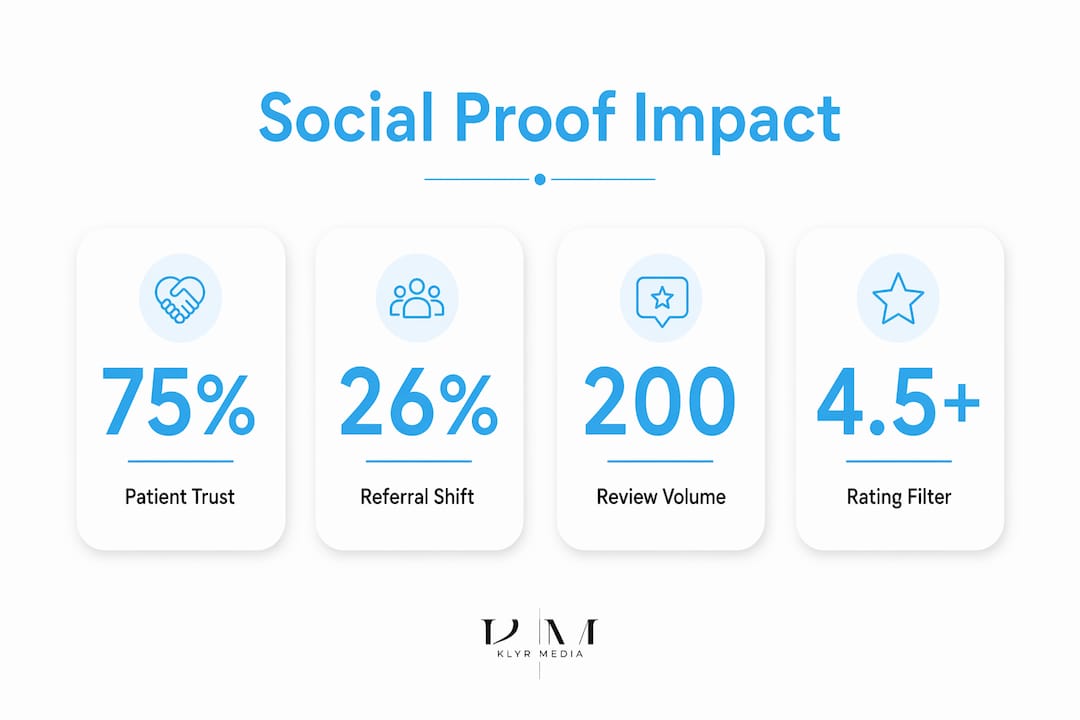
On the clinical side, the effect is equally concrete. A study published in the British Journal of General Practice found that GPs changed their referral inclination in 26% of instances after receiving social proof-enhanced information about a cancer risk algorithm, specifically being told that peers found it useful. That is not a marginal nudge. That is a meaningful shift in clinical behavior driven by peer validation, not additional technical evidence.
| Social proof type | Where it appears | Primary effect |
|---|---|---|
| Patient reviews (Google, Healthgrades) | Search results, practice website | First-impression trust |
| Peer clinician endorsements | CME content, EHR platforms | Clinical tool adoption |
| Video testimonials | Website service pages, social media | Emotional connection, anxiety reduction |
| In-office displays | Waiting rooms, checkout areas | Primes review engagement |
| Review widgets (4.5+ stars) | Service pages, booking pages | Appointment conversion |
Digital tools have made social proof far easier to deploy at scale. Review widgets embedded directly on service pages surface real patient feedback at the exact moment a visitor is deciding whether to book. Provider videos on social media platforms like Instagram or YouTube create parasocial familiarity before a patient walks in the door. AI-powered chatbots can surface relevant testimonials during a website visit, matching the patient’s apparent concern to a peer story that addresses it.
Ethical presentation remains the guardrail throughout. Displaying only a curated selection of glowing reviews without disclosing that filtering occurred is misleading. Patients who discover that a practice hid negative feedback lose trust fast, and that loss is hard to recover.
Best practices for putting social proof to work in your marketing
Placement is the first lever. Embedding review widgets on high-intent pages, specifically service pages and appointment booking pages, consistently outperforms placing testimonials on a standalone “Reviews” page that most visitors never find. Conversion-point placement is where social proof earns its return.
Automation is the second lever. Manually asking patients for reviews is inconsistent and easy to forget. Automated follow-up systems that identify satisfied patients immediately after a visit and send a timely review request produce far higher review volume than ad hoc outreach. The timing matters: a request sent within hours of a positive visit captures the patient while the experience is fresh.
Pro Tip: Balance volume and quality. A practice with 200 reviews averaging 4.2 stars often outperforms one with 15 reviews averaging 5.0 stars in patient perception, because volume signals that the positive experience is repeatable, not a fluke.
HIPAA compliance is non-negotiable throughout this process. Review solicitation systems must never include protected health information in outreach messages. Response templates for public reviews must avoid confirming that the reviewer is a patient. Your team needs to know this cold.
A practical checklist for ethical and effective social proof implementation:
- Filter displayed reviews for relevance and star rating (4.5+ is the standard that maximizes trust without appearing curated to the point of dishonesty)
- Disclose how peer acceptance metrics are generated when using AI-assisted tools
- Train front-desk and clinical staff on how to respond to negative reviews professionally
- Optimize review widgets for mobile, since most patients browse on their phones
- Place in-office signage that acknowledges patient feedback and invites new reviews
- Audit your review profile quarterly to catch and respond to outdated or inaccurate content
Staff training on reputation management is often the piece that gets skipped. A well-placed widget means nothing if a negative review sits unanswered for three months. Patients reading reviews notice response patterns. A practice that replies thoughtfully to criticism signals accountability, which is itself a form of social proof.
What the research actually shows about social proof’s impact
The evidence base here is stronger than most healthcare marketers realize.
The Jindal School study is the clearest data point on the mechanism: peer acceptance information dominates patient decision-making over technical accuracy data when both are presented together. Patients with limited prior experience or lower confidence in describing their symptoms respond most strongly to social proof disclosures. That means the patients who are hardest to reach through clinical messaging are precisely the ones most moved by peer validation.
The GP referral study adds a clinical dimension. A 26% shift in referral inclination after social proof exposure is a result that should get the attention of anyone deploying new clinical decision-support tools. If you want clinicians to adopt a new risk algorithm or digital health platform, peer endorsement from respected colleagues is more persuasive than a feature comparison sheet.
On the practice marketing side, a family clinic that implemented review widgets filtered to 4.5+ stars and placed them on service pages saw a 24% increase in appointment bookings. That is a direct revenue outcome from a relatively simple change in how existing patient feedback was displayed.
The ethical challenge embedded in all of this is real. When peer acceptance is low, patients will reject even highly accurate AI recommendations. That dynamic creates an incentive to inflate or misrepresent peer acceptance data, which is exactly the kind of manipulation that erodes long-term trust. The Jindal School researchers specifically recommend that AI tool designers draw social proof from diverse, representative populations and communicate transparently about how those metrics are generated. For healthcare marketers, the parallel principle is straightforward: show real reviews, respond to all of them, and never manufacture consensus.
Klyrmedia works with independent pharmacies, medical clinics, and healthcare practices across the United States to build HIPAA-compliant digital presences that put social proof where it actually converts. From review widget integration to automated patient follow-up systems, the goal is a reputation-building engine that runs without requiring your staff to manage it manually.
If your practice’s website is not actively surfacing patient feedback at the points where visitors decide whether to book, you are leaving appointments on the table. Klyrmedia’s marketing automation services handle the review solicitation, placement, and compliance layer so your team can stay focused on patient care.
Key Takeaways
Social proof consistently outweighs technical data in shaping patient trust, making peer validation the most powerful tool in a healthcare marketer’s kit.
| Point | Details |
|---|---|
| Peer validation beats technical data | Patients prioritize peer acceptance over AI accuracy, even when algorithm performance is high. |
| Clinical behavior shifts too | GPs changed referral decisions in 26% of cases after social proof exposure to a cancer risk algorithm. |
| Placement drives conversion | Review widgets on service pages, not standalone testimonial pages, produced a 24% appointment booking increase. |
| Automation scales review volume | Automated post-visit follow-up systems generate far more reviews than manual outreach. |
| Ethics and compliance are non-negotiable | HIPAA-compliant review solicitation and transparent disclosure of peer metrics protect both patients and your practice. |

