
Role of pay per click healthcare: a guide for practice owners
Discover the role of pay per click healthcare in boosting patient acquisition. Learn how to leverage PPC for immediate results!

Role of pay per click healthcare: a guide for practice owners

Most healthcare practices are waiting months for SEO to kick in while patients who need their services right now are clicking on a competitor’s ad. That’s the uncomfortable reality. The role of pay per click healthcare advertising plays in patient acquisition is often misunderstood or underestimated. PPC lets your practice appear immediately when someone searches for “urgent care near me” or “cardiologist accepting new patients,” and you only pay when they click. This guide covers how PPC actually works in healthcare, what compliance traps to avoid, and how to build campaigns that bring in the right patients.
Table of Contents
- Understanding pay-per-click advertising in healthcare
- Compliance and regulatory considerations for healthcare PPC campaigns
- Measuring and optimizing PPC performance for patient acquisition
- Differentiating your healthcare PPC strategy for maximum patient impact
- Why effective healthcare PPC requires more than ads and clicks
- How KLYR Media supports your compliant healthcare PPC success
- Frequently asked questions
Key Takeaways
| Point | Details |
|---|---|
| PPC offers immediate patient visibility | Unlike SEO, pay-per-click ads provide instant exposure when patients actively search for healthcare services. |
| Compliance is critical | Healthcare PPC must comply with platform rules, certifications like LegitScript, and HIPAA privacy regulations to avoid risks. |
| Measure performance safely | Use secure tracking methods to attribute patient acquisition without exposing protected health information. |
| Differentiate or lose patients | Generic PPC strategies often fail; tailoring messaging to patient trust and clinical value drives better outcomes. |
| PPC is a practice-wide effort | Successful healthcare PPC involves coordinated marketing strategy, compliance, and patient experience integration. |
Understanding pay-per-click advertising in healthcare
A lot of administrators assume that digital marketing means SEO first and ads later. But the role of pay-per-click in healthcare is fundamentally different from organic search. SEO is a long game. PPC is a faucet you can turn on.
Here’s the basic mechanic: you bid on keywords, your ad appears at the top of search results, and you pay only when someone clicks. No click, no charge. That pay-for-performance model is what makes healthcare PPC advertising so attractive for practices that need patients now, not six months from now.
It’s worth being precise about terminology. PPC is one piece of search engine marketing (SEM). SEM includes paid ads plus other tactics like display and remarketing, while PPC specifically refers to the cost-per-click mechanism. Knowing the difference helps you ask sharper questions when working with any marketing partner.
What makes PPC especially relevant for healthcare providers:
- Patients searching for symptoms or specialists have high intent, meaning they are close to booking
- Google Ads and Microsoft Ads both allow geographic targeting so you can limit spend to your service area
- Ad copy can highlight same-day appointments, insurance acceptance, or specific specialties immediately
- You can pause, adjust, or increase budget in real time based on patient volume needs
- Results are measurable from day one, unlike organic strategies that take time to show data
The immediacy is the point. When a competing hospital or chain clinic runs ads and you don’t, they own that top-of-page real estate while your practice sits unseen.
Compliance and regulatory considerations for healthcare PPC campaigns
Knowing how PPC works is one thing. Running it legally and safely in healthcare is another matter entirely. This is where many practices either give up or make costly mistakes.
Platforms like Google have specific “Healthcare and Medicines” rules that govern what can and cannot be advertised. Certain categories, including addiction treatment, online pharmacies, and some telehealth services, require third-party verification through LegitScript before your ads can run. LegitScript is a certification organization that reviews healthcare advertisers for legitimacy and regulatory compliance. If your practice falls into a regulated category and you skip certification, your ads simply won’t run or will be disapproved without warning.
Beyond platform rules, HIPAA (the Health Insurance Portability and Accountability Act) creates a compliance layer that most general marketers don’t understand. Using tracking technologies on your healthcare website can expose protected health information (PHI) to advertising vendors, which is a HIPAA violation unless you have a Business Associate Agreement (BAA) in place. A BAA is a legal contract that holds vendors accountable for protecting any patient data they touch.
Key compliance checkpoints before launching any healthcare PPC campaign:
- Confirm whether your specialty requires LegitScript certification before submitting ads
- Review your tracking pixels and third-party scripts for PHI exposure risk
- Ensure any vendor who may receive patient data has signed a BAA
- Avoid running condition-specific retargeting ads, which can imply a patient’s diagnosis
- Review landing page content for compliance with platform policies and HIPAA guidelines
Pro Tip: Before you install any new tracking pixel or analytics tool on a healthcare landing page, ask your vendor one direct question: “Will you sign a BAA?” If they say no or don’t know what that means, that’s your answer. Find someone who does.
Understanding these rules is not optional. For more on staying on the right side of the rules, healthcare marketing compliance is a topic worth reviewing in full before you spend a single dollar on ads. And when you’re ready to run campaigns, understanding how to optimize Google Ads for healthcare within these constraints is the next step.
Measuring and optimizing PPC performance for patient acquisition
Now that compliance is on your radar, let’s talk about what actually tells you whether your campaigns are working. Data without context is just noise.

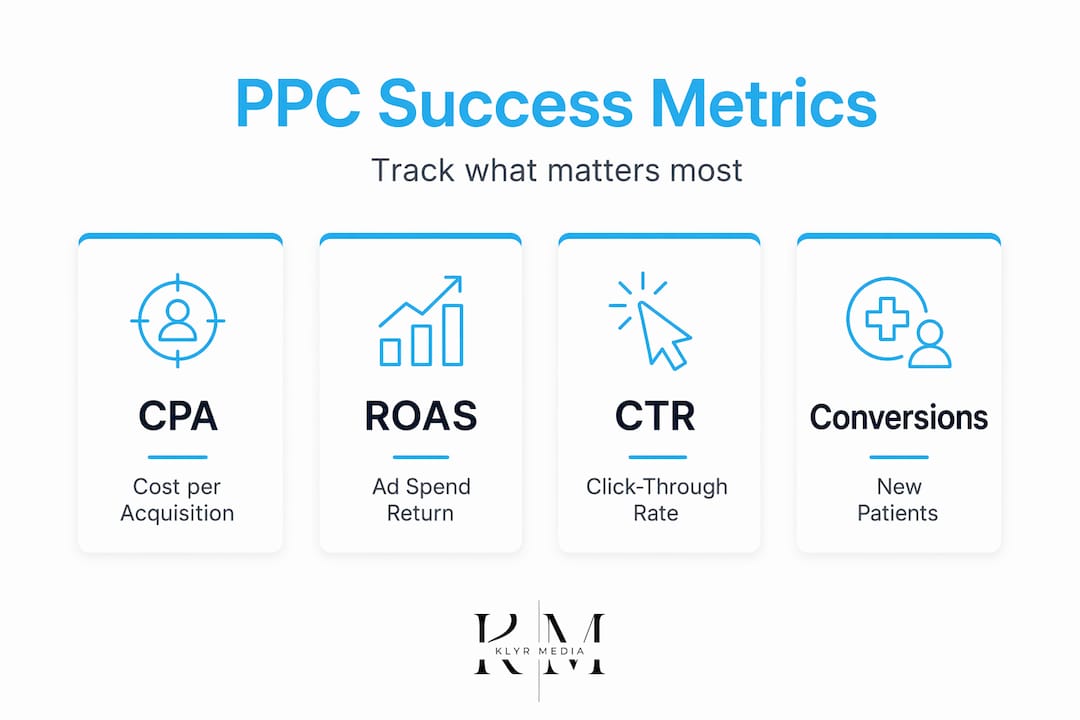
The two metrics that matter most in paid search for healthcare are cost per acquisition (CPA) and return on ad spend (ROAS). CPA tells you how much you spent to acquire one patient or booked appointment. ROAS tells you the revenue generated for every dollar spent. Tracking CPA and ROAS gives practices a clear picture of efficiency and helps justify or reallocate budget.
But here’s the catch: measuring those conversions without creating PHI exposure requires some technical setup. Condition-specific page retargeting using standard pixels is a compliance liability. Safer alternatives include server-side tagging, which processes data on your server before it reaches ad platforms, and offline conversion imports, where appointment booking data is uploaded directly to Google Ads without passing through third-party tracking.
Steps to build a compliant, performance-focused healthcare PPC campaign:
- Define your target patient profile before writing a single ad
- Set up conversion tracking using server-side or offline methods
- Use call tracking numbers that do not expose PHI in your tracking data
- Build dedicated landing pages for each campaign, not generic homepage traffic
- Review search term reports weekly to identify and exclude irrelevant or sensitive queries
- Test ad variations, including headlines and calls to action, on a 30-day rotation
- Adjust bids by time of day to align with when patients actually search and call
Landing page design is often the piece practices overlook. You can have the best-targeted ad in the world, and if your landing page is slow, confusing, or doesn’t clearly show your phone number and availability, patients leave. Website optimization for healthcare is directly tied to your PPC conversion rate. More on healthcare PPC campaign optimization can help you connect those dots.
| Metric | What it measures | Why it matters |
|---|---|---|
| Cost per acquisition (CPA) | Spend divided by conversions | Tells you if patient acquisition is cost-effective |
| Return on ad spend (ROAS) | Revenue divided by ad spend | Measures overall campaign profitability |
| Click-through rate (CTR) | Clicks divided by impressions | Signals ad relevance to your target audience |
| Conversion rate | Conversions divided by clicks | Shows how well your landing page performs |
| Quality Score | Google’s rating of ad relevance | Affects your cost per click directly |
Pro Tip: One often-missed efficiency lever is bid adjustments by device. If your patient data shows most appointment calls come from mobile, increase mobile bids by 20 to 30 percent and reduce desktop bids. Small adjustments like that can meaningfully shift your CPA.
Differentiating your healthcare PPC strategy for maximum patient impact
Measuring results is vital. But you can measure a mediocre campaign all day long and still struggle. The real impact of PPC on healthcare outcomes depends on what you’re saying in your ads, not just how much you’re spending.
Cookie-cutter PPC playbooks consistently underperform because healthcare is contextual. A general surgery practice in rural Montana has fundamentally different patient needs and competitive pressures than a concierge primary care clinic in downtown Chicago. Generic campaigns that push only on proximity and availability miss the factors patients actually weigh when choosing a provider: trust, communication style, specialty depth, and urgency responsiveness.
The most effective PPC strategies for clinics focus on patient value rather than raw volume. Volume-driven campaigns chase clicks. Value-driven campaigns attract the right patients who stay, refer others, and generate sustainable revenue.
Common pitfalls in healthcare PPC that sacrifice quality for quantity:
- Bidding on every possible keyword without excluding irrelevant terms
- Using generic ad copy that could apply to any practice in any city
- Sending all traffic to a homepage instead of a condition-specific landing page
- Ignoring negative keywords, which filter out searches your practice can’t serve
- Measuring success only by click volume, not by actual booked appointments
| PPC model | Focus | Outcome |
|---|---|---|
| Volume-driven | Maximum clicks and impressions | High spend, mixed patient quality |
| Value-driven | Targeted, intent-specific keywords and messaging | Lower volume, higher conversion and retention |
Targeted healthcare advertising built around specific conditions, procedures, or patient demographics consistently outperforms broad campaigns. And when PPC is paired with strong healthcare SEO services, the combined visibility compounds your practice’s presence across both paid and organic results.
Why effective healthcare PPC requires more than ads and clicks
Here’s something most PPC guides won’t say directly: a poorly positioned practice will not be saved by good ad mechanics. If a patient clicks your ad and lands on a website that doesn’t clearly communicate what makes you different, your ad spend is largely wasted. The click cost the same regardless of whether the patient books or bounces.
Healthcare marketing leaders are clear that weak positioning amplified by PPC leads to patient decisions driven by secondary factors like proximity or online reviews rather than genuine preference for your practice. PPC is a traffic tool. It can’t fix unclear messaging or a confusing patient experience once the click happens.
The other thing that doesn’t get enough attention is conversion attribution. Many practices avoid live pixel retargeting on condition-specific pages for good compliance reasons, but then they stop there and lose all visibility into what drove an appointment. That’s not the answer either. Offline conversion imports and call tracking done properly give you meaningful attribution without the PHI exposure risk.
Effective healthcare PPC is a practice-wide effort. It touches your brand messaging, your website, your front desk’s ability to convert a call into a booked appointment, and your compliance team’s awareness of what pixels are active on which pages. Treat it like an isolated ad campaign and the results reflect that. Treat it as an integrated part of your patient acquisition system, and the economics shift in your favor. For a grounded look at how patient engagement and compliance work together in practice, that connection is worth exploring before you finalize any campaign strategy.
How KLYR Media supports your compliant healthcare PPC success
You now have a real picture of what effective PPC in healthcare requires. Not just ads, but compliance-safe tracking, sharp positioning, and a website that converts. That’s a lot to manage alongside running a practice.
KLYR Media was built specifically for this. We help independent clinics and healthcare practices run HIPAA-compliant web design and patient acquisition systems that don’t cut corners on compliance. Our PPC management is built around your specific specialty and patient profile, not a generic template. We also offer marketing automation services that keep patients engaged after the first click, turning ad spend into lasting patient relationships. If you’re ready to see how an end-to-end approach works for your practice, explore our general healthcare solutions and let’s talk.
Frequently asked questions
How does pay-per-click advertising differ from SEO for healthcare practices?
PPC delivers immediate visibility by paying for clicks on ads, while SEO takes months to organically rank and attract traffic without direct per-click payment. Both matter, but PPC is the faster route to new patient acquisition.
What compliance challenges should healthcare providers be aware of when running PPC campaigns?
Providers must meet platform healthcare rules, potentially obtain LegitScript certification for certain categories, and ensure that tracking tools do not expose PHI without a Business Associate Agreement. Skipping these steps creates both legal risk and ad disapproval.
How can healthcare practices measure PPC campaign success without risking HIPAA violations?
By using server-side tagging and offline conversion imports instead of standard pixel tracking, practices can attribute appointments to specific ads without transmitting protected health information to ad platforms.
Why does a cookie-cutter PPC strategy often fail for healthcare providers?
Generic PPC campaigns miss the context and differentiation that healthcare patient decisions actually depend on, including trust and clinical value, which results in lower quality acquisition and wasted ad spend.

