
Stop Overpaying: Patient Acquisition Cost Benchmarks for Practices
2026 patient acquisition cost benchmarks, why fixing conversion beats more ad spend, and a 90 day HIPAA compliant plan to lower costs.

Stop Overpaying: Patient Acquisition Cost Benchmarks for Practices

Patient acquisition cost (PAC) is the average amount your practice spends to land one new patient, and across specialties it typically ranges within the general span observed in the industry. If you remember one thing from this article, remember this: the fastest way to bring that number down isn’t cutting your ad budget. It’s fixing what happens after the phone rings.
TL;DR:
- Improving inquiry-to-appointment conversion rates to around 85 percent can reduce effective patient acquisition cost by up to 27 percent without increasing ad spend.
- Tracking and correcting for call handling issues and implementing online booking can reveal hidden leaks that significantly inflate actual patient acquisition costs.
- Organic search, referrals, and reputation-building are consistently cheaper channels than paid social, especially when call tracking and multi-touch attribution are properly used.
- Focusing on operational improvements like fast follow-up, direct appointment requests, and review generation provides greater cost savings than simply increasing advertising budgets.
- Conducting a 90-day audit and systematically fixing conversion leaks before reallocating budget is the most effective way to lower patient acquisition costs sustainably.
Table of Contents
- How to Calculate Patient Acquisition Cost (Nominal and Effective)
- Patient Acquisition Cost Benchmarks by Specialty and Practice Type
- Patient Acquisition Cost by Marketing Channel
- Why Conversion Rate Beats Ad Spend as a Cost Lever
- A 90-Day Roadmap to Lower Patient Acquisition Cost
- The KPIs That Keep Patient Acquisition Cost Honest
- How These Patient Acquisition Cost Benchmarks Were Compiled
- How Klyrmedia Approaches Measuring and Lowering PAC
- Why Most PAC Advice Gets the Priority Backwards
- Ready to Lower Your Patient Acquisition Cost?
- Sources
How to Calculate Patient Acquisition Cost (Nominal and Effective)
Most practice managers calculate PAC the simple way and stop there. That’s the mistake. The nominal formula is straightforward: total marketing and sales costs divided by new patients acquired. Spend $8,000 in a month and bring in 20 new patients, and your nominal PAC is $400.
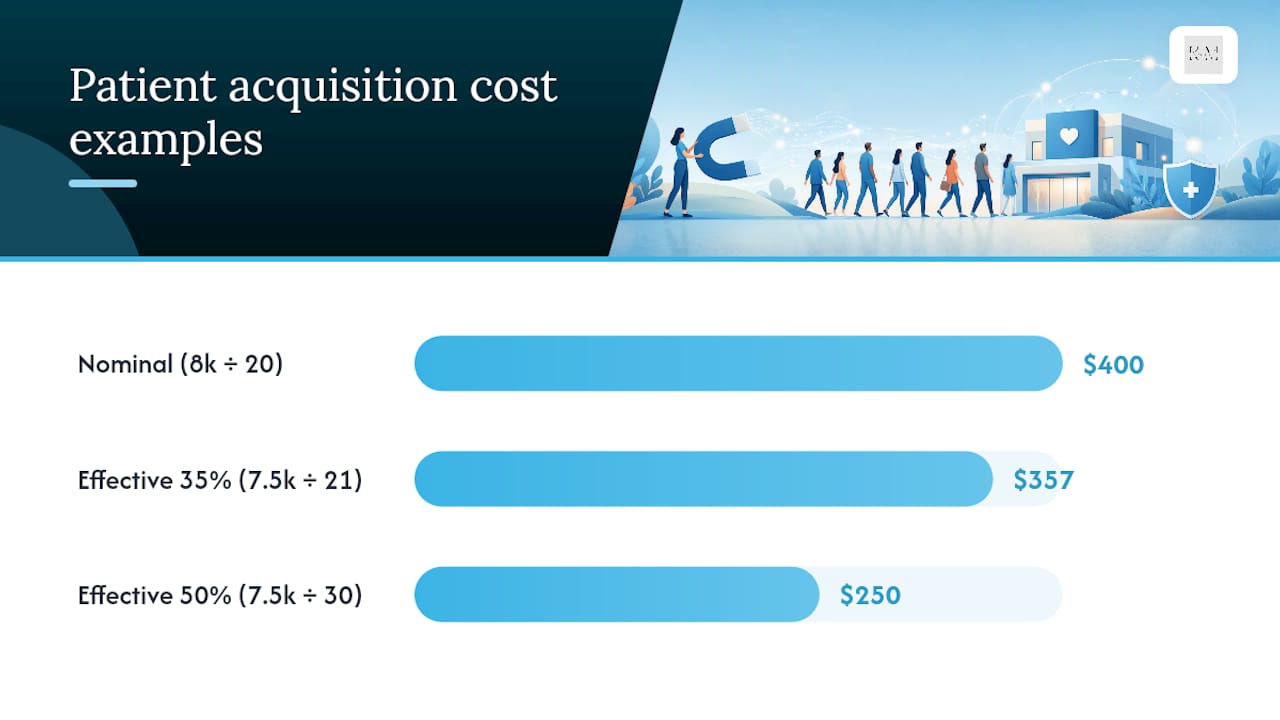
But that number lies to you if your front desk is dropping calls. The effective PAC formula corrects for that: marketing spend divided by (inquiries multiplied by conversion rate). If you generated 100 inquiries at a 40% conversion rate, that’s 40 new patients, not 20, and your effective PAC tells you what’s actually achievable versus what you’re leaving on the table.
Before you calculate either number, make sure you’re counting every real cost, not just the obvious ones:
- Paid advertising spend (Google Ads, social, directories)
- Staff time spent on intake calls, scheduling, and follow-up
- Software and CRM subscription costs allocated to acquisition
- Agency or freelancer fees for campaign management
- Directory listing and reputation-management fees
- Creative production costs (photography, video, ad copy)
Here’s a worked example. A dermatology practice spends $6,000 on Google Ads, pays $1,200 in staff time for intake handling, and $300 for a CRM tool, for a total of $7,500. That spend generates 60 inquiries. At a 35% conversion rate, that’s 21 new patients. Effective PAC: $7,500 ÷ 21 = $357. Push conversion to 50% with no added spend, and effective PAC drops to $250. Same budget, radically different outcome.
Patient Acquisition Cost Benchmarks by Specialty and Practice Type
Numbers without context are useless, so here’s the context. Across specialties, the mean PAC sits around $370, but that average hides a widespread variance driven by procedure value, sales cycle length, and how competitive the local market is.
Practice type matters as much as specialty. A solo primary care practice usually lands on the lower end of its category because referrals and word of mouth do heavy lifting. A multi-location dental group typically pays more per patient because it’s running paid campaigns across multiple markets simultaneously, often with less local trust built up in each one. Elective and cosmetic practices sit at the top of the range across the board, since the sales cycle is longer and the competition for high-value procedures is fierce.
Now the part that should change how you budget. Cross-specialty analysis shows that pushing inquiry-to-appointment conversion up to roughly 85% cuts effective PAC by 19% to 27%, with no increase in ad spend.
Patient Acquisition Cost by Marketing Channel
Not every dollar you spend costs the same in the end, and channel choice is a big reason why.
Organic search and referrals consistently run cheaper over time because you’re not paying per click for patients who already trust you or already found you through a search that signals real intent. Paid social tends to cost more per patient because it interrupts rather than answers a question someone was already asking.
A few things distort these numbers if you’re not careful:
- Call volume rarely gets tracked properly, so channels that drive phone calls look artificially expensive on a spreadsheet that only counts web form fills.
- Multi-touch attribution matters. A patient who found you on Google, then converted after a Facebook retargeting ad, gets miscredited to whichever channel your software defaults to.
- Directory fees often get buried in a general “marketing” line, which understates true directory-channel PAC.
If you’re running paid search without call tracking layered underneath, you genuinely don’t know your real numbers. Half your conversions might be phone calls your dashboard is blind to. A detailed guide on optimizing Google Ads for healthcare walks through how to fix that gap specifically for HIPAA-sensitive campaigns.
Why Conversion Rate Beats Ad Spend as a Cost Lever
Here’s the math most practices never run. Say you spend $10,000 a month and generate 100 inquiries. You didn’t spend a dollar more. You just stopped losing patients you already paid to reach.
Statistically, that conversion swing is worth more than most practices’ entire quarterly ad increase. Most PAC bloat traces back to three operational failures, not a weak campaign: slow follow-up on inquiries (anything past five minutes and interest cools fast), intake staff reading from scripts that sound like a hostage negotiation instead of a conversation, and no online booking option for patients who’d rather click than call during business hours.
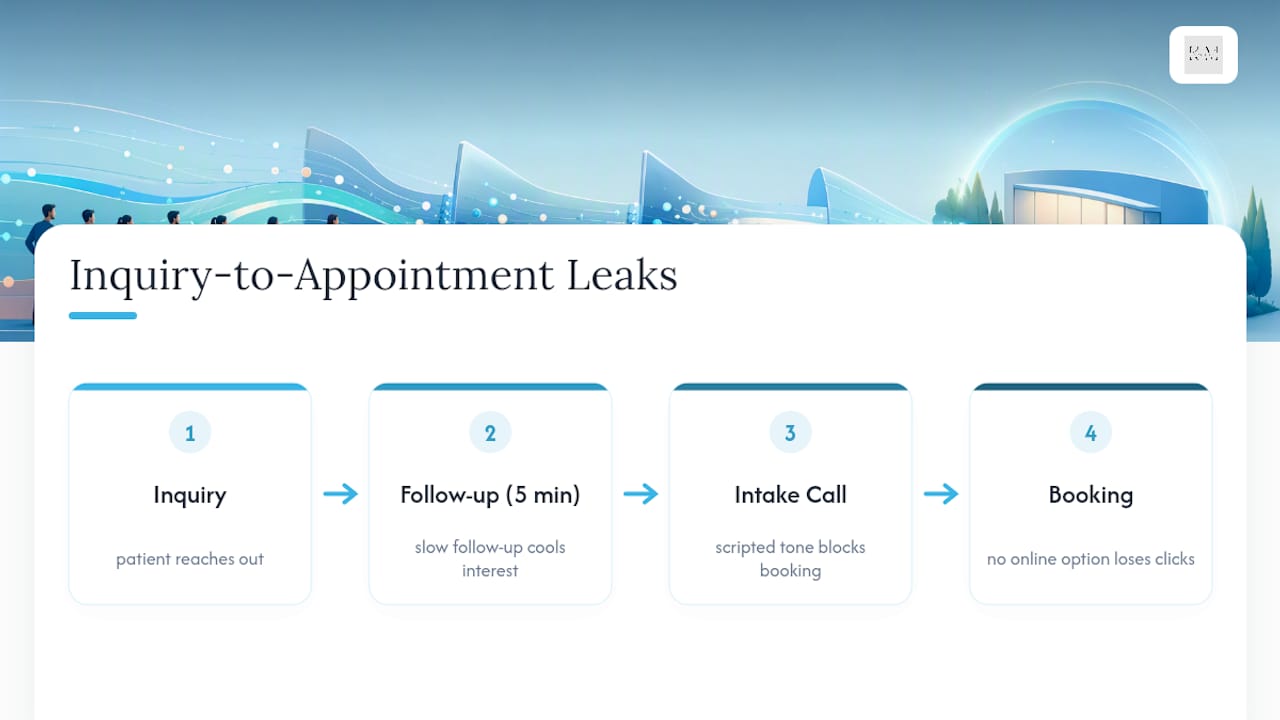
Call tracking paired with same-day response produces an outsized return specifically for urgent-care and specialty channels, where a patient in pain isn’t going to wait around for a callback tomorrow.
Pro Tip: Record and review ten of your front desk’s inquiry calls this month. You’ll almost always find the leak in the first sentence, either a rushed tone or a failure to ask for the appointment directly.
A 90-Day Roadmap to Lower Patient Acquisition Cost
Reducing PAC isn’t one big move. It’s a sequence, and the order matters more than the tactics themselves.
Fix conversion first, because it’s free:
- Audit your call handling and fix response time before touching your ad budget
- Add or fix online booking so patients aren’t forced to call during business hours
- Rewrite intake scripts to ask for the appointment directly instead of just answering questions
Then work channel by channel:
- Tighten PPC targeting to cut wasted clicks that never converge into real inquiries
- Invest in local SEO and Google Business Profile optimization since organic channels compound in value over time instead of resetting every month
- Build a review-generation habit, since reputation directly affects both click-through rate and conversion rate on paid channels
Reduce total acquisition pressure through retention:
- Run a reactivation campaign for lapsed patients, who convert faster and cheaper than cold inquiries
- Consider a membership or recall program for specialties with predictable return visits
The roadmap itself: weeks 1 through 3, audit call handling and booking friction. Weeks 4 through 8, fix the leaks you found and start A/B testing intake scripts. Weeks 9 through 12, reallocate saved budget into the channel that showed the best effective PAC, and scale it.
The KPIs That Keep Patient Acquisition Cost Honest
PAC by itself can mislead you if you’re not watching the numbers feeding into it. Track these alongside it:
- Inquiries and inquiry-to-appointment conversion rate, since a low conversion rate is usually the real problem hiding behind a “high PAC”
- Appointment show rate, because a booked appointment that no-shows still cost you money
- Cost per lead (CPL), which tells you funnel-top efficiency separately from conversion efficiency
- Lifetime value (LTV) and the LTV:PAC ratio, with roughly 3:1 treated as a healthy target by most practice finance guides
Instrument this with call tracking, UTM parameters on every campaign link, a booking-source field in your CRM, and a system that ties completed revenue back to acquisition channel.
How These Patient Acquisition Cost Benchmarks Were Compiled
The specialty and channel ranges above draw on industry benchmark syntheses from 2026, aggregated across platform data and practice-reported figures rather than a single proprietary survey.
A few honest caveats:
- Specialty variance is real. A rural pediatric practice and an urban cosmetic clinic aren’t playing the same game, even inside the same national average.
- Local competition intensity moves PAC more than most national benchmarks admit. Two dermatology practices ten miles apart can have wildly different numbers.
- Clinical trial recruitment costs are a different animal entirely, ranging from $143 to over $11,000 per patient depending on therapeutic area. Don’t benchmark your outpatient PAC against trial recruitment economics.
To build your own benchmark, pull 90 days of spend and new-patient counts by channel, then normalize by treatment mix and payer mix before comparing yourself to any national figure.
How Klyrmedia Approaches Measuring and Lowering PAC
Klyrmedia builds HIPAA-compliant tracking into every campaign we manage for healthcare clients, because call attribution and CRM integration touch patient data the moment a phone rings. That means call tracking, source attribution, and CRM fields that actually tie back to revenue, not just clicks.
The first 90-day engagement we recommend to any new practice client starts exactly where this roadmap does: audit conversion before touching spend.
Why Most PAC Advice Gets the Priority Backwards
Most PAC guidance out there is really ad-spend guidance wearing a different name. It talks you through channel selection, bid strategy, targeting refinements, all useful, all secondary. The research here points somewhere else: conversion rate moves effective PAC further and faster than almost any spend adjustment you can make, and it costs you nothing but attention.
The conventional advice tells you to chase cheaper clicks. The better advice tells you to stop losing the patients you already paid to reach.
If you’re a practice owner reading this wondering where to start, start with your own call recordings, not your campaign dashboard. The benchmarks in this article matter, but they’re a mirror, not a strategy. Use them to see where you stand, then fix the conversion leak before you touch the spend.
— Opinly
Ready to Lower Your Patient Acquisition Cost?
Some agencies work with independent practices instead of large hospital systems, so strategies fit call volume, staff size, and local markets rather than using generic national templates. The measurement layer can include HIPAA-compliant tracking, call attribution, and CRM integration that ties every new patient back to a real source.
A typical engagement might start with a 90-day audit covering intake handling, booking friction, and channel spend, followed by a prioritized roadmap of quick wins before any budget reallocation happens. That may include HIPAA-compliant website design with secure booking forms and healthcare SEO services designed to reduce long-term PAC through organic visibility rather than increasing ad spend. If you’re ready to see where your practice’s real conversion leak is, request an audit and we’ll show you the numbers before we recommend a single dollar of spend.
Sources
- Patient Acquisition Cost: Benchmarks, Variables, and the Conversion Optimization Opportunity
- Patient acquisition cost: How to calculate and lower your CAC
- How to reduce your patient acquisition costs
- HIPAA information

