

Medical Website Design: A 2026 Guide for Providers

Medical website design is the practice of building secure, patient-centered, and regulatory-compliant websites specifically for healthcare providers, clinics, pharmacies, and medical practices. Unlike general web design, this discipline requires HIPAA compliance, SSL encryption, signed Business Associate Agreements (BAAs), and patient portal integration as baseline requirements. The industry term is healthcare website design, and it covers everything from UX architecture to clinical system integration. Google classifies healthcare sites as “Your Money or Your Life” (YMYL) content, meaning E-E-A-T standards directly affect your search rankings and patient trust. If your website does not meet these standards, you are losing patients before they ever call.
What is medical website design and why does it matter?
Medical website design is clinical infrastructure, not just a digital brochure. A poorly built healthcare site creates legal liability, operational inefficiency, and lost patient volume. Think of it this way: your website is often the first clinical touchpoint a patient has with your practice. If it feels confusing, slow, or untrustworthy, they leave. That is revenue that never walked in.
The core purpose of healthcare website design is to serve three masters simultaneously: the patient who needs clear, accessible information; the provider who needs operational tools like scheduling and EHR integration; and the regulator who requires documented compliance. Most general web designers only think about the first one. That gap is exactly where practices get into trouble.

Healthcare providers in the United States operate under federal HIPAA regulations, ADA accessibility requirements, and increasingly strict search engine quality guidelines. A site that ignores any one of these three areas will underperform, regardless of how good it looks. This is why specialized medical website development exists as its own discipline.
What features and compliance standards set medical sites apart?
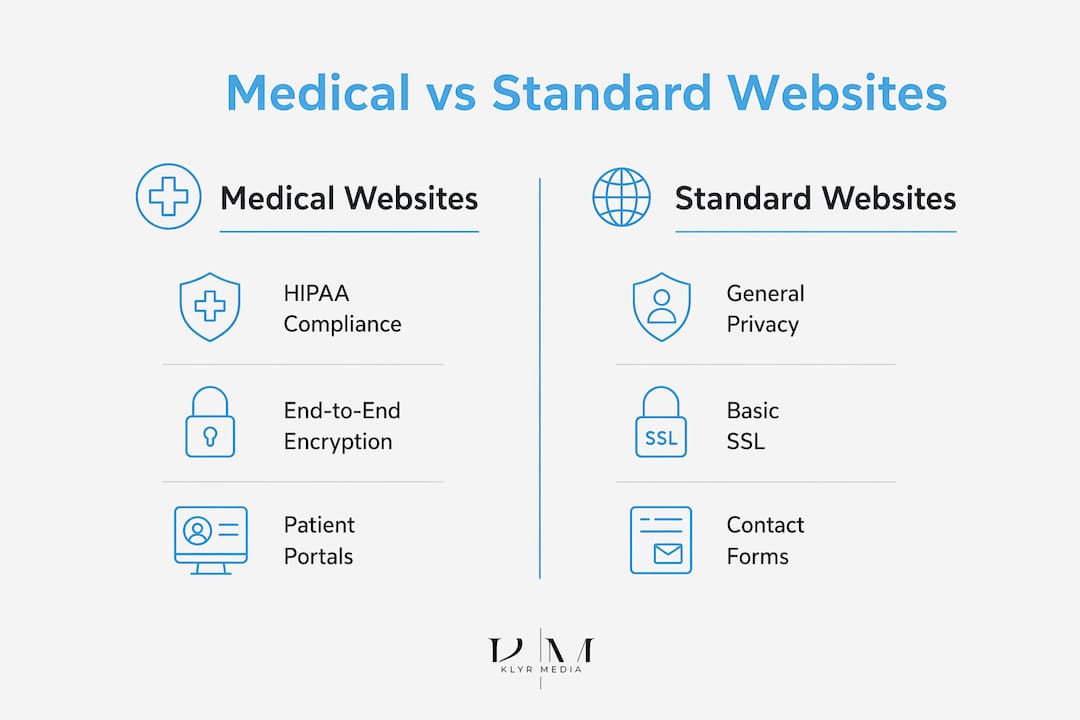
The technical and legal requirements for a compliant healthcare website go well beyond what a standard business site needs. Here is what separates a medical website from everything else:
- HIPAA compliance: Any site collecting, transmitting, or storing Protected Health Information (PHI) requires signed BAAs with every third-party vendor that touches that data, including your form builder, chat tool, and analytics platform.
- SSL/TLS encryption: End-to-end encryption is mandatory for all data transmission. An SSL certificate is the floor, not the ceiling.
- Role-based access controls: Staff members should only access the patient data their role requires. This limits breach exposure and satisfies HIPAA’s minimum necessary standard.
- ADA accessibility: Section 508 and WCAG 2.1 guidelines require screen reader compatibility, sufficient color contrast, keyboard navigation, and alt text on all images.
- Patient portals: Secure portals allow patients to view records, request refills, and message providers without using unsecured email.
- EHR/EMR integration: Connecting your website to systems like Epic, Athenahealth, or DrChrono creates a unified workflow. EHR integration reduces administrative burden and makes the patient experience feel connected rather than fragmented.
- Secure contact forms: Standard HTML forms are not HIPAA-compliant. You need encrypted, BAA-covered form solutions.
Pro Tip: Before signing with any web vendor, ask for a copy of their BAA and confirm they support end-to-end encryption for all form submissions. If they cannot produce a BAA, they cannot legally handle PHI on your behalf.
The HIPAA compliance requirements for medical websites are documented and enforceable. Violations carry fines ranging from $100 to $50,000 per violation. That is not a risk worth taking to save money on a cheaper developer.
How does medical website design improve patient experience?
Patients visiting your website are often anxious, in pain, or confused about their care options. Empathetic UX design acknowledges that reality and removes friction at every step. The goal is not to impress visitors with flashy design. The goal is to get them to book an appointment without frustration.
Mobile-first design is non-negotiable
Most patients search for healthcare providers on their phones. A mobile-first approach to booking flow optimization produced a 42% rise in mobile conversions for one healthcare website. That number reflects a real pattern: when booking is easy on a phone, patients follow through. When it is not, they call a competitor.
Mobile-first design means your navigation collapses cleanly, your CTAs are thumb-friendly, your forms auto-fill where possible, and your page loads in under three seconds. These are not nice-to-haves. They are conversion requirements.
Design elements that build trust
Visual design in healthcare carries more weight than in most industries. Patients are making decisions about their health, so credibility signals matter enormously. Here are the elements that move the needle:
- Clear, prominent CTAs: “Book an Appointment” or “Request a Refill” should be visible without scrolling on every key page.
- Provider profiles with photos and credentials: Patients want to know who they are seeing. A photo and a brief bio reduce anxiety and increase booking rates.
- Whitespace and clean layouts: Cluttered pages feel chaotic. Clean layouts feel trustworthy. This is especially true for older patients or those with cognitive challenges.
- Accessible color choices: High-contrast color schemes help patients with visual impairments and satisfy ADA requirements at the same time.
- Readable typography: Body text should be at least 16px. Medical content is dense; small fonts increase abandonment.
Pro Tip: Run usability tests with actual patients, not just your staff. A/B test your appointment booking flow with two different CTA placements and measure which version produces more completed bookings over a 30-day period.
Medical website design vs. standard business website design
The differences between healthcare website design and general web design are not cosmetic. They are structural, legal, and strategic.
| Factor | Medical Website Design | Standard Business Website Design |
|---|---|---|
| Regulatory compliance | HIPAA, ADA, WCAG 2.1 required | No mandatory compliance framework |
| Data security | End-to-end encryption, BAAs, role-based access | Basic SSL sufficient for most use cases |
| Content standards | YMYL classification, E-E-A-T required by Google | Standard content quality guidelines apply |
| System integration | EHR, EMR, patient portals, billing systems | CRM, e-commerce, or email tools |
| Design stakes | Patient safety and care access affected by UX | Revenue and brand perception affected by UX |
| SEO complexity | Local SEO plus clinical content authority | Standard keyword and technical SEO |
| Legal liability | Non-compliance risks federal fines | Minimal legal exposure from design choices |
The stakes in healthcare web design are categorically higher. A confusing checkout on a retail site costs a sale. A confusing booking flow on a medical site can delay care. That is why investing in specialized web design for healthcare is not optional for practices that take patient outcomes seriously.
General web designers are not trained to think about HIPAA, BAAs, or clinical system integration. They build beautiful sites that create compliance gaps. Those gaps become your legal problem, not theirs.
Best practices for medical websites that drive patient acquisition
A well-built healthcare website does more than satisfy regulators. It actively grows your practice. Here are the practices that produce measurable results:
-
Build local SEO into your content architecture. Healthcare sites that rank well typically include 100 or more locally optimized pages targeting non-branded search queries. Each service you offer, each condition you treat, and each neighborhood you serve deserves its own page. This is how you capture patients searching “urgent care near me” or “pharmacy in [city].”
-
Add schema markup to every key page. Schema markup tells search engines exactly what your page contains, whether that is a physician profile, a service description, or a location. Combined with Core Web Vitals optimization, schema and page speed are the two technical levers with the highest SEO return for healthcare providers.
-
Publish transparent, medically accurate content. Google’s E-E-A-T framework rewards sites where real clinicians author or review content. Include author bylines with credentials, cite reputable sources, and update content regularly. This builds both search authority and patient trust.
-
Integrate online scheduling directly into your site. Do not send patients to a third-party booking page. Keep scheduling on your domain, connected to your EHR, so the experience feels unified. Every redirect is a drop-off risk.
-
Optimize your website for conversions continuously. Page speed, form length, and CTA placement all affect how many visitors become booked patients. Treat your website like a living system, not a finished product.
-
Use provider profiles as trust anchors. A detailed profile with a photo, credentials, specialties, and patient reviews reduces the perceived risk of choosing a new provider. Practices that feature strong provider profiles consistently see higher first-appointment booking rates.
Pro Tip: You can maintain full HIPAA compliance and still run conversion rate experiments. Use a BAA-covered analytics platform like Google Analytics 4 with IP anonymization enabled, and never pass PHI through your tracking parameters.
Key takeaways
Effective medical website design requires compliance, clinical integration, and patient-centered UX working together as a single system.
| Point | Details |
|---|---|
| Compliance is the foundation | HIPAA, ADA, and signed BAAs are non-negotiable requirements, not optional upgrades. |
| Patient UX drives revenue | Simplified booking flows and mobile-first design directly increase appointment conversions. |
| YMYL classification raises the stakes | Google holds healthcare sites to E-E-A-T standards, making content quality a ranking factor. |
| EHR integration matters | Connecting your site to clinical systems reduces admin burden and improves patient experience. |
| Local SEO is a growth engine | Locally optimized service pages capture patients actively searching for nearby care. |
The part most healthcare providers get wrong
Here is something I have seen repeatedly: a clinic spends $8,000 on a beautiful new website, and six months later they are wondering why new patient volume has not moved. The site looks great. It just does not work.
The mistake is treating medical website design as a visual project. It is not. It is a systems project. The design is the last 20% of the work. The first 80% is architecture: HIPAA-compliant infrastructure, EHR integration, local SEO structure, schema markup, and a content strategy built around what patients actually search for.
I have also seen the opposite problem: practices so focused on compliance that their site feels like a legal document. Patients do not read legal documents. They scan for the information they need, and if they cannot find it in seconds, they leave. The real skill in healthcare website design is holding both truths at once. Your site must be airtight from a compliance standpoint and genuinely easy to use for someone who is scared or in pain.
The other thing worth saying: not every web agency can do this well. General web developers are not trained in HIPAA requirements, and healthcare-specific developers are not always strong on conversion design. When you are evaluating partners, ask for examples of HIPAA-compliant sites they have built, and ask specifically how they handle BAAs with their tooling stack. The answer will tell you everything.
— Opinly
How Klyrmedia builds compliant, high-performing healthcare websites
If you are a clinic, independent pharmacy, or medical practice trying to compete with larger chains, your website is one of the most important tools you have. Klyrmedia specializes in HIPAA-compliant website design built specifically for healthcare providers across the United States.
Klyrmedia handles the full stack: secure infrastructure with signed BAAs, EHR integration, local SEO architecture, and conversion-optimized design that turns website visitors into booked patients. The agency also offers marketing automation that connects directly to your website, so patient follow-up happens automatically without adding to your team’s workload. If your current site is not bringing in new patients consistently, that is a solvable problem.
FAQ
What is medical website design?
Medical website design is the process of building secure, HIPAA-compliant, and patient-centered websites for healthcare providers. It includes regulatory compliance, clinical system integration, and UX design tailored to patient needs.
How is a medical website different from a regular business website?
Medical websites require HIPAA compliance, signed BAAs, end-to-end encryption, and ADA accessibility standards that standard business websites do not. They also integrate with EHR and EMR systems and must meet Google’s E-E-A-T content standards.
What are the essential features of a medical website?
The core features include a secure patient portal, HIPAA-compliant contact forms, online appointment scheduling, provider profiles, mobile-first design, and EHR integration. These top healthcare website features directly affect both compliance and patient conversion rates.
Does my healthcare website need to be hipaa-compliant?
Yes, if your website collects, transmits, or stores any Protected Health Information. This includes contact forms, appointment requests, and chat tools. Every vendor that handles PHI must sign a BAA.
How does medical website design affect my search rankings?
Google classifies healthcare content as YMYL, which means your site is held to higher E-E-A-T standards. Sites with credentialed authors, locally optimized pages, schema markup, and fast load times consistently rank higher and attract more organic patient traffic. Learn more about healthcare SEO strategy to understand how search and design work together.

