

Medical SEO Step by Step: A 2026 Guide for Providers

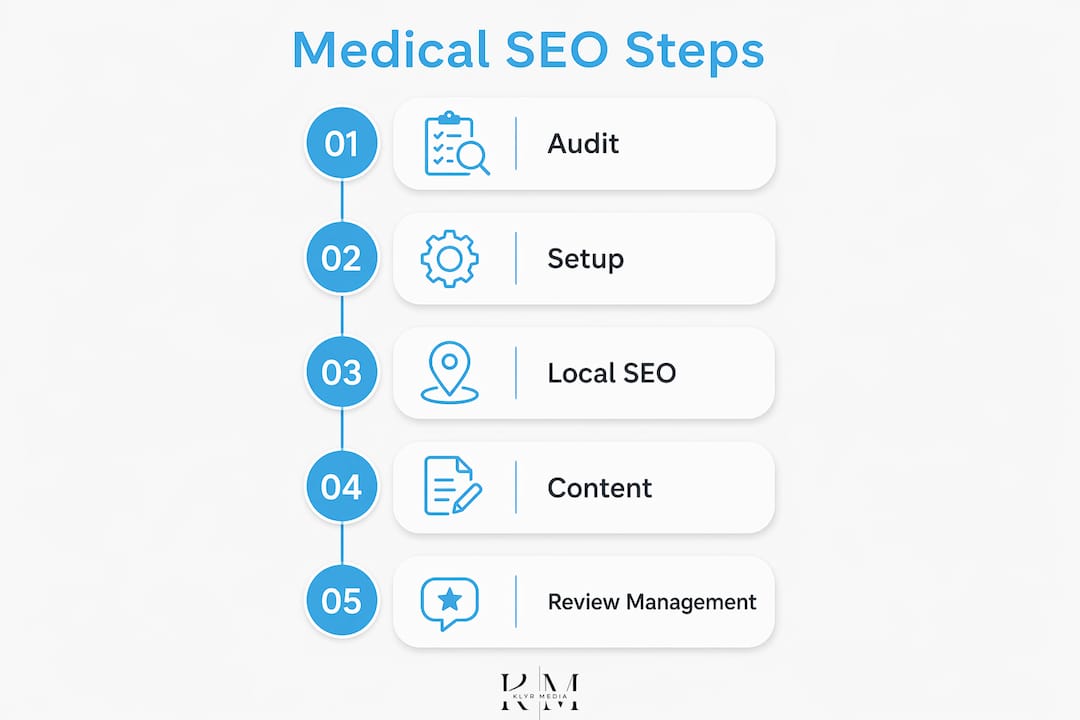
Medical SEO step by step is the systematic process healthcare providers use to build search engine visibility, attract local patients, and grow appointment volume through organic search. 77% of patients use search engines to find a provider before ever picking up the phone. That single fact should change how you think about your website. A structured approach to SEO for healthcare websites is not optional anymore. It is the difference between a full schedule and a waiting room that never fills up.
What prerequisites do you need before starting medical SEO?
Before you touch a single keyword, you need a clean foundation. Skipping this step is the most common reason medical SEO programs stall after three months.
Start with a HIPAA compliance audit of your tracking stack. PHI exposure through analytics is a legal risk that outweighs any SEO gain. Tools like Google Analytics 4 can capture form data, appointment details, or IP addresses in ways that violate HIPAA if not configured correctly. Audit every pixel, tag, and form on your site before you start driving more traffic to it.

Next, set up or audit your Google Business Profile (GBP). Claim it, verify it, and confirm that your Name, Address, and Phone number (NAP) match exactly across every healthcare directory where your practice appears. Directories like Healthgrades, Zocdoc, and WebMD are the ones that matter most for medical practices.
Then build your technical infrastructure:
- XML sitemap: Submit it to Google Search Console so search engines can crawl your pages efficiently.
- Robots.txt: Block admin pages, patient portal URLs, and any pages that could expose sensitive data.
- Schema markup plan: Identify which schema types you will deploy. MedicalClinic, Physician, and LocalBusiness are the three you need from day one.
- Keyword research tools: Use Google Search Console, Google Keyword Planner, or similar platforms to identify the terms patients actually search.
- Editorial calendar: Assign named clinician reviewers to every content piece before publishing. This is not optional for E-E-A-T compliance.
Pro Tip: Set up a dedicated analytics property with IP anonymization and form field exclusions before you launch any SEO campaign. One misconfigured tag can create a HIPAA liability that no ranking is worth.
How do you build the technical and local SEO foundation?
Local SEO accounts for over 70% of new patient inquiries for medical practices. That means your Google Business Profile and local citation network are not supporting players. They are the main event.
Deploy the right schema markup
Schema markup tells search engines exactly what your practice is, who works there, and what conditions you treat. Deploy these three schema types in this order:
- LocalBusiness schema with your practice name, address, phone, hours, and geo-coordinates.
- MedicalClinic schema with specialty, accepted insurance types, and service area.
- Physician schema for each provider, linked to their NPI registry number, state board listing, and hospital affiliations. Structured Physician schema linked to authoritative sources is how search engines verify your credibility. It is not cosmetic. It is the infrastructure that makes E-E-A-T real.
Build location pages that actually convert
Each physical location needs its own dedicated page. Not a copy-paste template with the address swapped out. Each page needs unique content: local landmarks, neighborhood context, provider bios specific to that location, and patient reviews from that office. Thin location pages are one of the fastest ways to get filtered out of local search results.
Treat your Google Business Profile as an acquisition engine
A fully optimized GBP with photos, Q&A, and active review management drives significantly more patient inquiries than a static or incomplete profile. Update your hours for holidays, post weekly updates, and answer every question in the Q&A section within 24 hours.
Review management is not a “nice to have.” Responding to all sub-4-star reviews within 48 hours directly influences local pack rankings and patient trust. Set a calendar reminder. Make it a protocol, not a reaction.
Pro Tip: Add at least 10 photos to your GBP: exterior, interior, staff headshots, and exam rooms. Profiles with photos consistently outperform those without in local pack visibility.
How do you build content that earns topical authority?
The 2026 healthcare SEO environment has shifted. Building comprehensive topical authority across an entire specialty now outperforms targeting individual keywords. Think of it as covering a subject so thoroughly that Google has no reason to send patients anywhere else.
Here is how to build that content library:
- Specialty-specific clinical pages: Cover every condition you treat, every procedure you offer, and every symptom that leads patients to your door. A cardiology practice should have pages on chest pain, arrhythmia, heart failure, stress testing, and echocardiography. Not one generic “heart health” page.
- Patient-facing question content: Medical content performs best when it answers questions patients are too embarrassed or scared to ask out loud. “Will this procedure hurt?” “How long until I feel normal?” “What happens if I don’t treat this?” These are the pages that build trust before a patient ever calls.
- Named author reviewers: Every page needs a named clinician reviewer with credentials, a headshot, and a link to their professional profile. Anonymous medical content fails E-E-A-T review.
- FAQPage and MedicalCondition schema: Chain these schema types to your Physician schema so search engines can verify the entire content graph, not just individual pages.
- Transparent provider information: List credentials, board certifications, and hospital affiliations on every provider bio. Include pricing ranges where appropriate and before/after information for elective procedures.
The content timeline breaks into three phases. Months 0–3 focus on foundations: technical setup, core service pages, and GBP optimization. Months 3–6 shift to content compounding: publishing 40–80 pages that expand your specialty coverage. Months 6–12 target authority scale: earning citations in trusted health publications, building digital PR, and refining based on performance data.
Pro Tip: Write one “hub” page per specialty that links out to all related condition and procedure pages. This internal linking structure signals topical depth to search engines and keeps patients on your site longer.
What are the most common pitfalls in medical SEO?
Healthcare is classified by Google as YMYL content, meaning “Your Money or Your Life.” Generic SEO tactics that work for e-commerce or local restaurants will get your medical site penalized, not ranked.
Watch for these specific mistakes:
- PHI in analytics: Review every form submission path. If a patient types their name and condition into a contact form, and your analytics tool captures that data, you have a HIPAA problem. Configure form field exclusions before launch.
- Boilerplate location pages: Duplicate content across location pages is one of the fastest ways to lose local rankings. Each page must be genuinely unique.
- Paid ad promises disguised as SEO: Organic medical SEO takes 9–12 months to show meaningful ROI. Anyone promising results in 60 days is running paid ads and calling it SEO.
- Ignoring review management: A cluster of unanswered 2-star reviews signals to both patients and Google that your practice does not care about feedback. Respond to every negative review within 48 hours, professionally and without disclosing any patient information.
- Multi-state telehealth schema errors: If you practice across state lines, your schema must reflect the correct jurisdictional service areas. Incorrect location data in schema confuses search engines and can suppress your rankings in the states where you are licensed.
- Uncontrolled AI indexing: Use a llms.txt file to control how AI large language models index and represent your content. This is a 2026 best practice that most practices have not implemented yet.
Healthcare SEO is not a marketing channel you can shortcut. The same quality standards that protect patients in clinical care apply to the content you publish online. Low-quality pages do not just fail to rank. They actively damage the trust patients place in your practice before they ever walk through the door.
How do you measure success and keep improving?
Tracking the right metrics separates practices that grow from those that spin their wheels. Appointment requests from organic search is your north star metric. Everything else supports it.
| KPI | What to track | Why it matters |
|---|---|---|
| Organic appointment requests | Form submissions and call tracking from non-paid search | Direct measure of SEO revenue impact |
| GBP insights | Profile views, direction requests, and call clicks | Shows local search visibility and patient intent |
| Local pack rankings | Position for core service + city keyword combinations | Indicates competitive standing in your market |
| Review velocity | New reviews per month and average star rating | Influences both rankings and patient conversion |
| Organic traffic by page | Sessions and engagement rate per service page | Identifies content gaps and top performers |
Set up a monthly reporting cadence. Review GBP insights, organic traffic trends, and review scores together. They tell a connected story. A drop in GBP calls often traces back to a review score decline or a competitor adding new photos and posts.
Digital PR is the accelerator most practices ignore. Earning citations in publications like Healthline, WebMD, or local news outlets builds the kind of authority that schema alone cannot create. Pitch your providers as expert sources for health stories. One citation in a trusted health publication can move rankings faster than 10 new blog posts.
Pro Tip: Set a Google Alert for your practice name and your top providers. When you appear in a publication that does not link back to your site, reach out and request a link. Most editors will add it.
Key Takeaways
Medical SEO for healthcare providers succeeds when technical compliance, local infrastructure, and topical content authority are built in sequence, not in parallel.
| Point | Details |
|---|---|
| HIPAA audit comes first | Audit your analytics tracking stack before driving any new traffic to avoid PHI exposure. |
| Local SEO drives most leads | Over 70% of new patient inquiries come from local search, making GBP optimization non-negotiable. |
| Content needs named reviewers | Every clinical page requires a credentialed author or reviewer to satisfy E-E-A-T standards. |
| ROI takes 9–12 months | Organic search growth is not fast. Set realistic expectations and track appointment requests, not just traffic. |
| Review response is a ranking signal | Responding to sub-4-star reviews within 48 hours improves both local rankings and patient trust. |
What I have learned from running medical SEO programs
The practices that see the biggest gains are almost never the ones with the biggest budgets. They are the ones that build the foundation correctly before publishing a single blog post.
The most common mistake I see is practices that rush into content production before their technical infrastructure is solid. They publish 30 pages in 90 days, none of them reviewed by a named clinician, no schema deployed, GBP half-complete. Then they wonder why nothing ranks. The answer is that search engines cannot verify who wrote the content, where the practice is located, or whether the information is trustworthy.
E-E-A-T is not a checklist item. It is an architecture. Physician schema linked to NPI registry data, content reviewed by board-certified providers, location pages with genuine local context. These elements work together. Pull one out and the whole structure weakens.
The other misconception worth addressing directly: local SEO and content SEO are not separate strategies. They reinforce each other. A well-optimized GBP sends patients to your website. A well-structured website with strong topical authority pushes your GBP higher in the local pack. Practices that treat them as separate workstreams leave significant patient acquisition on the table.
The phased approach works. Foundations first, then content compounding, then authority scale. Practices that follow this sequence consistently see meaningful organic growth by month nine. The ones that skip steps are still troubleshooting technical issues at month twelve.
— Opinly
How Klyrmedia supports compliant medical SEO from the ground up
A medical SEO program is only as strong as the website it runs on. If your site is not built for HIPAA compliance, every optimization you layer on top carries legal risk.
Klyrmedia builds HIPAA-compliant healthcare websites specifically for medical clinics, independent pharmacies, and healthcare practices across the United States. Every site includes proper tracking configurations, secure form handling, and the technical infrastructure that medical SEO requires. If you are ready to build a patient acquisition system that is both effective and compliant, Klyrmedia’s team can help you get there without the guesswork that generic agencies bring to healthcare. Learn more about local SEO for healthcare to see how the full strategy comes together.
FAQ
What is medical SEO step by step?
Medical SEO step by step is a structured process covering HIPAA compliance audits, technical setup, local SEO infrastructure, content creation, and performance tracking. Each phase builds on the previous one to create sustainable organic patient acquisition.
How long does medical SEO take to show results?
Most well-executed healthcare SEO programs show meaningful ROI within 9–12 months. Promises of results in 60 days typically rely on paid advertising, not organic search growth.
Why does local SEO matter so much for medical practices?
Local SEO drives over 70% of new patient inquiries for medical practices. Google Business Profile optimization and consistent NAP citations across healthcare directories are the primary drivers of that traffic.
What is E-E-A-T and why does it apply to healthcare websites?
E-E-A-T stands for Experience, Expertise, Authoritativeness, and Trustworthiness. Google applies these standards strictly to healthcare content because it is classified as YMYL. Named clinician reviewers, structured schema, and links to authoritative sources like the NPI registry are the concrete ways to satisfy these requirements.
Do I need a HIPAA-compliant website for SEO to work?
A HIPAA-compliant website is the prerequisite for safe medical SEO. Without proper tracking configurations and secure form handling, driving more traffic to your site increases your legal exposure rather than your patient volume.

