

Lead Generation Process for Pharmacies: 2026 Guide

The lead generation process for pharmacies is the systematic approach of attracting, engaging, and converting prospective patients into loyal, long-term customers through targeted digital marketing and community outreach. Independent pharmacies face real pressure from big chains and online retailers, and a scattered approach to pharmacy marketing strategies simply does not cut it anymore. The good news: a focused, multichannel system built around patient segmentation, Google Business Profile, AI chatbots, and Google Ads can consistently fill your pipeline with high-quality leads. This guide walks you through every stage, from setup to optimization, so you stop leaving revenue on the table.
What does the lead generation process for pharmacies require to get started?
Before you run a single ad or send one SMS, you need the right foundation. Skipping this step is the most common reason pharmacy marketing budgets disappear without results.
The table below compares the core tools every independent pharmacy needs before launching any lead acquisition campaign.
| Tool | Primary Function | Why It Matters |
|---|---|---|
| Google Business Profile | Local search visibility | Drives walk-in and call traffic from nearby patients |
| Local Inventory Ads | Real-time stock display | Converts urgent medication searches into same-day visits |
| AI Chatbot | 24/7 patient engagement | Captures leads when staff are unavailable |
| Refill Portal | Online prescription management | Reduces friction and increases patient retention |
| CRM System | Patient data and segmentation | Enables targeted, personalized follow-up campaigns |
Your website is the hub of every lead generation effort. It must be fast, mobile-friendly, and HIPAA-compliant. A site that leaks patient data or loads slowly kills conversions before they start. Patient segmentation improves marketing effectiveness by tailoring campaigns to specific needs, which means your CRM must be set up to tag patients by condition, age group, or medication type from day one.

Staff training matters more than most owners realize. Your team needs to know how to respond to leads generated online, whether that is a chatbot inquiry, a prescription transfer request, or a webinar signup. Content planning is equally non-negotiable. Map out at least 60 days of educational posts, email topics, and SMS messages before you flip the switch on any paid campaign.
Pro Tip: Set up your Google Business Profile completely before spending a dollar on ads. An active Google Business Profile with updated photos, hours, and patient reviews boosts discoverability and credibility at zero cost.
Which lead generation tactics deliver the best results for pharmacies in 2026?
The tactics that work in 2026 share one trait: they target specific patients with specific messages at the right moment. Mass marketing is no longer effective. The future is in building trust through education and targeting specific patient segments with content that speaks directly to their health needs.
Here are the tactics that consistently generate the highest-quality pharmacy leads:
-
Patient segmentation and targeted messaging. Build patient personas around chronic conditions like diabetes, hypertension, or pediatric compounding. Targeted campaigns outperform broad messaging for independent pharmacies every time. A diabetes management campaign with condition-specific content will always outperform a generic “we fill prescriptions” ad.
-
Edu-tainment on social media. Pharmacists who share expertise on Instagram, LinkedIn, and Facebook build trust long before a prescription transfer happens. Short videos explaining medication interactions, seasonal health tips, or Medicare Part D changes position you as a community health resource, not just a retailer.
-
Prescription transfer incentives. A prominent “Transfer Your Prescription in 60 Seconds” button paired with a simple online form and a gift card incentive maximizes new patient conversions. Reduce the number of form fields to the absolute minimum. Every extra click costs you a lead.
-
Google Ads with transactional-intent keywords. Focus your ad spend on phrases like “pharmacy that delivers” or “compounding pharmacy near me.” Using negative keyword lists in Google Ads significantly increases ROI by excluding information-seeking clicks like “what is ibuprofen.” You pay only for patients ready to act.
-
Geofencing near clinics and hospitals. Geofencing targets patients within a 500-meter radius of nearby clinics and hospitals with display ads promoting convenient services like zero-wait refills. These patients already have a prescription in hand. You just need to be the closest, most visible option.
-
SMS and WhatsApp refill reminders. SMS messaging achieves a 98% open rate in the US and UK. That number alone should make SMS your top retention channel. Automated refill reminders sent three days before a patient runs out, combined with personalized health alerts, keep patients engaged between visits.
-
Health topic webinars. Webinars on topics like managing heart health or Medicare Part D allow pharmacies to capture high-quality leads and gather first-party data in a post-cookie world. They also position your pharmacy as a community health hub, which is exactly the differentiation independent pharmacies need against big chains.
Pro Tip: Run Local Inventory Ads showing live stock levels for high-demand medications. An ad showing “Ozempic in stock near me” attracts nearby patients with urgent needs who are ready to pick up the same day.
How do you measure and improve your pharmacy lead generation efforts?
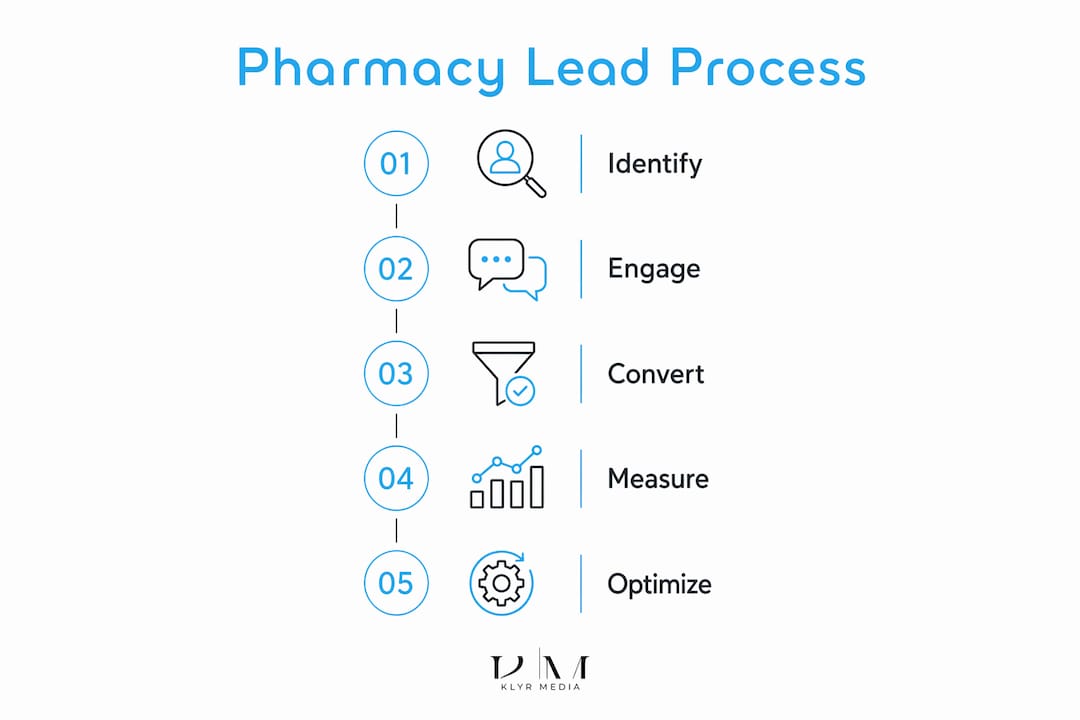
Tracking the right numbers tells you where your money is working and where it is wasting. Most pharmacy owners track the wrong metrics, focusing on website visits instead of patient conversions.
The metrics that actually matter for pharmacy lead acquisition are:
- Customer Acquisition Cost (CAC): Total marketing spend divided by new patients acquired in a given period.
- Patient Lifetime Value (LTV): Average revenue per patient multiplied by average retention period. This number justifies your ad spend.
- Refill adherence rate: The percentage of patients who refill on schedule. Low adherence signals a retention problem, not just a marketing problem.
- Lead-to-patient conversion rate: How many inquiries, form fills, or chatbot conversations turn into actual prescriptions filled.
Google Analytics and your CRM together give you a complete picture. Tag every lead source, whether it is a Google Ad, a social media post, or a webinar signup, so you know exactly which channel drives the most valuable patients. A/B testing landing pages is non-negotiable. Test one variable at a time: headline, button color, form length, or offer. Small changes in conversion rate compound into significant revenue differences over a year.
| Metric | What to Track | Optimization Action |
|---|---|---|
| CAC | Cost per new patient acquired | Shift budget to lowest-CAC channels |
| LTV | Revenue per patient over time | Increase refill reminders and personalized outreach |
| Refill adherence | Percentage of on-schedule refills | Automate SMS reminders 3 days before refill date |
| Conversion rate | Leads converted to active patients | A/B test landing pages and prescription transfer forms |
Refining your negative keyword list in Google Ads is one of the fastest ways to cut wasted spend. Review search term reports weekly and add irrelevant queries to your exclusion list. First-party data collected through webinars and content downloads also feeds your CRM with high-intent leads you can nurture over time. Check out the 2026 healthcare digital marketing checklist to make sure your tracking setup covers every channel.
What are common mistakes in the pharmacy lead generation process?
The mistakes that sink pharmacy marketing budgets are predictable. Knowing them in advance saves you months of wasted spend.
- Running broad awareness ads without transactional intent. Paying for clicks from people searching “how does ibuprofen work” is money gone. Every ad campaign needs a negative keyword list from day one.
- Ignoring HIPAA compliance in digital marketing. Using non-compliant forms, tracking pixels, or email tools that store patient data without proper safeguards exposes you to serious legal risk. Compliance is not optional.
- Skipping retention marketing. Acquiring a new patient costs far more than keeping an existing one. Retention strategies using SMS reminders and personalized newsletters increase lifetime patient value and turn your pharmacy into a community staple.
- Inconsistent digital presence. A Google Business Profile that has not been updated in six months, a website with broken links, or a social media page that went quiet three months ago all signal to patients that you are not paying attention.
- Messaging that never changes. If your ads and emails say the same thing they said two years ago, you are invisible to patients who have new needs. Update your messaging when you add services, hire a specialist, or see a seasonal health trend.
“The pharmacies that win long-term are the ones that treat every patient interaction as the start of a relationship, not a transaction.”
Pro Tip: Set a monthly calendar reminder to audit your Google Business Profile, check your ad negative keyword list, and review your SMS open rates. Thirty minutes a month prevents the slow drift that kills pharmacy marketing results.
Key takeaways
A successful pharmacy lead generation process combines patient segmentation, compliant digital infrastructure, and consistent multichannel outreach to attract and retain high-value patients.
| Point | Details |
|---|---|
| Build the foundation first | Set up Google Business Profile, CRM, and a HIPAA-compliant website before running paid campaigns. |
| Segment before you message | Patient personas for conditions like diabetes or hypertension outperform broad pharmacy ads every time. |
| Use SMS for retention | SMS achieves a 98% open rate, making it the most effective channel for refill reminders and health alerts. |
| Track CAC and LTV together | Knowing what a patient costs to acquire and what they are worth over time drives smarter budget decisions. |
| Avoid broad ad targeting | Negative keyword lists in Google Ads cut wasted spend and focus budget on patients ready to act. |
What I have learned after watching pharmacies grow and stall
Working closely with independent pharmacies across the US, I have seen the same pattern repeat. The pharmacies that grow consistently are not the ones with the biggest ad budgets. They are the ones that treat their digital presence like a front door, not an afterthought.
The biggest shift I have seen in 2026 is the move away from one-size-fits-all campaigns toward genuine patient education. Pharmacists who show up on Instagram explaining a drug interaction or hosting a 20-minute webinar on Medicare Part D changes are building something a chain pharmacy cannot replicate: real trust. That trust converts to prescription transfers, refill loyalty, and word-of-mouth referrals that no ad can buy.
The pharmacies that stall are usually the ones chasing the next tactic without fixing the foundation. They run Google Ads to a website that loads in six seconds on mobile. They collect email addresses but never send a follow-up. They set up a chatbot and forget to check the conversation logs. The 2026 digital marketing trends for healthcare providers are genuinely exciting, but only if your infrastructure can support them.
My honest advice: pick two or three tactics from this guide, execute them well for 90 days, measure the results, and then add the next layer. Consistency beats complexity every time.
— Opinly
How Klyrmedia helps pharmacies build a lead-ready digital presence
Your lead generation efforts are only as strong as the website behind them. A slow, non-compliant, or poorly designed site turns away the very patients your ads and social media posts worked hard to attract.
Klyrmedia builds HIPAA-compliant pharmacy websites designed specifically for independent pharmacies and healthcare practices across the United States. Every site is built for speed, mobile performance, and patient conversion, with secure forms, compliant data handling, and local SEO baked in from the start. If you are ready to stop sending paid traffic to a site that leaks leads, Klyrmedia’s pharmacy-focused web design and healthcare digital solutions give you the infrastructure to make every marketing dollar count.
FAQ
What is the lead generation process for pharmacies?
The lead generation process for pharmacies is a systematic approach to attracting prospective patients, engaging them with relevant content or offers, and converting them into active, loyal customers through digital and community-based marketing channels.
How do I increase pharmacy leads without a big ad budget?
An active Google Business Profile with updated photos and patient reviews drives local discoverability at no cost. Combining this with edu-tainment content on social media and automated SMS refill reminders builds a steady lead pipeline without heavy ad spend.
Why is patient segmentation important for pharmacy lead acquisition?
Patient segmentation allows you to tailor campaigns to specific health conditions like diabetes or hypertension, which consistently outperforms broad messaging. Targeted campaigns deliver a higher return on every marketing dollar spent.
What metrics should I track to measure pharmacy lead generation success?
Track Customer Acquisition Cost, patient Lifetime Value, refill adherence rate, and lead-to-patient conversion rate. These four metrics together show whether your marketing is attracting the right patients and keeping them long-term.
How does HIPAA compliance affect pharmacy digital marketing?
HIPAA compliance governs how patient data is collected, stored, and used in all digital marketing activities, including website forms, email campaigns, and chatbots. Non-compliant tools expose pharmacies to significant legal and financial risk.

