Insurance Keywords for Healthcare Ads: What to Bid On in 2026
Which insurance keywords work in healthcare ads, what Google and CMS rules apply, and how clinics and pharmacies can write compliant copy that fills the schedule.

Insurance Keywords for Healthcare Ads: What to Bid On in 2026

Patients type insurance into the search box before they type your name. “Urgent care that takes Medicare.” “Pharmacy near me accepts Medicaid.” If your ads ignore those searches, the revenue never walks in. If your ads handle them carelessly, you risk disapprovals, suspended accounts and a compliance headache. This guide shows independent pharmacies and clinics how to pick insurance keywords, write copy that doesn’t overpromise coverage, and keep the landing page and tracking clean. The thesis is simple: insurance intent is the most valuable intent in your account, and it needs a healthcare-specific setup to run safely.
TL;DR
- “Insurance keywords” can mean two things: searches from patients checking whether you take their plan, and searches from people shopping for coverage. Most clinics and pharmacies should build for the first.
- Plan-type and program-level terms (Medicare, Medicaid, in-network) carry the intent. Individual plan names are tricky, so test them carefully.
- Ads that promote insurance coverage itself face certification rules on Google. Ads that promote your care and say which plans you accept are a different job, but your account still has to match the policy.
- Never imply every patient is covered. Say patients “may qualify” and let the plan decide.
- Keep tracking pixels and form data off pages where patients enter health details unless your HIPAA setup allows it.
Table of Contents
- What “insurance keywords” actually mean for a provider
- The insurance keyword themes worth building
- The rules that decide whether your ads run
- Writing insurance copy that doesn’t overpromise
- Connecting keyword, ad and landing page
- What to measure
- Let us run the insurance side of your ads
- Our perspective
- FAQ
- Sources
What “insurance keywords” actually mean for a provider
In the agency world the phrase gets used loosely. Two very different searchers hide behind it.
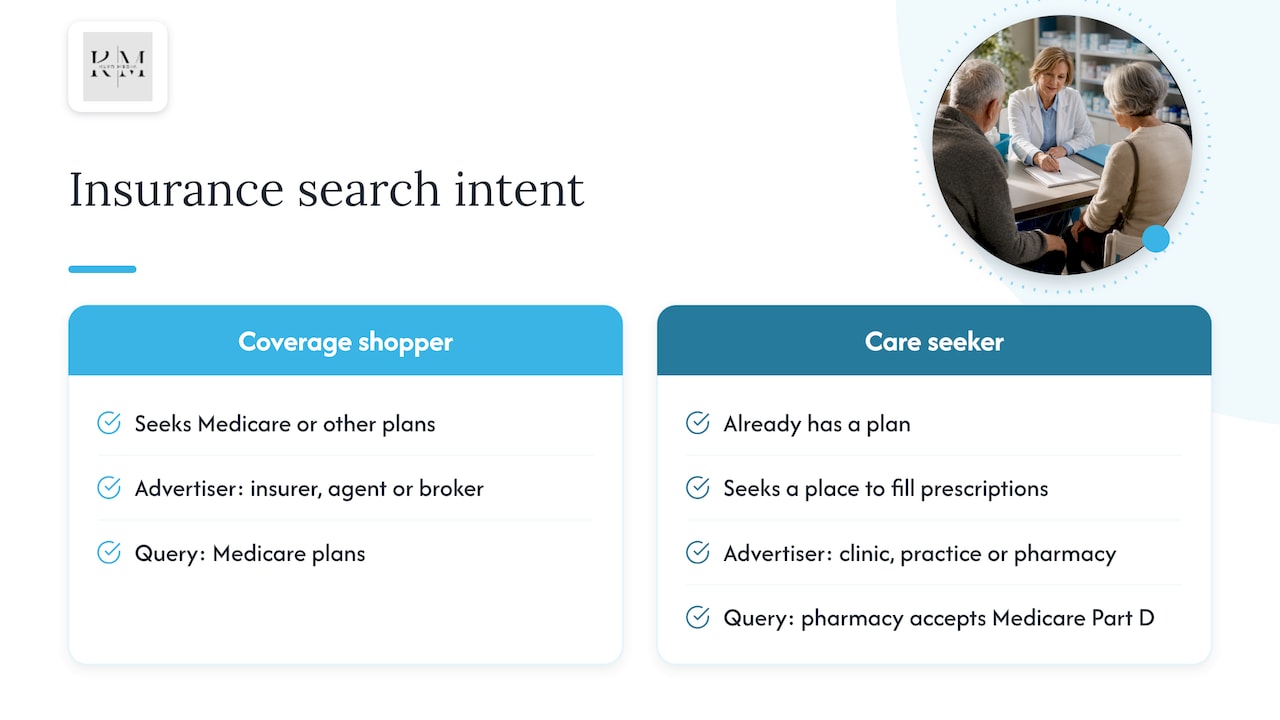
The coverage shopper. This person wants a plan: Medicare Advantage, a Medigap policy, an individual marketplace plan. The advertiser is an insurer, an agent or a broker. Google treats these ads as a regulated category.
The care seeker with a card in their wallet. This person already has a plan and wants to know who will see them without a surprise bill. The advertiser is you: a clinic, practice or pharmacy. The keyword is a service plus an insurance modifier, such as “family doctor accepts Medicaid” or “flu shot covered by insurance.”
Mixing the two up is the most common mistake we see in healthcare account structure. A pharmacy that builds campaigns around “Medicare plans” attracts people shopping for coverage that you can’t sell them. A pharmacy that builds around “pharmacy that accepts Medicare Part D” attracts patients who can fill a prescription tomorrow.
Microsoft’s own description of its health insurance ad format is a useful window into how the platforms see this space. Its ads trigger on non-brand queries such as generic Medicare and plan-type searches, built from feed data like plan type and organization category, and bidding on specific plan names wasn’t supported at launch. The takeaway applies to you too: plan-type and program-level intent is where volume sits.
The insurance keyword themes worth building
Start with the themes below, then split them by service line so each ad group has one clear job.
| Theme | Example searches | Who it fits | Landing page should say |
|---|---|---|---|
| Program-level | “doctor accepts Medicaid,” “Medicare pharmacy near me” | Clinics, pharmacies | Which programs you take, how to confirm eligibility |
| Plan-type | “PPO urgent care,” “HMO primary care” | Clinics, practices | Network status by plan type and how to verify |
| Service plus coverage | “covered flu shot,” “physical therapy covered by insurance” | Pharmacies, clinics | What the service is, that coverage depends on the plan |
| Cost-driven | “copay,” “out of pocket,” “cash price” | Pharmacies, specialty practices | Transparent pricing path, no coverage promises |
| Network status | “in-network,” “out of network” | Practices | Current network list, a way to call and verify |
A few habits make this table work in a live account.
- Separate “accepts” intent from “covers” intent. “Accepts” is about your billing. “Covers” is about the plan’s benefits, which you don’t control.
- Mine your own front desk. The questions your staff answer all day (“Do you take Blue Cross?”) are your keyword list.
- Use negatives hard. Exclude “insurance agent,” “quote,” “buy insurance,” “enroll” and “plans 2026” if you aren’t selling coverage. Those clicks cost money and never convert.
- Treat carrier names with care. Searchers type them constantly. Whether to bid on them, and how to word the ad, depends on the platform’s current policy and on whether your contract with the payer allows it. Check both before you build.
The rules that decide whether your ads run
Google’s health insurance certification
Google’s health insurance advertising policy says advertisers in the United States must be certified by Google to advertise health and medical insurance coverage, with government advertisers pre-approved. Ads exclusively for dental, vision and travel health insurance aren’t restricted. The covered products include individual health insurance, short-term or limited-duration plans, fixed indemnity plans, Medicare Advantage, Medigap and Medicaid. Advertisers registered with the US government to sell ACA-compliant plans need an additional certificate to promote and bid on ACA health insurance keywords, applied for in the same application as the general healthcare certification.
The process has its own order of operations. Per Google’s application guidance, US health insurance advertisers obtain G2RS (G2 Risk Solutions) certification before they submit the Google Ads healthcare application. The application goes in at the child account level with the certified domain, not at the manager account level, and it includes the Google Ads customer ID. An agency applying for you has to document its relationship with you or the license holder.
What does that mean for a clinic or pharmacy? If your campaign sells coverage, plan for certification before launch. If your campaign promotes care and lists the plans you accept, read the policy against your exact ad and landing page, because the line between the two is where disapprovals happen. Our walkthrough of Google’s medical ad policy for clinics and pharmacies covers the account-level questions, and the six-point policy checklist is a quick pre-launch pass. Microsoft has its own rules and a tracking trap worth a look in our Bing healthcare policy audit.

CMS rules if you help patients enroll
Some independent practices and pharmacies also assist with marketplace enrollment through agents or brokers on staff. If that’s you, CMS rules apply to your ads. The July 2026 CMS guidelines for compliant marketplace advertising prohibit:
- misleading consumers about Marketplace coverage, qualified health plans, premium tax credits and cost-sharing subsidies
- cash or cash-equivalent enrollment inducements
- false claims that consumers will always qualify for $0 insurance or premiums
- government-logo facsimiles
- fake or incorrect legislative citations
They also keep agents responsible for third-party marketing and require retaining consent and eligibility-review documentation for at least 10 years. CMS lists this tip sheet among its agent and broker compliance resources, dated August 2026.
The supply chain point matters if you outsource. CMS expects agents to vet lead generators and marketing companies for ACA, HIPAA and TCPA compliance, avoid leads sold to multiple agents, and personally review third-party creative, since CMS doesn’t pre-approve Marketplace marketing. The same logic is sound for any provider: before you hand your budget to a vendor, learn how to choose a marketing agency and ask who reviews every ad before it goes live.
Writing insurance copy that doesn’t overpromise
The patient wants a yes or no. The plan decides the answer. Your ad has to bridge that gap honestly.
CMS’s advertising and marketing tip sheet for agents and brokers (September 2023) says plan advertising should accurately communicate plan information without guaranteeing benefits. It suggests wording like “may qualify” for free or low-cost plans or cost assistance, because the Marketplace determines eligibility during the application. That phrasing is a good model for any provider ad that touches coverage.
Here’s how it plays out in a headline and description.
| Risky | Safer |
|---|---|
| Everyone is covered. $0 visits. | Most major plans accepted. Call to confirm yours. |
| Free flu shot with insurance | Flu shots available. Many plans cover them, so bring your card. |
| Medicare covers your prescriptions here | We accept many Medicare Part D plans. Check yours with our team. |
| Guaranteed approval | You may qualify. We’ll help you check. |
Some rules of thumb we’d put on a sticky note at every front desk:
- Name what you control. Your network status, your hours, your billing team, your cash price.
- Name what you don’t control as conditional. Benefits, copays, deductibles and prior authorizations belong to the plan.
- Give a verification path. A phone number, an eligibility form or a text line. The ad promises the check, not the outcome.
- Keep logos honest. Don’t use government or carrier logos unless you have the right to. CMS lists government-logo facsimiles among the prohibited practices for Marketplace advertising.
What about slogans? The search results for this keyword are mostly creative galleries: clever posters and campaign mood boards from insurers. Fun to browse, not much use to a pharmacy running a $40-a-day search campaign. In local search, the best “slogan” is a specific line: “Accepting Medicaid and most PPO plans. Same-day appointments.”
Connecting keyword, ad and landing page
A tight chain looks like this: the search term names the plan type, the ad repeats it, and the landing page confirms it in the first screen.
- One insurance theme per ad group. “Medicaid primary care” gets its own ad group, its own ad copy and its own page section.
- Match the page to the promise. If the ad says “We accept Medicare,” the page needs a plain list of accepted programs, a note on how to verify, and a button to call or book.
- Keep the form short. Name, phone and preferred time are usually enough. Don’t ask for member IDs or diagnoses on a first-touch form unless your HIPAA setup is built for it.
- Update the list. Payer contracts change. An outdated “accepted plans” page turns into complaints and wasted clicks.
Where HIPAA enters the picture
HHS’s summary of the HIPAA Privacy Rule defines marketing as a communication encouraging people to buy or use a product or service. It requires a covered entity to get authorization before using or disclosing protected health information for marketing, with exceptions for face-to-face marketing and promotional gifts of nominal value. Health plans are covered entities under the rule, and so are health care providers that conduct certain transactions electronically.
Practically, that touches three things in your ad account: remarketing lists built from patient pages, form submissions that pass health details to ad platforms, and follow-up messages that use patient data. An insurance-themed landing page where someone types a plan ID is exactly where a stray tracking tag can do damage. That’s why we keep a separate rule: no pixel firing on pages that collect health details until the tag setup has been reviewed against your HIPAA obligations. Your compliance officer or healthcare attorney makes the final call on what’s allowed for your practice.
What to measure
Impressions and clicks won’t tell you whether insurance keywords pay. Track:
- Calls and booked appointments by insurance theme. Medicaid searches and PPO searches usually convert and value out differently.
- Call quality. Did the caller ask about a plan you don’t take? That’s a negative keyword or an ad copy fix.
- Cost per booked appointment, not cost per click.
- Show rate. Insurance-confused patients no-show more often when the ad promised more than the front desk can deliver.
- Disapprovals and limited-status warnings. Review them weekly. A flagged ad group is a policy conversation, not a bidding problem.
Tie each metric back to the insurance theme so you can move budget toward the ones that fill chairs and fill prescriptions.
Let us run the insurance side of your ads
If this feels like a lot to hold in your head while you’re running a practice or a pharmacy counter, that’s the point where an agency earns its fee. KLYR Media works only with healthcare providers, and our Healthcare PPC Service covers Google Ads, Bing Ads and social media advertising for independent pharmacies, medical clinics and healthcare practices, with compliance built in from day one. Our HIPAA-compliant web design and performance reporting sit alongside it, so the keyword, the ad, the landing page and the numbers come from the same team.
If you’d like us to look at your insurance keyword structure and landing pages, start at klyrmedia.com.
Our perspective
Independent pharmacy and clinic owners tell the same story: patients call, ask whether you take their plan, and hang up if the answer isn’t instant. That’s a leak, and the phone is what breaks.
Insurance intent is where a local provider can beat the big chains and the online pharmacy giants, because a patient who types a plan name wants a nearby answer. But the same keywords sit next to the most policed ad categories on the internet. Our view is that you shouldn’t have to choose between growth and compliance.
That’s why we build healthcare-only: HIPAA-compliant sites, search and paid campaigns, and automated follow-up designed to work together, so a patient who clicks an insurance ad lands on a page that confirms what the ad said and gets a prompt follow-up. Compliance isn’t a layer we add at the end. It shapes how we set up the account from the first day.
Generic agencies treat “Medicare” like any other keyword. We don’t. We want your ads to say what you can honestly deliver, to the patients who can actually use it.
Opinly
FAQ
Can a clinic or pharmacy bid on insurance carrier names?
It depends on the platform’s current policy, your payer agreements and what the ad says. Google’s health insurance rules are written mainly for advertisers promoting coverage, so read the policy against your exact ad. Our healthcare PPC team reviews this before a campaign launches.
Do I need Google certification to say I accept Medicare?
Google requires certification to advertise health and medical insurance coverage in the United States. An ad that promotes your care and lists accepted plans is a different thing from selling a plan, but your wording and landing page should be checked against the policy. When an ad leans toward selling coverage, plan for certification first.
How should an ad explain coverage without implying everyone is covered?
Talk about what you accept and what you’ll verify, not what the plan will pay. Phrases like “most major plans accepted” and “you may qualify” keep the decision with the plan, which matches the approach in CMS’s advertising guidance.
Can I use patient lists for insurance-themed remarketing?
Be very careful. Under the HIPAA Privacy Rule, using protected health information for marketing generally needs the patient’s authorization, with limited exceptions. Check your list sources and tags with your compliance officer or healthcare attorney before you build any audience.
Sources
- Health insurance, Advertising Policies Help (Google)
- Google Ads healthcare application guidance
- Agent, Broker, and Web-broker Guidelines for Compliant Marketplace Advertising and Marketing (CMS, July 2026)
- General Resources, CMS agents and brokers
- AB Advertising and Marketing Tip Sheet (CMS, September 2023)
- Summary of the HIPAA Privacy Rule (HHS)

