

How to Optimize Local SEO for Healthcare Practices

Local SEO optimization is the process of improving your healthcare practice’s online presence so patients in your area find you first. 46% of all Google searches carry local intent, and those searches convert at a far higher rate than broad queries. For independent clinics, pharmacies, and medical practices, that number represents real appointment volume. Google Business Profile signals account for roughly 36% of Local Pack ranking factors in 2026. If you are not actively managing your local presence, you are handing patients to whoever is.
How to optimize local SEO: the core components every practice needs
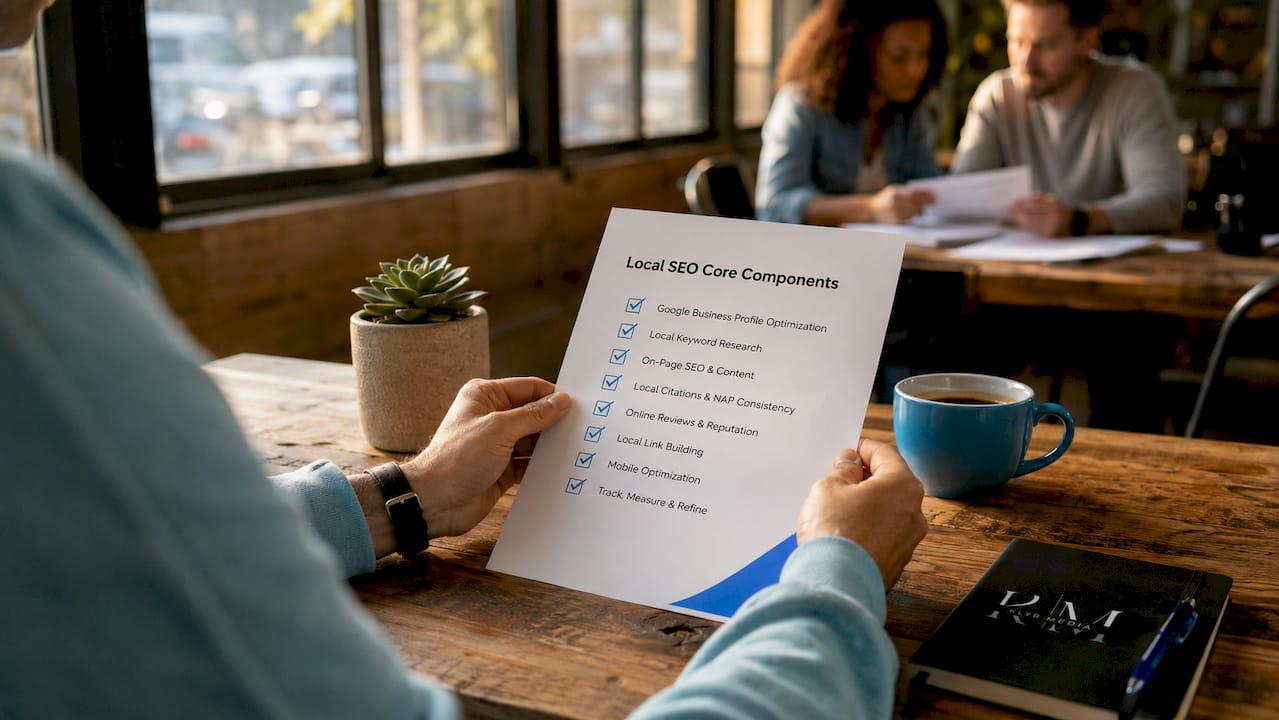
Getting local search right starts with knowing what Google actually measures. The industry term for this work is “local search optimization,” and it covers three interconnected layers: your Google Business Profile (GBP), your website’s on-page signals, and your citation footprint across the web.
Here is what each layer requires:
Google Business Profile
- Verified listing with accurate name, address, and phone number (NAP)
- Complete service categories, hours, and a keyword-rich description
- Regular photo uploads and weekly posts
- Active Q&A management
Website on-page signals
- Localized service pages targeting city or neighborhood terms
- Title tags and meta descriptions that include location and specialty
- Schema markup for healthcare entities (MedicalClinic, Physician, FAQPage)
- Embedded Google Maps on contact and location pages
Citation footprint
- Consistent NAP data across Google, Yelp, Healthgrades, WebMD, and Zocdoc
- Listings in local business directories and chamber of commerce sites
- Healthcare-specific directory profiles that reinforce your specialty
| Component | Primary Tool | Why It Matters |
|---|---|---|
| GBP optimization | Google Business Profile | 36% of Local Pack ranking weight |
| NAP consistency | Directory audit tools | Google cross-references dozens of sources |
| On-page local signals | CMS with Schema support | Captures organic traffic outside the Map Pack |
| Citation building | Healthcare directories | Validates practice legitimacy to search engines |
| Review management | GBP + patient outreach | Influences both rankings and patient trust |
Pro Tip: Run a NAP audit before anything else. A single address discrepancy across Healthgrades, Yelp, and your website can suppress your Local Pack ranking faster than any missing keyword.
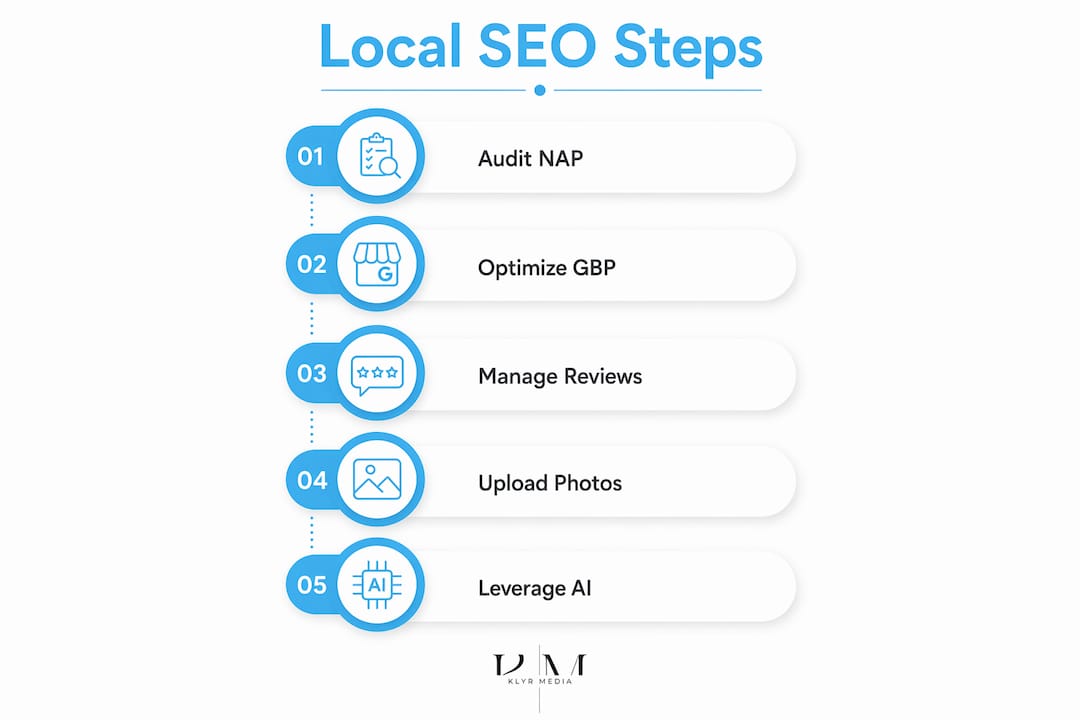
For a deeper breakdown of 2026 ranking tactics specific to healthcare clinics, Klyrmedia’s blog covers the current signal hierarchy in detail.
Step-by-step: how to set up and improve your GBP and local on-page SEO
Execution matters more than strategy here. A well-structured plan beats a vague intention every time.
- Claim and verify your GBP listing. Go to Google Business Profile, search for your practice, and request ownership. Google mails a postcard with a verification PIN to your physical address.
- Fill every field completely. Add your primary category (e.g., “Medical Clinic” or “Pharmacy”), secondary categories, services with descriptions, hours including holidays, and a 750-character business description that naturally includes your city and specialty.
- Seed the Q&A section. Post the questions patients actually ask, such as “Do you accept Medicare?” or “Is same-day appointment available?” Then answer them yourself. Seeding Q&A with patient queries helps AI-generated local answers pull accurate information about your practice.
- Build localized service pages on your website. Each page should target a specific city or neighborhood, include unique content about that location, embed a Google Map, and use a title tag formatted as “Service + City + State.”
- Add Schema markup. Use MedicalClinic or Physician schema on provider pages, FAQPage schema on your FAQ section, and LocalBusiness schema sitewide. This makes your content machine-readable for AI discovery.
- Respond to every review within 48 hours. Mention the service and location naturally in your response. This reinforces local keyword signals without stuffing.
Common pitfalls to avoid:
- Adding keywords to your GBP business name. Keyword stuffing in GBP names risks automatic suspension by Google.
- Publishing duplicate content across city pages. Each page needs genuinely different information about that location.
- Ignoring mobile page speed. Most local searches happen on phones, and a slow site loses patients before they ever read your content.
Pro Tip: Create a simple spreadsheet tracking your GBP post dates, photo uploads, and review responses. Consistency over 90 days produces more measurable ranking movement than any single one-time update.
For a full walkthrough of GBP setup for clinics, Klyrmedia’s dedicated guide covers every field and category choice.
How to manage citations, reviews, and real-world prominence
Citations are mentions of your practice’s NAP data across the web. Google cross-references dozens of directories to validate that your information is accurate. Inconsistent data weakens your authority. Consistent data builds it.
Start with the directories that matter most for healthcare:
- Google Business Profile (primary)
- Healthgrades, Zocdoc, WebMD, and Vitals for medical credibility
- Yelp and Apple Maps for general local visibility
- Your state’s medical board directory
- Local chamber of commerce and neighborhood business associations
Reviews are not just a trust signal for patients. They are a ranking signal for Google. The most effective way to collect them is to ask at the point of care, either through a follow-up text or a printed card with a QR code linking directly to your GBP review page.
Real-world prominence carries more weight than most practice owners realize. Local backlinks from news outlets, chambers of commerce, and community groups outperform generic directory links in SEO value. Sponsor a local health fair. Partner with a neighboring physical therapy clinic. Get quoted in a local newspaper article about flu season. These offline actions create online signals that algorithms trust.
Photos are a fast, underused lever. Healthcare businesses with 100+ photos on GBP receive dramatically more calls and direction requests than those with few or none. Adding 3 to 5 photos monthly, including staff headshots, waiting room images, and exterior shots, keeps your profile active and signals ongoing engagement.
Pro Tip: Ask patients to mention a specific service or location in their review. “Great experience at the downtown clinic” reinforces your local keyword signals far better than a generic five-star rating.
How is AI changing local SEO for healthcare practices?
AI is not replacing local SEO. It is raising the bar for what “good” looks like. AI Overviews appear in 40% of local business queries, and healthcare searches are squarely in that group. When a patient asks “urgent care near me open now,” Google’s AI pulls from structured, verified sources. If your data is incomplete or inconsistent, you get left out.
The shift that matters most is from listing management to entity management. Local SEO is shifting toward entity-based optimization, which means Google needs to understand the relationships between your practice, your providers, your services, and your locations. Schema markup is how you communicate those relationships in machine-readable language.
Here is what entity-based local SEO looks like in practice:
- Each physician has a dedicated page with Physician schema, linked to the practice’s MedicalClinic schema
- Each service page references the location it serves and links back to the provider
- Your GBP, website, and directory listings all use identical NAP data
- FAQ pages use FAQPage schema so AI can pull direct answers from your content
Local SEO and Answer Engine Optimization must be treated as a unified strategy, not separate tracks. Track your AI search visibility alongside traditional rank tracking. Look for whether your practice appears in AI Overviews for key queries. If it does not, the gap is usually missing structured data or thin content on service pages.
The AI-driven patient intake space is evolving fast, and practices that align their digital presence with how AI reads and surfaces information will have a compounding advantage over the next few years.
Pro Tip: Run a 90 to 180-day optimization cycle focused on entity SEO. Add Schema, fix NAP inconsistencies, and publish localized content in that window. Then measure. The results compound over time.
Key Takeaways
Healthcare practices that combine Google Business Profile accuracy, consistent NAP data, localized website content, and structured Schema markup build the strongest foundation for local search visibility in 2026.
| Point | Details |
|---|---|
| GBP is your highest-leverage asset | Google Business Profile signals drive 36% of Local Pack rankings; keep it fully updated. |
| NAP consistency is non-negotiable | Google cross-references dozens of directories; one mismatch can suppress your ranking. |
| Photos and reviews compound over time | Practices with 100+ GBP photos see dramatically more calls and direction requests. |
| Entity SEO beats listing management | Schema markup connecting providers, services, and locations is now a core ranking requirement. |
| AI Overviews demand structured content | 40% of local queries trigger AI Overviews; incomplete data means your practice gets skipped. |
What I have learned watching healthcare practices win and lose at local SEO
The practices that rank consistently are not the ones running the most ads or publishing the most blog posts. They are the ones that treat their local presence like a patient chart: updated regularly, accurate down to the detail, and reviewed on a fixed schedule.
What I see most often is a practice that did a solid GBP setup three years ago and has not touched it since. The hours changed. A provider left. The address got reformatted differently on Healthgrades. None of it feels urgent until a competitor with a fresher profile starts showing up above you for searches you used to own.
The other thing I will say plainly: short-term hacks do not hold. Buying reviews, keyword-stuffing your business name, or spinning the same city page content across 20 locations all carry real suspension and penalty risk. The practices that build real community presence, earn genuine reviews, and maintain clean structured data are the ones that survive algorithm updates.
Patient experience is the core SEO driver that nobody talks about enough. A patient who gets a callback, finds your hours accurate, and sees a photo of your actual waiting room before they arrive is a patient who leaves a real review. That review does more for your ranking than any technical fix.
The step-by-step local SEO guide Klyrmedia published for 2026 reflects exactly this philosophy: systematic, patient-focused, and built for the long game.
— Opinly
How Klyrmedia helps healthcare practices rank locally
Running a clinic means your time is already spoken for. Local SEO requires consistent attention across GBP, your website, citations, and Schema markup. That is a lot to manage without a system behind it.
Klyrmedia builds HIPAA-compliant websites for healthcare practices that are structured from the ground up for local search visibility. Every site includes localized service pages, Schema markup, and GBP integration. Beyond the website, Klyrmedia manages the full local SEO footprint: citation cleanup, review strategy, and AI-ready content. If you are a clinic, pharmacy, or independent practice looking to attract more local patients without guessing what works, Klyrmedia is built for exactly that.
FAQ
What is local SEO for healthcare practices?
Local SEO is the process of improving a practice’s online visibility so patients in the surrounding area find it in Google search results. It covers Google Business Profile, NAP consistency, localized website content, and citation management.
Why does Google Business Profile matter so much?
GBP signals account for roughly 36% of Local Pack ranking factors. An incomplete or outdated profile directly reduces your chances of appearing in the top three local results.
How often should I update my Google Business Profile?
Weekly updates, including new photos, posts, and review responses, maintain the activity signals Google uses to assess prominence. Monthly at minimum is the floor, not the goal.
What is NAP consistency and why does it affect rankings?
NAP stands for Name, Address, and Phone number. Google cross-references this data across dozens of directories. Any mismatch signals unreliable information and weakens your local ranking authority.
How does AI affect local search for healthcare?
AI Overviews appear in 40% of local queries. Practices with complete structured data and accurate GBP listings are far more likely to appear in those AI-generated answers than those with thin or inconsistent profiles.

