

How to Grow Your Patient Base: 2026 Strategies

The strategies that actually grow and retain your patient base
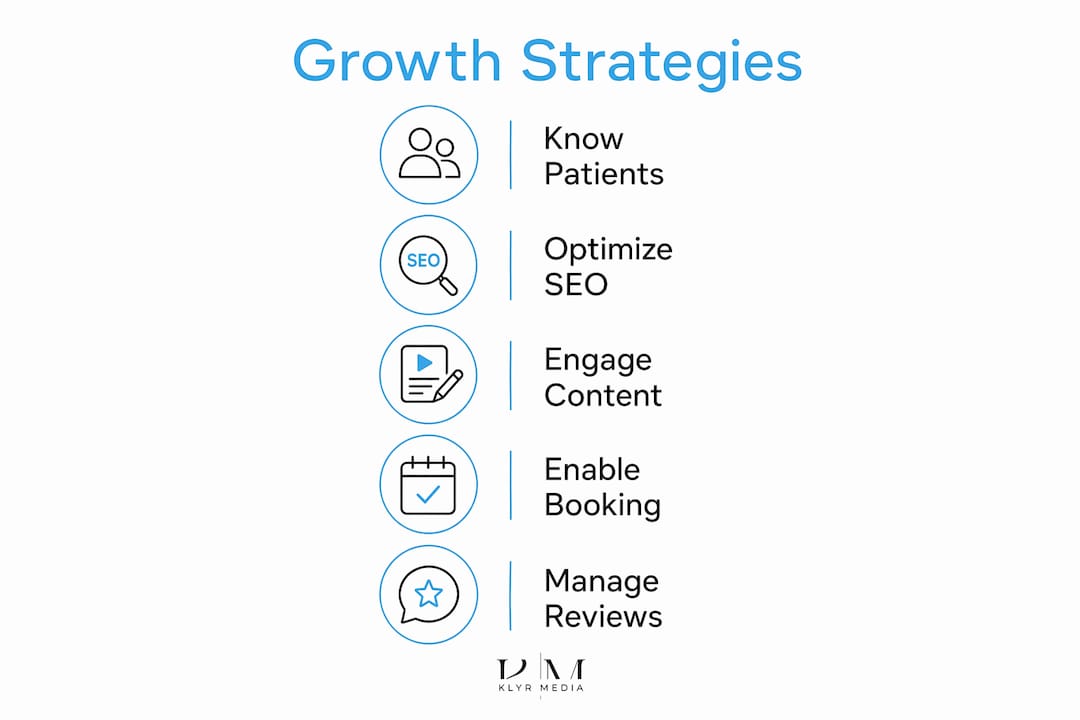
Growing a patient base is not about one magic tactic. It is about building a system where new patients find you, choose you, and keep coming back. Here is what works in 2026:
- Optimize your Google Business Profile so local patients find you first in search results
- Launch a structured referral program for both patients and referring physicians
- Add online booking to capture appointments around the clock, not just during office hours
- Run automated recall campaigns to bring existing patients back before they drift to a competitor
- Publish condition-specific content that answers the questions your patients are already searching
- Respond to inquiries fast — speed of response is one of the highest-leverage moves you can make
- Integrate telehealth to remove access barriers and expand your geographic reach
- Accept more insurance plans and communicate billing clearly to reduce drop-off at the front door
None of these work in isolation. The practices that grow consistently treat patient acquisition as a layered, ongoing system, not a one-time campaign. That framing matters more than any single tactic on this list.
Table of Contents
- Know your practice and your patients before you scale
- Digital marketing approaches that bring new patients through the door
- How to keep the patients you already have
- Advanced moves for competing with large healthcare systems
- Klyrmedia builds the growth system your practice needs
- Key Takeaways
Know your practice and your patients before you scale
You cannot grow what you do not understand. Before spending a dollar on ads or a minute on content, get clear on who your current patients are and where they come from.
Start with these questions:
- Who are your best patients? Age, insurance type, condition, visit frequency. These are the people you want more of.
- Where did they find you? Referrals, Google search, insurance directories, word of mouth? Tracking referral sources tells you where to invest.
- What is your current retention rate? If patients are not returning, acquisition spend is just filling a leaky bucket.
- How is your staff performing on first impressions? Front desk tone, wait times, and scheduling ease all affect whether a new patient books a second appointment.
- What do your reviews say? Patient feedback is free market research. Read it seriously.
Staff quality deserves its own mention here. A warm, efficient front desk converts inquiries into booked appointments. A cold or disorganized one loses patients before they ever see the provider. Training your team on phone etiquette, scheduling workflows, and patient communication is a growth strategy, not just an operational nicety.
Measure the right KPIs from the start: new patient volume per month, patient retention rate, no-show rate, referral source breakdown, and average revenue per patient. These numbers tell you where the real leaks are.
Digital marketing approaches that bring new patients through the door

77% of patients use search engines to research providers before booking. That single fact should shape your entire digital presence. If you are not showing up where patients are looking, you are invisible.
Google Business Profile and local SEO
Your Google Business Profile is often the first thing a prospective patient sees. An optimized GBP profile with complete information, accurate hours, photos, and strong reviews receives 7 times more clicks than an incomplete one. That is not a small edge. Fill every field, post updates regularly, and respond to every review, positive or negative.
Local SEO goes hand in hand with your profile. Use location-specific keywords on your website, build citations in directories like Healthgrades and Zocdoc, and make sure your name, address, and phone number are consistent everywhere. For a deeper look at local search tactics specific to medical practices, the fundamentals have not changed but the competition has gotten sharper.
Content that earns trust before the first appointment
Blogs, FAQ pages, and short educational videos answer the questions patients are already typing into Google. A family medicine practice that publishes a clear article on “when to see a doctor for chest pain” is building trust with someone who has not yet chosen a provider. That is patient acquisition without a single ad dollar spent.
Condition-specific landing pages work especially well for specialists. A dermatology practice with a dedicated page for eczema treatment will outrank a generic “services” page almost every time.
Online booking and inquiry response speed
Practices offering 24/7 online self-scheduling see 30–40% of appointments booked outside office hours. That means a substantial number of new patients who would have called, hit voicemail, and moved on get captured. An online scheduling system removes that friction entirely.
Reviews and reputation management
Ask every satisfied patient for a Google review. Make it easy: send a text with a direct link right after the appointment. Respond to negative reviews calmly and professionally. Patients read how you handle criticism as much as they read the criticism itself.
Social media
You do not need to be everywhere. Pick one or two platforms where your patient demographic actually spends time, typically Facebook for older adults and Instagram for younger ones, and post consistently. Educational content, staff spotlights, and community involvement posts perform better than promotional ones.
Pro Tip: Run a small paid campaign on Google or Meta to amplify your best-performing organic content. Even a modest budget behind a post that already resonates can generate a meaningful spike in profile visits and appointment requests.
How to keep the patients you already have
Acquisition gets all the attention, but retention is where the real money is. A patient who stays with your practice for five years is worth far more than five one-time visitors. The math is simple; the execution takes discipline.
- Automated appointment reminders via text or email cut no-show rates significantly and reduce the friction of rescheduling. Patients forget. A well-timed reminder fixes that.
- Recall campaigns for preventive care, annual physicals, flu shots, and chronic disease check-ins bring patients back on a schedule rather than waiting for them to remember. Proactive engagement between visits consistently outperforms episodic care for retention.
- Personalized follow-ups after procedures or new diagnoses show patients you are paying attention. A quick check-in message two days after a procedure costs almost nothing and builds loyalty that paid ads cannot buy.
- Community outreach builds your reputation outside the clinic walls. Health fairs, school partnerships, and local employer wellness programs put your name in front of people who have not yet needed a doctor but will.
- Insurance transparency matters more than most practices realize. Clearly listing accepted plans on your website and training staff to answer coverage questions confidently reduces the number of patients who ghost you after the first call.
- Telehealth services expand your reach to patients who cannot easily come in, whether due to distance, mobility, or schedule. Offering a telehealth option for follow-ups and minor concerns keeps patients in your panel rather than sending them to urgent care or a competitor.
Building loyalty also means making it easy to access primary care without unnecessary barriers. Same-day appointments, extended hours, and a responsive after-hours line all signal to patients that you actually want them there.
Patients who feel genuinely cared for refer their friends and family. That is the most cost-effective patient recruitment channel you have.
Advanced moves for competing with large healthcare systems
Independent practices often feel outgunned by hospital systems with massive marketing budgets. The gap is real, but it is not insurmountable. The advantage you have is speed and personal connection. Use both.
Close the referral loop fast
Physician referrals remain the highest-converting patient acquisition channel in healthcare. Referred patients arrive with built-in trust and follow through at higher rates than patients from any other source. But most practices treat referrals passively, waiting for the fax and moving on.
The practices that generate the most referral volume do one thing differently: they close the loop. Sending structured feedback to the referring physician within 48 hours, confirming the patient was seen and summarizing the plan, dramatically increases how often that physician refers again. Direct fax-to-EMR workflows reduce friction on both ends and make your practice the easiest one to refer to.
Stat to know: Closed-loop referral communication within 48 hours has been shown to substantially boost referral volume and provider preference. Most practices never do it.
Speed of response is your biggest conversion lever
Responding to patient inquiries within 5 minutes increases conversion rates by 900%. Read that again. Speed beats almost every other marketing tactic. Set up automated text responses for after-hours inquiries, train your front desk to prioritize callbacks, and consider a live chat option on your website. The patient who calls three practices and hears back from only one will book with that one.
Build a layered acquisition system, not a single channel
Practices that combine SEO, referrals, content, and paid advertising as a coordinated system see 30–50% more inquiries for similar or lower cost than those relying on a single channel. Patients today consult multiple sources before choosing a provider, including AI assistants, review platforms, and social media. A multi-channel presence means you show up wherever they look.
HIPAA compliance is not optional in digital marketing
Using patient data for marketing, running automated follow-up campaigns, or deploying chatbots on your website all require HIPAA-compliant tools and workflows. A data breach or a compliance violation does not just carry financial penalties; it destroys the patient trust you spent years building. Vet every platform you use for HIPAA compliance before you deploy it, and document your policies.
Klyrmedia builds the growth system your practice needs
Independent practices that want to grow without burning out their staff or guessing at marketing need a system built for healthcare, not a generic agency that treats your clinic like a plumbing company.
Klyrmedia is a digital marketing and web development agency built exclusively for healthcare providers. The concrete difference: every website Klyrmedia builds is HIPAA-compliant by design, not patched for compliance after the fact. Local SEO, automated patient follow-up campaigns, online booking integration, AI-powered chatbots, and pay-per-click advertising are all handled under one roof, coordinated around your specific growth goals. No juggling five vendors. No generic playbooks.
The practice owners Klyrmedia works with are competing with hospital systems and urgent care chains that have marketing departments. Klyrmedia gives independent clinics and pharmacies the same infrastructure, without the enterprise price tag. If you are ready to stop patching together your marketing and start running a real patient acquisition system, see what Klyrmedia offers for practices like yours.
Key Takeaways
Building a patient base that grows and stays requires a coordinated system of digital presence, fast response, proactive retention, and HIPAA-compliant technology working together.
| Point | Details |
|---|---|
| Speed converts inquiries | Responding within 5 minutes increases patient conversion rates by 900%. |
| GBP optimization pays off | Complete Google Business Profiles receive 7 times more clicks than incomplete ones. |
| After-hours booking captures patients | 30–40% of appointments are booked outside office hours when online scheduling is available. |
| Close the referral loop | Sending physician feedback within 48 hours substantially increases referral volume over time. |
| Klyrmedia for healthcare growth | Klyrmedia provides HIPAA-compliant websites, local SEO, and automated follow-up systems built specifically for independent practices. |

