
How to Create Medical Content That Converts and Complies
Learn how to create medical content that converts and complies with our essential guide. Ensure accuracy and engage patients effectively.

How to Create Medical Content That Converts and Complies

Start with a patient-question blog post or a procedure page, assign a clinician reviewer before you write a single word, and publish nothing without a visible medical disclaimer. That’s the short version of how to create medical content that actually moves patients from search to appointment.
Your 3-item pre-publish checklist:
- Assign a clinician reviewer — a practicing physician, nurse, or licensed clinician who will verify accuracy and sign off with their name, credential, and review date
- Assign a writer or agency with healthcare content experience and HIPAA awareness
- Schedule a publish date and a medical review date at the same time — not after
Place this disclaimer at the top of every clinical article and at the bottom of every service or procedure page. Both placements. No exceptions.
Table of Contents
- Why patient search intent should drive every content decision
- How to plan your content before anyone writes a word
- Writing rules that make medical content readable and convert patients
- What every practice must do for HIPAA compliance and clinical sign-off
- The SEO and technical checklist your medical pages need
- Who owns what, and how often should you review content?
- Three ready-to-use templates for your first content push
- Key Takeaways
- The case for compliance-first content, not content-first compliance
- Klyrmedia handles the hard parts of medical content for your practice
- Authoritative sources every medical content team should bookmark
Why patient search intent should drive every content decision
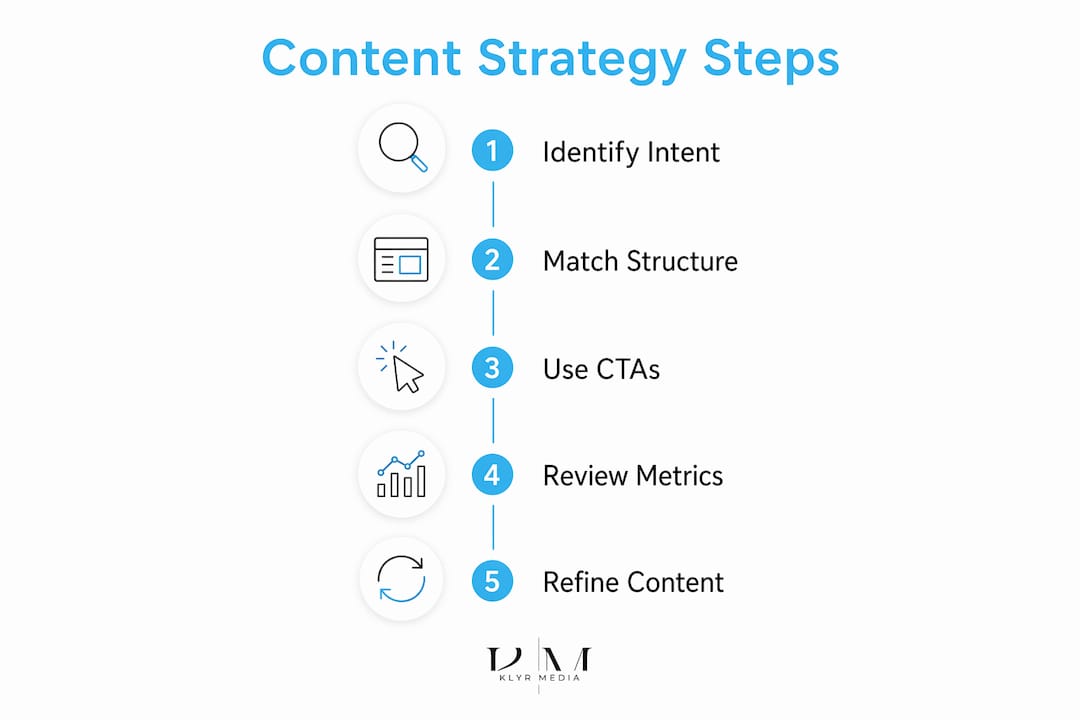
Patient searches fall into three buckets: informational, navigational, and transactional. Match the wrong content type to the wrong intent and you get traffic that never books.
- Informational intent (“what causes knee pain”) → Q&A blog post or condition explainer; CTA: “Learn more about our orthopedic services”
- Navigational intent (“Dr. Smith family practice Chicago”) → provider profile or location page; CTA: “View our team” or “Get directions”
- Transactional intent (“book a telehealth appointment near me”) → service page with a direct booking flow; CTA: “Request an appointment today”
Structure follows intent. An informational page needs short paragraphs and a soft CTA. A transactional page needs a booking button above the fold and a clear description of what happens next, like how an online doctor approval process works for telehealth visits. Keep paragraphs short and write in plain language throughout.
How to plan your content before anyone writes a word
Start with an audit, not a blank page.
- Audit existing pages — pull organic traffic, top queries, and bounce rates; flag any page with outdated clinical guidance or no reviewer credit
- Build a patient-question inventory — pull from your front desk’s most common calls, Google’s “People Also Ask” boxes, and your patient portal messages
- Flag clinical risk — any page covering diagnosis, dosage, or treatment needs a clinician reviewer assigned before drafting begins
- Map gaps — compare your question inventory to your existing pages; the gaps are your next 90 days of content
Sample editorial calendar:
| Month | Topic | Content Type | Owner | Review Date |
|---|---|---|---|---|
| Month 1 | “What to expect at your first cardiology visit” | Blog post | Writer + cardiologist | 2 weeks post-draft |
| Month 2 | Cardiac stress test service page | Procedure page | Writer + cardiologist | 2 weeks post-draft |
| Month 3 | FAQ: Heart health questions answered | FAQ page | Writer + cardiologist | 2 weeks post-draft |

Cost and time reality check: In-house writing typically runs 4–8 hours per 1,000-word page when a clinician review round is included. Agency-produced HIPAA-aware content varies widely by scope; expect a higher per-asset cost but faster turnaround and built-in compliance checks. Nothing publishes without clinician sign-off and a legal/consent review for any patient story or photo.
Writing rules that make medical content readable and convert patients
Nine out of 10 adults struggle with complex health information. That’s not a readability problem — it’s a lost-patient problem.
Writing checklist for every page:
- Lead each section with a direct answer in 40–60 words — this targets featured snippets and keeps skimmers engaged
- Use “you” language throughout (“your symptoms,” “your provider”)
- Explain clinical terms inline the first time they appear (“hypertension, or high blood pressure”)
- Research indicates that 9 out of 10 adults have difficulty understanding complex health information; therefore, always use plain language and aim for a reading level that middle school or early high school students can easily understand. Test with readability tools to ensure your text is clear and accessible.
- Use question-based H2 headings (“What causes lower back pain?”)
- Keep paragraphs short; use bullet lists for symptoms, steps, and warnings.
- Place a CTA at the end of every section on transactional pages; on informational pages, one CTA near the bottom is enough
Sample CTAs by intent:
- Informational: “Have questions about your symptoms? Our team is here to help — [request a callback].”
- Navigational: “Meet our providers and find the right fit for your care.”
- Transactional: “Ready to book? Schedule your appointment online in under 2 minutes.”
Pro Tip: Run your draft through the Hemingway Editor before sending it to your clinician reviewer. Fix passive voice and long sentences first — it saves the clinician time and gets you a faster sign-off.
What every practice must do for HIPAA compliance and clinical sign-off
Ohio State Wexner Medical Center requires every piece of health content to be reviewed by a practicing clinician before publication. That standard should be yours too.
PHI do/don’t checklist:
- Do not publish patient names, photos, or identifiable case details without written HIPAA-compliant authorization
- Do not use before/after photos or patient testimonials without a signed release
- Do use anonymized, composite examples (“a patient in their 50s with Type 2 diabetes…”)
- Do confirm any third-party vendor (CMS, email platform, chatbot) has a signed Business Associate Agreement (BAA) before it touches patient data
For patient stories or visual media, collect written consent that specifies exactly how the content will be used and where it will appear. Keep signed releases on file. This is non-optional under HIPAA.
The SEO and technical checklist your medical pages need
Combine on-page SEO with schema markup and local signals. That combination is what gets a practice page into the map pack and the featured snippet at the same time.
| Element | Requirement |
|---|---|
| Title tag | 50–60 characters; include primary keyword and location |
| Meta description | 140–160 characters; include a CTA phrase |
| H1 | One per page; matches the patient’s search query |
| First paragraph | Direct answer in 40–60 words |
| Schema type | MedicalCondition, Physician, MedicalClinic, FAQPage |
| Google Business Profile | Complete, verified, appointment link active |
| NAP consistency | Name, address, phone identical across all directories |
| Mobile | Passes Google’s Mobile-Friendly Test; tap targets ≥ 48px |
| Accessibility | Alt text on all images; sufficient color contrast; keyboard navigable |
For local visibility, healthcare SEO starts with a fully completed Google Business Profile, consistent NAP across Healthgrades, Zocdoc, and Yelp, and location-specific service pages for each clinic address. FAQPage schema on your Q&A content increases the chance of appearing in “People Also Ask” results.
Who owns what, and how often should you review content?
Set ownership before you publish, not after something goes wrong.
- Content owner — the administrator or marketing lead who manages the editorial calendar and tracks review dates
- Clinician reviewer — a practicing provider who verifies clinical accuracy; their name and credential appear on the page
- Editor — checks readability, CTA placement, and compliance with your style guide
- Technical owner — handles schema, metadata, and page performance
Ohio State Wexner Medical Center documents reviewer credentials on every published page. Follow that model. For review cadence, NHS content policy requires systematic clinical checks and reviews at least every three years for stable content. For fast-changing topics like drug interactions, vaccine schedules, or telehealth regulations, review every 6–12 months. Stamp every page with a “Last reviewed” date and a “Next review due” date in your CMS.
KPIs to track monthly: organic traffic per page, appointment conversion rate, phone call volume from content pages, telehealth sign-up rate, and average time on page.
Three ready-to-use templates for your first content push
Blog post template:
- Headline formula: “What Is [Condition/Procedure]? What [City] Patients Need to Know”
- Intro (40–60 words): Direct answer to the headline question
- H2 sections: “What causes [condition]?” / “Who is at risk?” / “How is it treated?” / “When should you see a doctor?”
- CTA placement: End of article; one inline CTA after the treatment section
- Word count: 800–1,200 words; meta title 55 characters, meta description 155 characters
Procedure/service page template:
- Symptoms or conditions it addresses
- Who is a good candidate
- What to expect during the procedure
- Recovery and follow-up
- Clinician credentials block
- Booking CTA above the fold and at the bottom
FAQ page template:
- Pull questions from “People Also Ask” and your front desk logs
- Answer each in 40–60 words (snippet-friendly)
- Add FAQPage schema to every answer
- Word count: 600–1,000 words; one CTA at the bottom
| Template | Target Word Count | CTA Placements | Schema Type |
|---|---|---|---|
| Blog post | 800–1,200 | 1 inline + 1 end | Article, FAQPage |
| Procedure/service page | 600–800 | Above fold + end | MedicalProcedure, Physician |
| FAQ page | 600–1,000 | 1 end | FAQPage |
Key Takeaways
Compliant, patient-centered medical content requires a clinician reviewer, a visible disclaimer, intent-matched structure, and a scheduled review cycle before a single page goes live.
| Point | Details |
|---|---|
| Assign a clinician reviewer first | Every clinical page needs a practicing provider’s name, credential, and a visible review date. |
| Match content type to patient intent | Informational, navigational, and transactional searches each need a different page structure and CTA. |
| Use plain language and short paragraphs to keep patients engaged and reduce confusion. | |
| Schedule review cycles at publication | Fast-changing topics need more frequent review; stable content can run on an annual or longer cycle. |
| Klyrmedia builds this process for you | Klyrmedia delivers HIPAA-aware, clinician-reviewed content and local SEO for U.S. healthcare practices. |
The case for compliance-first content, not content-first compliance
Most practices bolt compliance onto content after the fact. A disclaimer gets added at the last minute. The clinician review happens after the page is already indexed. That’s backwards, and it shows up in your rankings.
Google’s E-E-A-T framework, which stands for Experience, Expertise, Authoritativeness, and Trustworthiness, weighs author credentials and reviewer metadata heavily for medical pages. A page with no visible reviewer, no “last reviewed” date, and no sourced clinical claims signals low trust to both patients and search algorithms. The practices that win in local search aren’t publishing more content. They’re publishing content that looks and reads like it came from a real clinical team, because it did.
The other thing most guides miss: content clusters beat one-off pages every time. Publishing a cardiology blog post, a stress test service page, and a heart health FAQ that all link to each other builds topical authority in a way that a single page never can. That’s how independent practices compete with hospital systems that have 10x the domain authority.
Klyrmedia handles the hard parts of medical content for your practice
Running a practice is already a full-time job. Building a compliant content program on top of that, with clinician review workflows, HIPAA-aware publishing, and local SEO, is where most practices stall.
Klyrmedia specializes in exactly this for independent pharmacies, medical clinics, and healthcare practices across the United States. The work includes content strategy, HIPAA-compliant website builds, on-page and local SEO, content production with clinician review workflows, and performance reporting so you can see which pages are actually driving appointments. Practices that work with Klyrmedia get better local visibility and patient engagement without having to manage a content team or second-guess compliance on their own.
Ready to get your first compliant content pages live? Talk to the Klyrmedia team and get a plan built around your practice’s patient intent and growth goals.
Authoritative sources every medical content team should bookmark
Before publishing any clinical claim, verify it against these U.S.-focused sources:
- CDC — disease data, vaccine schedules, public health guidance
- HHS / HHS.gov HIPAA resources — PHI rules, BAA requirements, patient authorization standards
- AHRQ — patient safety, health literacy, and evidence-based practice guidelines
- NIH / NLM — peer-reviewed research via PubMed; use for Tier 1 clinical sourcing
- Google Search Central — schema markup documentation, E-E-A-T guidance for YMYL content
- WCAG 2.1 — accessibility standards for medical web pages
- Ohio State Wexner Medical Center content guidelines — a real-world model for clinician review and health literacy standards
Always date-stamp your sources and check state medical board rules and telehealth regulations for any state-specific clinical guidance. Federal standards set the floor; your state may require more.
This article is general information, not legal or medical advice. Confirm current HIPAA rules and clinical standards with HHS or a qualified healthcare attorney for your specific situation.

