

How to Automate Healthcare Marketing in 2026

Healthcare marketing automation is the use of HIPAA-compliant technology and workflows to engage patients throughout their care journey with personalized, timely, consent-based messaging. The industry term for this practice is “marketing automation for healthcare providers,” and it covers everything from appointment reminders to re-engagement campaigns for lapsed patients. If you run a clinic, independent pharmacy, or medical practice, you already know the problem: your staff is stretched thin, patients go quiet after their first visit, and generic email blasts produce almost nothing. Learning how to automate healthcare marketing fixes all three of those problems at once, but only if you do it right. The compliance stakes are real, and the tools you pick matter enormously.
What tools are best for healthcare marketing automation?
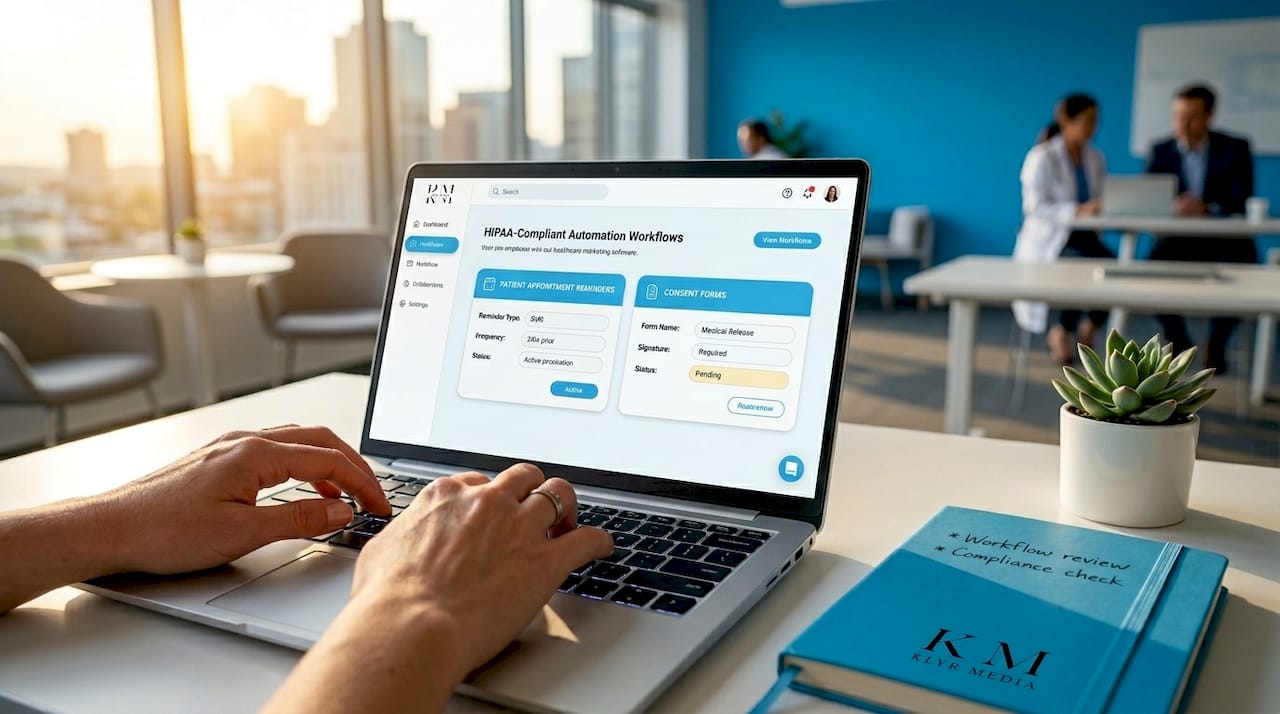
The right platform is not just about features. It’s about whether the vendor will sign a Business Associate Agreement (BAA) with you, because without one, you are not HIPAA-compliant. HIPAA-compliant marketing automation tools must include BAAs, end-to-end encryption, audit logs, and role-based access control. That narrows the field considerably.
Here are the platforms that meet the bar for most healthcare practices:
- HubSpot (with BAA): Strong CRM, email automation, and landing pages. Requires a HIPAA add-on and a signed BAA. Best for practices that want an all-in-one marketing hub.
- Salesforce Health Cloud: Built specifically for healthcare. Native HIPAA controls, deep EHR integration, and advanced segmentation. Better suited for larger practices or health systems.
- ActiveCampaign (with BAA): Affordable, flexible automation workflows, and a BAA available on higher-tier plans. Popular with mid-size clinics.
- Klara or Luma Health: Purpose-built for patient communication. Handles SMS, appointment reminders, and two-way messaging with compliance baked in.
| Platform | BAA Available | Key Automation Features | Best For |
|---|---|---|---|
| HubSpot | Yes (HIPAA add-on) | Email, CRM, workflows, landing pages | Multi-channel marketing teams |
| Salesforce Health Cloud | Yes | EHR integration, segmentation, analytics | Large practices, health systems |
| ActiveCampaign | Yes (higher tiers) | Email sequences, tagging, SMS | Mid-size clinics on a budget |
| Luma Health | Yes | SMS reminders, recalls, two-way chat | Patient communication focus |
Integration with your practice management system is non-negotiable. A platform that cannot pull appointment status or patient visit history from your EHR will force your team to manually update lists, which defeats the purpose entirely.
Pro Tip: Before signing any contract, ask the vendor for their BAA template and have your compliance officer review it. A BAA that limits liability to the vendor without covering your specific use cases is not worth the paper it’s printed on.
How to design consent-compliant automation workflows
Most practices get this wrong. They assume that because a patient gave their phone number at intake, they have consent to send automated texts. That assumption is a compliance failure waiting to happen. Written consent is required under TCPA for automated or PHI-referencing healthcare texts, and it must be transparent, include message types, frequency, and a clear opt-out path.
The right approach is a consent-forward enrollment journey. Here’s how to build one:
- Separate enrollment from consent. Signing up for a patient portal is not the same as consenting to marketing texts. Treat these as two distinct steps with two distinct forms.
- Collect channel-specific opt-ins. A patient who agrees to email reminders has not agreed to SMS. Capture preferences by channel: email, SMS, and phone calls separately.
- Use double opt-in for SMS. Send a confirmation text after signup that requires the patient to reply “YES” before any further messages go out. Consent-forward enrollment journeys increase program sign-ups by making permissions clear and reducing friction.
- Document everything. Store consent timestamps, IP addresses, and form versions in your CRM. If you ever face an audit, this is your defense.
- Honor opt-outs immediately. Opt-out requests must be processed within 10 business days under CAN-SPAM, but best practice is within 24 hours. Every “STOP” reply or unsubscribe click should trigger an immediate suppression across all channels.
The most effective compliant messaging flows are appointment reminders sent 48 hours and 2 hours before a visit, post-visit follow-ups asking about recovery or satisfaction, and re-engagement campaigns for patients who have not returned in 6 or 12 months. None of these require clinical data. They run on appointment status and visit history alone, which keeps you well clear of PHI-based marketing triggers.
Pro Tip: Build your consent UX as if it were clinical intake. Clear language, no pre-checked boxes, and a visible opt-out link in every message. Patients who feel respected stay subscribed longer and show up more reliably.
Step-by-step guide to implementing automation in your practice
Before you touch a single workflow, do a data readiness check. Your patient records need to be clean, your practice management system needs to sync with your chosen platform, and your compliance team needs to sign off on the data flows. Skipping this step means you will be sending the wrong messages to the wrong people from day one.
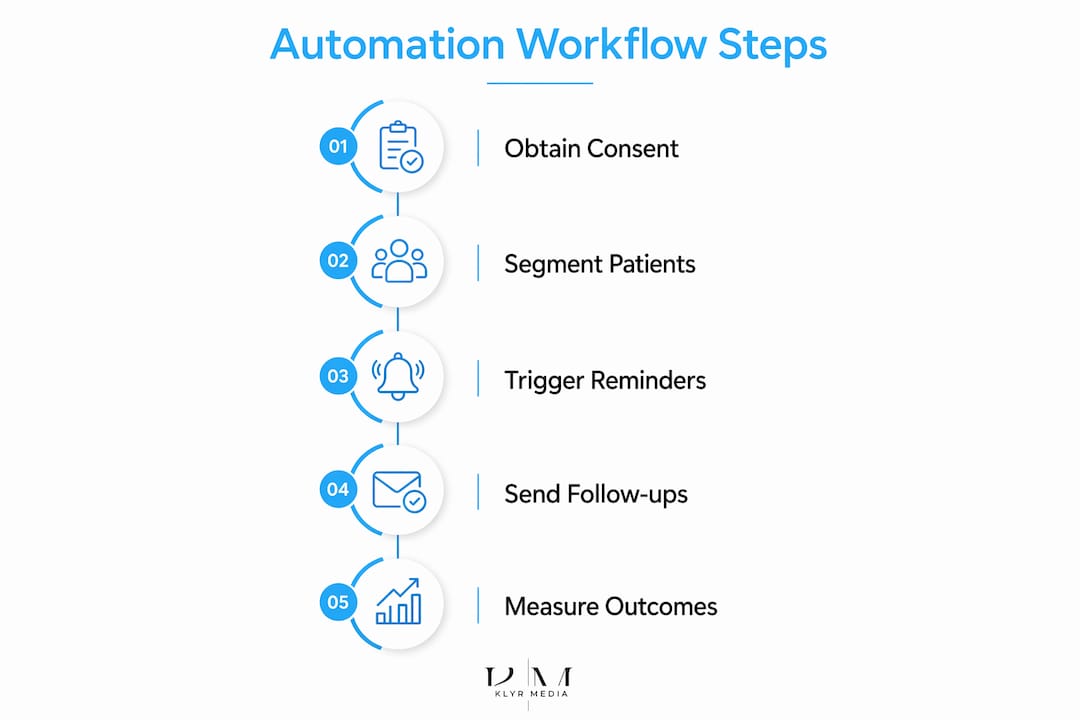
Once you’re ready, follow this sequence:
-
Map your patient journey triggers. Identify every moment where a message adds value: new patient welcome, appointment booked, appointment reminder, post-visit follow-up, recall due, lapsed patient re-engagement. Each trigger becomes the entry point for an automation sequence.
-
Segment your patient list. New patients need different messaging than returning ones. Patients scheduled for a wellness visit need different content than those coming in for a chronic condition follow-up. Automation sequences that personalize via appointment type, care pathway, and new versus returning status consistently outperform generic blasts.
-
Build multi-channel sequences that respect preferences. If a patient opted into email only, do not send them an SMS. Your platform should enforce this automatically, but verify it in testing. Email works well for longer content like care tips or practice updates. SMS works best for time-sensitive reminders.
-
Set up your metrics dashboard before launch. You need to track no-show rates, re-appointment rates, and patient re-engagement rates from the start. If you launch without a baseline, you cannot prove the automation is working.
Common pitfalls to avoid:
- Launching without testing opt-out flows end to end
- Using a single list for all patients instead of segmented audiences
- Forgetting to update suppression lists across all connected platforms
- Sending messages that reference clinical details without explicit PHI authorization
Pro Tip: Run a “ghost patient” test before going live. Create a fake patient record, go through every automation trigger, and verify that every message arrives correctly, that opt-out works, and that no PHI appears where it should not.
How to measure and optimize your automation efforts
Open rates are a vanity metric in healthcare marketing. The numbers that actually matter are appointment conversion rate, no-show reduction, and patient re-engagement rate. If your automation is working, you will see fewer empty slots on the schedule and more returning patients on the books.
Track these metrics by connecting your marketing platform to your practice management system. When a patient clicks a “Book Now” link in an email and completes an appointment, that conversion should be visible in both systems. Without that connection, you are flying blind.
Optimization techniques that actually move the needle:
- A/B test message timing. A reminder sent 48 hours before an appointment may outperform one sent 24 hours before, or vice versa. Test one variable at a time and run each test for at least 30 days.
- Refine segmentation quarterly. Patient behavior changes. Someone who was a frequent visitor last year may have lapsed. Update your segments based on actual visit data, not assumptions.
- Audit consent records every 6 months. Patients change their minds. Preferences collected 18 months ago may no longer reflect current wishes. A regular audit also protects you during compliance reviews.
Automation programs that prioritize aftercare reminders and re-engagement consistently outperform acquisition-focused campaigns in healthcare. This is a counterintuitive finding for practices that spend heavily on new patient ads. Retaining the patients you already have is cheaper, more compliant, and more effective than chasing new ones.
What are common compliance mistakes in healthcare marketing automation?
The biggest mistake is using a tool that does not have a signed BAA. HIPAA requires written authorization before using PHI for marketing communications, and that authorization must be specific to the intended use. A generic intake form does not cover you.
Here are the compliance failures that show up most often:
- No BAA with the marketing vendor. This is the most common and most expensive mistake. Fines for HIPAA violations start at $100 per violation and can reach $50,000 per incident.
- Implied consent for SMS. Assuming a patient consented because they gave you their number is a TCPA violation. Misassumptions about implied consent are the leading cause of compliance failures in healthcare texting programs.
- Opt-outs not syncing across systems. If a patient unsubscribes from email in HubSpot but your SMS platform does not know about it, you will keep messaging them. Cross-system synchronization is mandatory to honor opt-outs and stay compliant.
- Personalization that pulls clinical data. Using a patient’s diagnosis or medication in a marketing message without explicit PHI authorization is a direct HIPAA violation.
Treat consent, suppression, and messaging preferences as a single source of truth synchronized across all systems. If any one platform holds a stale opt-out record, you are one message away from a complaint.
Key takeaways
Healthcare marketing automation works best when compliance, consent management, and patient-centered sequencing are built in from the start, not added as an afterthought.
| Point | Details |
|---|---|
| Choose compliant tools first | Only use platforms with signed BAAs, encryption, and audit logs before building any workflow. |
| Consent is channel-specific | Collect separate opt-ins for email, SMS, and phone. Never assume one form covers all channels. |
| Post-visit sequences drive ROI | Aftercare reminders and re-engagement campaigns outperform new patient acquisition campaigns in retention and cost. |
| Sync opt-outs across all systems | A suppression in one platform must propagate to every connected tool within 24 hours. |
| Measure what moves the schedule | Track no-show rates and re-appointment rates, not just open rates, to prove automation value. |
What I’ve learned from healthcare automation projects
Here’s the uncomfortable truth most marketing consultants won’t tell you: the practices that get the most out of automation are not the ones with the fanciest tools. They are the ones that spent two weeks cleaning their patient data and mapping their consent flows before touching a single workflow builder.
I’ve seen clinics drop $15,000 on a Salesforce Health Cloud implementation and then send their first campaign to a list that included patients who had opted out six months earlier. The tool was not the problem. The process was.
The other thing I keep seeing is practices that obsess over new patient acquisition campaigns while their existing patients quietly disappear. A patient who visited once and never came back is revenue that never walked in again. A well-timed re-engagement email at the 90-day mark, asking how they’re doing and offering an easy rebooking link, costs almost nothing and recovers a meaningful percentage of those lapsed relationships.
The future of this space is AI-driven personalization layered on top of compliant consent infrastructure. Platforms are already using predictive models to identify patients at risk of lapsing before they actually do. That is where the real gains are. But none of it works without the foundation: clean data, explicit consent, and a suppression list that every platform respects.
Start with the boring stuff. The results are anything but boring.
— Opinly
How Klyrmedia helps you build compliant automation that actually works
If you’ve read this far, you know the gap between “we have a marketing platform” and “we have a compliant, patient-centered automation system” is significant. Klyrmedia closes that gap for independent pharmacies, medical clinics, and healthcare practices across the United States.
Klyrmedia builds HIPAA-compliant marketing systems from the ground up, including consent management architecture, practice management system integration, and multi-channel automation sequences designed specifically for healthcare workflows. Their AI-powered marketing automation services handle everything from patient engagement strategy to campaign execution, so your team focuses on care while the system handles follow-up. If you’re ready to stop losing patients between visits, Klyrmedia is worth a conversation.
FAQ
What is healthcare marketing automation?
Healthcare marketing automation is the use of HIPAA-compliant software to send personalized, consent-based messages to patients at key points in their care journey, including appointment reminders, post-visit follow-ups, and re-engagement campaigns.
Do I need a BAA with my marketing automation vendor?
Yes. Any vendor that handles protected health information on your behalf must sign a Business Associate Agreement. Operating without one is a direct HIPAA violation regardless of how the data is used.
What is the difference between HIPAA and TCPA in healthcare marketing?
HIPAA governs the use of protected health information in marketing communications, while TCPA governs automated text messages and calls. Healthcare marketers must comply with both, which means obtaining written authorization for PHI use and explicit written consent for automated texts.
Which marketing automation tools work best for clinics?
HubSpot with a HIPAA add-on, Salesforce Health Cloud, ActiveCampaign on higher-tier plans, and purpose-built tools like Luma Health are among the top healthcare marketing automation tools. The right choice depends on your practice size, budget, and integration requirements.
How do I measure whether my automation is working?
Track appointment conversion rate, no-show reduction, and patient re-engagement rate rather than open rates alone. Connect your marketing platform to your practice management system so you can see which campaigns actually result in completed appointments.

