
5 Documents U.S. Clinics Must Get From HIPAA Compliant SMS Platforms
For U.S. clinics: five procurement proofs to demand from HIPAA compliant SMS platforms — signed BAA, encryption, exportable audit logs, RBAC/MFA, and...

5 Documents U.S. Clinics Must Get From HIPAA Compliant SMS Platforms

Yes, U.S. healthcare providers can text patients, but only through a vendor that signs a Business Associate Agreement and proves it, not just claims it. Before you sign anything, demand five things: a signed BAA, encryption in transit and at rest, exportable audit logs, role-based access controls with MFA or SSO, and documented patient consent capture. If a vendor hedges on any of these, do not route protected health information through native SMS. Fall back to a secure patient portal instead.
TL;DR:
- Ensure vendors provide a signed Business Associate Agreement and enforce encryption in transit and at rest; without these, PHI transmission is not HIPAA-compliant.
- Request concrete proof documents like SOC 2 or HITRUST certificates, audit logs, and data residency details to verify vendor compliance claims.
- Recognize that SMS encryption is limited to encryption between the platform and carrier; true end-to-end encryption across networks is not guaranteed for native SMS.
- Use SMS only for logistical purposes like appointment reminders and verification; reserve portals for sharing sensitive health information or test results.
- Implement strict procurement and operational policies, including device management, template controls, and fallback to secure portals, to mitigate common staff errors.
Table of Contents
- What HIPAA Actually Requires From an SMS Vendor
- Which Product Features Actually Map to HIPAA Requirements?
- When Should You Use SMS vs. a Secure Portal?
- What Should Your Procurement Checklist Look Like?
- Where Does “HIPAA-Capable” Still Fall Short?
- How clinics can implement compliant messaging
- What Matters Most When You Choose a Texting Vendor
- Sources
What HIPAA Actually Requires From an SMS Vendor
The confusion around texting and HIPAA usually comes from people treating “compliant” as a marketing label instead of a legal condition. It isn’t a badge a vendor slaps on a pricing page. It’s a set of obligations that only exist once a covered entity and a vendor have a specific contract in place.
Start with the plain legal requirement: 45 CFR 164.502(e) says a covered entity cannot disclose protected health information to a vendor without first getting “satisfactory assurances,” meaning a signed Business Associate Agreement. No BAA means no legal basis for sending PHI through that vendor’s system, full stop. Any SMS platform that tells you a BAA is “optional” or “available on enterprise plans only” is telling you it treats compliance as an upsell, not a baseline.
45 CFR 164.504 spells out what that agreement actually has to cover. A real BAA defines how the vendor may use and disclose PHI, what happens if there’s a breach, how quickly they have to notify you, and what happens to your data when the contract ends. A boilerplate one-pager that mentions “HIPAA compliant service” in the footer is not the same document. Read the actual clauses. If breach notification timelines aren’t specified in days, push back.
Then there’s the technical layer. 45 CFR 164.312 requires four categories of technical safeguards: access controls, audit controls, integrity controls, and transmission security. Translate that into questions you can actually ask a sales rep:
- Does the platform encrypt data in transit (TLS 1.2 or higher) and at rest (AES-256 or equivalent)?
- Can every message send, edit, and delete action be traced to a specific user with a timestamp?
- Are audit logs exportable, and how long are they retained?
- Does the platform enforce role-based permissions so front-desk staff can’t see clinical notes meant for providers?
- Is multi-factor authentication mandatory, or optional and rarely turned on?
Administrative safeguards matter just as much and get skipped more often. A vendor needs documented security policies, an incident response plan, workforce training records, and a system for capturing and storing patient consent. HHS keeps a central hub for HIPAA guidance that’s worth bookmarking, because it walks through covered entity responsibilities in plain language rather than statute-speak.
Here’s a number that should change how you shop: requesting concrete proof documents during procurement, rather than accepting verbal assurances, does two things at once. It filters out vendors who are bluffing, and it gives you an audit trail if the Office for Civil Rights ever comes asking questions after an incident. That second part matters more than most administrators realize until they’re living it.
Before you sign, ask every vendor to hand over:
- A signed BAA template you can review with legal, not just a compliance FAQ page.
- A security whitepaper detailing encryption standards, data residency, and backup procedures.
- SOC 2 Type II or HITRUST certification, if they have one. Not every legitimate vendor holds HITRUST, but the absence of any third-party audit should raise your scrutiny.
- A sample audit log export so you can see what fields it actually captures.
- A written statement on where data is stored and whether it stays within U.S. data centers.
Vendors who resist providing any of these are telling you something. Take the hint.
Which Product Features Actually Map to HIPAA Requirements?
Compliance language and product features don’t always line up the way marketing pages suggest. This is where procurement teams get misled, often without realizing it.
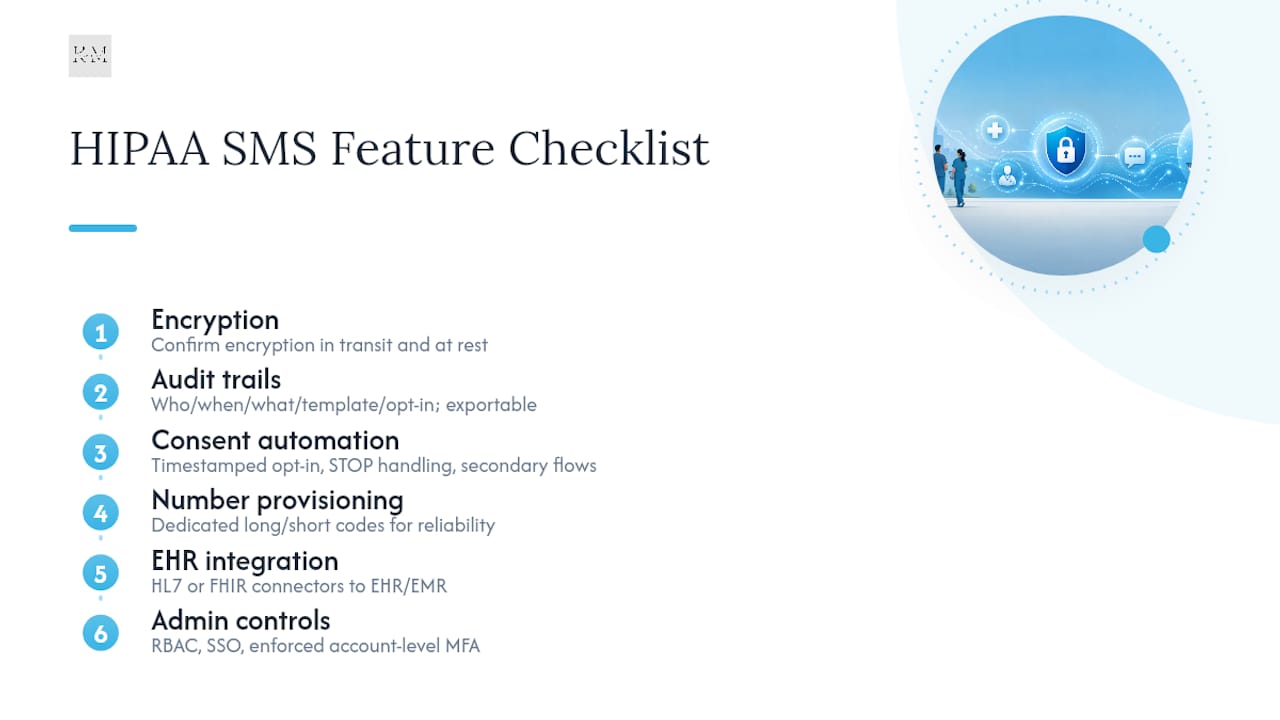
Encryption claims need translation. “End-to-end encrypted” sounds airtight, but for SMS specifically, it’s often misleading. Native SMS travels through carrier networks that no vendor fully controls, which means true end-to-end encryption across the whole path isn’t realistic for standard text messages. What you actually want confirmed is encryption in transit between the platform and the carrier, plus encryption at rest for anything stored on the vendor’s servers. If a sales page leans hard on “end-to-end” without specifying where encryption starts and stops, ask directly.
Audit trails need specific fields, not just a log. A usable audit trail records who sent a message, when, to whom, what template was used, and whether the patient opted in or out. It should be exportable in a standard format (CSV or JSON, typically) and retained long enough to satisfy your organization’s record retention policy, often six years or more depending on state rules layered on top of HIPAA. Ask whether logs are immutable, meaning staff can’t quietly edit history after the fact.
Consent automation saves your front desk real time. Look for platforms that capture opt-in language automatically at first contact, log it with a timestamp, and handle STOP replies without a human having to intervene. Secondary consent flows, where a patient can opt into appointment reminders but not marketing texts, reduce both legal exposure and patient irritation.
Number provisioning affects deliverability and trust. Dedicated long codes or short codes tend to route more reliably than shared numbers, and they matter operationally when patients need to recognize your clinic’s number on caller ID or reply history.
Integration capability separates a real HIPAA-capable platform from a texting app with a compliance sticker. Look for HL7 or FHIR connectors that sync with your EHR or EMR system, along with admin controls like RBAC, SSO, and enforced MFA at the account level, not just as an option buried in settings.
Pro Tip: Ask for a live demo of the STOP/opt-out flow before you sign anything. If a rep has to check with engineering to show you how it works, that tells you it’s not a mature feature.
Operationally, verify template controls (so staff can’t freelance PHI into a text field), suppression lists for patient communication preferences, and a documented fallback to a secure portal link when a message needs more than a one-line reminder.
When Should You Use SMS vs. a Secure Portal?
The safest rule of thumb: SMS is for logistics, portals are for medical content. Getting this wrong is how PHI ends up somewhere it shouldn’t.
- Appointment confirmations and reminders. “Reminder: your appointment with Dr. Patel is tomorrow at 2:00 PM. Reply C to confirm.” No diagnosis, no medication name, minimal identifying detail. This is the textbook safe use case, and it’s also the one with the clearest ROI for cutting no-show rates.
- Check-in prompts. A text telling a patient to complete digital intake forms before arrival carries almost no PHI risk, since the link itself should route to an authenticated portal.
- Medication refill reminders, worded generically. “Your prescription refill is ready for pickup” works. Naming the specific medication in the text does not, especially for anything sensitive.
- Test results and treatment recommendations. These belong behind a secure, authenticated portal login, never in the SMS body itself. Send a text that says “You have a new secure message” and let the patient log in to read it.
- Behavioral health and substance use disclosures. These carry extra legal protection under separate federal rules beyond HIPAA, and they should never touch native SMS content, even as a passing reference.
- Staff-to-staff clinical messaging. Provider-to-provider communication about a specific patient’s case requires stronger vendor controls than patient-facing reminders. Treat it as a separate risk category with its own access rules, not an extension of your patient texting platform.
The hybrid pattern that works best in practice: use SMS to notify and gather consent, then hand off anything PHI-heavy to a portal link. A clinic’s approach to secure messaging often blends both channels deliberately rather than picking one exclusively. For consent language, something as simple as “Reply YES to receive appointment reminders by text. Msg & data rates may apply. Reply STOP to opt out” covers the bases without ever touching clinical detail. If your reminder workflow is your biggest pain point, a compliance-first approach to appointment reminders is worth reviewing before you finalize templates.
What Should Your Procurement Checklist Look Like?
Treat this like an RFP requirement list, not a nice-to-have.
- Require a signed BAA before any pilot data touches the platform, not after.
- Request the SOC 2 or HITRUST report directly, and have someone actually read it rather than filing it.
- Get written confirmation of encryption standards for both transit and storage.
- Ask for a sample audit log export and check whether the fields match what your compliance officer needs.
- Confirm U.S. data residency in writing, especially if the vendor uses cloud infrastructure that could span regions.
During the pilot phase, run these tests before rolling out clinic-wide:
- Export an audit log and confirm it captures sender, recipient, timestamp, and message content history.
- Test SSO and MFA login flows with a non-admin staff account.
- Walk through the consent capture flow as a patient would experience it.
- Send a STOP reply and confirm the system suppresses future messages automatically.
- Simulate a service outage and see how the platform handles failover.
On the contract itself, work with legal to pin down breach notification timelines in specific days, not vague “prompt notification” language, along with who bears responsibility for notifying patients, what happens to your data on contract termination (return or verified deletion), and where liability sits if the vendor’s own infrastructure fails. Then plan the rollout: staff training sessions before go-live, updated internal policies reflecting the new tool, device management rules if staff text from personal phones, and a recurring compliance review, quarterly is reasonable, rather than a one-time signoff. For clinics also weighing telehealth integration alongside messaging, a vendor vetting guide for telehealth platforms covers overlapping procurement questions worth asking in the same RFP cycle.
Where Does “HIPAA-Capable” Still Fall Short?
“HIPAA compliant” on a vendor’s homepage doesn’t mean the risk disappears. It means the contractual and technical minimums are met, and the rest is on you.
Native SMS travels across carrier networks that no single vendor fully controls, and CTIA’s messaging interoperability documentation confirms that carrier-to-carrier routing doesn’t come with a universal end-to-end encryption guarantee. That’s structurally different from a consumer app like Signal, which offers genuine end-to-end encryption but does not offer a BAA and isn’t built for covered entity use, regardless of how secure its underlying protocol is.
Human error causes more incidents than infrastructure failure. Staff texting PHI from personal, unmanaged phones. Pasting a lab result into a template field meant for generic reminders. Sending a message to the wrong patient because two records share a similar name. None of these are exotic failures. They’re the ordinary, boring mistakes that happen when a busy front desk is juggling forty tasks at once.
Mitigate with:
- Enforced device management policies for any phone that touches patient messaging.
- Locked templates that physically prevent free-text PHI entry.
- Automatic portal fallback for anything beyond a scheduling reminder.
- Clear retention and deletion schedules so old message data doesn’t linger indefinitely.
When something does go wrong, audit logs and a properly executed BAA are what let you investigate fast and respond to OCR’s breach reporting requirements without scrambling for documentation that should have existed from day one.
How clinics can implement compliant messaging
Some marketing agencies work with independent pharmacies, medical clinics, and healthcare practices to integrate secure patient communication into automation systems for appointment reminders, follow-ups, and patient retention.
A typical engagement starts with discovery: understanding patient communication gaps and compliance posture. Then, assistance with vendor evaluation criteria, integration of messaging APIs into existing systems, and building consent capture directly into automation workflows. Staff training and ongoing monitoring round out the rollout to help maintain compliance.
No agency should promise regulatory outcomes. However, agencies can help document BAAs properly, implement consent flows that hold up to scrutiny, and connect messaging platforms to existing marketing automation systems.
What Matters Most When You Choose a Texting Vendor
Most guidance on this topic spends too much time on encryption jargon and not enough on the paperwork that actually protects you legally. A vendor with flawless AES-256 encryption and no signed BAA offers you zero legal cover. A vendor with a properly executed BAA, decent encryption, and exportable audit logs protects you far better, even if their marketing page is less flashy.
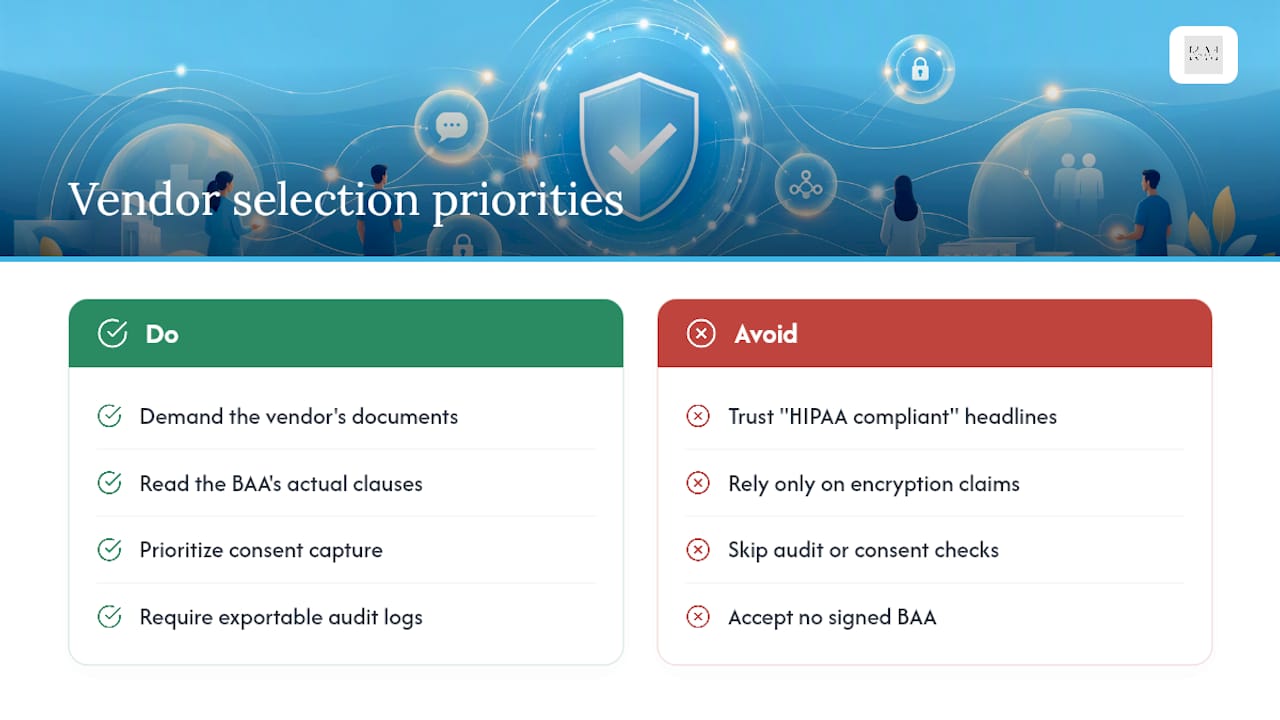
The conventional advice tells administrators to “look for HIPAA compliant” in a vendor’s copy. That phrase means nothing on its own. Demand the documents. Read the BAA’s actual clauses instead of trusting the word “compliant” in a headline.
Prioritize consent capture and audit logging before you worry about which encryption algorithm sounds most impressive. Those two things determine how fast you can respond if something goes wrong, and they’re also what most vendors gloss over fastest when a sales call gets uncomfortable.
— Opinly
This article is general information, not a substitute for advice from a qualified doctor. Consult a qualified healthcare professional about your own circumstances before acting on anything here.
Sources
Save the primary sources, not secondhand summaries. Bookmark 45 CFR 164.502 and 45 CFR 164.504 for BAA requirements, 45 CFR 164.312 for technical safeguards, and the HHS HIPAA hub for plain-language guidance. Keep the CDC’s HIPAA overview handy too. File every vendor’s signed BAA, SOC 2 or HITRUST report, and a sample audit log export alongside these citations so you’re not hunting for proof during an actual investigation.
- 45 CFR 164.502 — Uses and disclosures: organizational requirements
- HIPAA for professionals — HHS
- Breach portal — U.S. Department of Health & Human Services, OCR

