
Healthcare Website Accessibility: A 2026 Compliance Guide
Learn what is healthcare website accessibility and why it's crucial for patient access. Ensure compliance and avoid legal risks by 2026.

Healthcare Website Accessibility: A 2026 Compliance Guide

Healthcare website accessibility is defined as the practice of designing and maintaining digital health resources so that all patients, including those with disabilities, can use them fully and independently. The industry standard term for this practice is digital accessibility, and it is governed primarily by the Web Content Accessibility Guidelines (WCAG) 2.1 Level AA. Federal law now treats inaccessible healthcare websites as a form of discrimination, placing real legal risk on providers who ignore it. If your clinic, pharmacy, or practice has a website, a patient portal, or a scheduling app, this applies to you directly.
What is healthcare website accessibility and why does it matter?
Healthcare website accessibility means every patient can perceive, navigate, and interact with your digital tools regardless of their visual, hearing, motor, or cognitive abilities. This is not a niche concern. The Americans with Disabilities Act (ADA) classifies private healthcare entities as places of public accommodation, which means courts apply WCAG 2.1 AA to assess whether your website discriminates against patients with disabilities. Inaccessible tools that block patients from booking appointments, viewing lab results, or making payments create legally recognized discriminatory barriers.

Section 504 of the Rehabilitation Act adds another layer. As of april 2026, the Department of Health and Human Services (HHS) mandates WCAG 2.1 Level AA compliance for all healthcare providers receiving federal funds. That covers 92% of physicians, 43% of dentists, and 100% of hospitals. The scope is broad, and the deadlines are firm.
The importance of website accessibility in healthcare goes beyond avoiding lawsuits. Accessible design improves usability for elderly patients, people with temporary injuries, and anyone using a mobile device in poor lighting. When your digital front door works for everyone, you retain more patients and build real trust.
What legal and technical standards govern healthcare website accessibility?
Two federal frameworks define the compliance landscape for healthcare providers.
Section 504 of the Rehabilitation Act applies to any organization receiving federal funding, including Medicare and Medicaid reimbursements. The HHS rule treats inaccessible websites, apps, and kiosks as discrimination under federal law. Compliance deadlines are set at may 11, 2027 for providers with 15 or more employees, and may 10, 2028 for smaller entities.
Title III of the ADA covers private healthcare entities as places of public accommodation. Courts consistently apply WCAG 2.1 AA as the technical benchmark for determining whether a website is accessible.
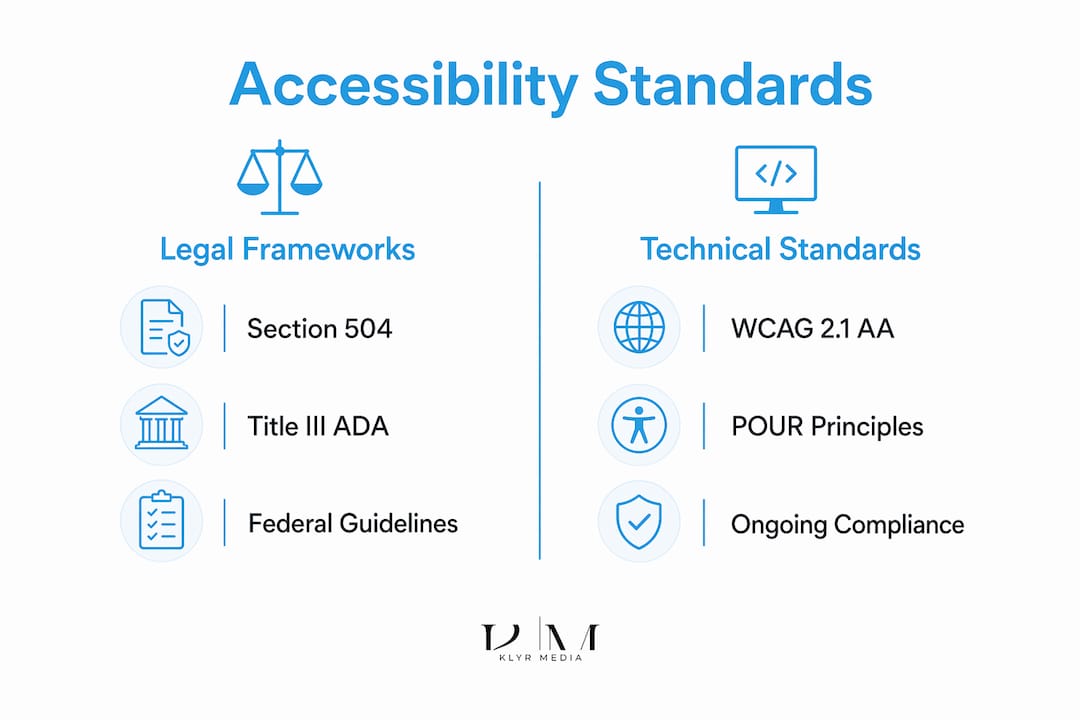
WCAG 2.1 Level AA organizes requirements around four principles. The POUR framework stands for Perceivable, Operable, Understandable, and Robust. Each principle addresses a different category of patient need.
| WCAG Principle | What it requires | Patient impact |
|---|---|---|
| Perceivable | Alt text for images, captions for video | Patients with vision or hearing loss can access content |
| Operable | Full keyboard navigation, no seizure-triggering content | Patients with motor impairments can use the site |
| Understandable | Clear language, consistent navigation, error messages | Patients with cognitive disabilities can complete tasks |
| Robust | Compatible with screen readers and assistive tech | All patients using assistive devices get equal access |
One critical point most providers miss: legal responsibility stays with you, not your vendor. If your third-party scheduling tool or billing portal fails WCAG 2.1 AA, your organization is liable.
What are common accessibility barriers on healthcare websites?
Most healthcare websites have accessibility gaps that patients encounter every day. These barriers fall into four categories tied to the POUR framework.
- Vision barriers: Missing alt text on images, low color contrast between text and background, and PDFs that screen readers cannot parse. A patient using a screen reader cannot understand a chart with no text description.
- Hearing barriers: Videos without captions or transcripts. Telehealth intake videos and patient education content are frequent offenders.
- Motor barriers: Forms and menus that require a mouse to navigate. Patients with limited hand mobility rely on keyboard-only navigation, and sites that block this lock them out entirely.
- Cognitive barriers: Confusing form instructions, inconsistent navigation labels, and error messages that do not explain how to fix the problem. These affect patients with memory issues, learning disabilities, or anxiety.
The scope of accessible healthcare websites extends beyond the homepage. Patient portals, telehealth apps, appointment schedulers, online payment systems, and even self-service kiosks must all conform to WCAG 2.1 AA. A patient who cannot complete a check-in kiosk at your front desk faces the same barrier as one who cannot book online.
Pro Tip: Run your website through a free automated checker like the WAVE tool or axe DevTools as a first pass. Automated tools catch roughly 30% of issues. Manual testing with a screen reader like NVDA or VoiceOver is required to find the rest.
The consequences of these barriers are direct. Patients who cannot access your digital tools delay care, call your staff for help, or leave for a competitor. Each barrier is also a potential ADA complaint or HHS investigation.
How does accessibility compliance improve patient experience and reduce legal risk?
Accessibility is a civil rights issue, not a technical preference. The HHS rule treats inaccessible websites as discrimination, placing it in the same legal category as a clinic without a wheelchair ramp. That framing matters because it shifts how you should think about your digital tools.
“Accessibility improvements enhance usability for a diverse patient population, including seniors and people with disabilities, leading to better health outcomes and patient retention.”
The benefits of website accessibility in healthcare compound over time. WCAG 2.1 AA compliance lowers friction for a broader patient population, including elderly patients with age-related vision or hearing changes. When your website is easier to use, patients complete tasks without calling your staff, appointment no-shows drop, and satisfaction scores rise. You can read more about how these improvements connect to broader digital patient experience outcomes.
Reducing legal risk requires a structured approach. Here is what that looks like in practice:
- Conduct a baseline audit. Use both automated tools and manual testing with assistive technologies to document your current gaps.
- Remediate by priority. Fix barriers that block core patient tasks first: scheduling, portal login, and payment.
- Update vendor contracts. Require every third-party platform to meet WCAG 2.1 AA in writing. This is non-negotiable under Section 504.
- Schedule recurring audits. Accessibility degrades as websites change. Quarterly reviews catch regressions before they become complaints.
- Document everything. An accessibility statement and a remediation log demonstrate good-faith effort if a complaint is filed.
Providers who treat accessibility as a one-time project will fail. The law expects ongoing compliance, and patients expect consistent access.
What practical steps can healthcare providers take to improve website accessibility?
Improving digital accessibility starts with knowing what you have. A comprehensive audit covers every patient-facing digital asset, not just the main website.
- Website: Check all pages, not just the homepage. Blog posts, service pages, and contact forms all fall under WCAG 2.1 AA.
- Patient portal: Test login flows, messaging, lab result displays, and prescription refill requests with a screen reader.
- Telehealth platform: Verify that video interfaces have captions and that controls are keyboard-accessible.
- Mobile app: Test on both iOS with VoiceOver and Android with TalkBack.
- Kiosks: Self-service kiosks for check-in, payment, and wayfinding must offer equal access under Section 504.
Staff training is often overlooked. Your front desk team, content editors, and IT staff all affect accessibility. Content editors who add images without alt text undo months of remediation work. Training takes a few hours and prevents ongoing regressions.
Pro Tip: When signing contracts with any digital health vendor, include a clause requiring WCAG 2.1 AA conformance and the right to audit. Providers cannot transfer liability to vendors, but contracts create accountability and give you recourse.
The table below maps common digital assets to the team responsible for maintaining accessibility.
| Digital asset | Primary owner | Key accessibility check |
|---|---|---|
| Main website | Web/marketing team | Alt text, color contrast, keyboard nav |
| Patient portal | IT or vendor | Screen reader compatibility, form labels |
| Telehealth app | Vendor (with contract clause) | Captions, keyboard controls |
| Check-in kiosk | Facilities/IT | Audio output, tactile controls |
| Social media content | Marketing team | Alt text on images, captions on video |
Accessibility is a continuous operational process. Integrating audits into content workflows prevents the gradual degradation that happens when teams update pages without accessibility checks. Assign ownership, set review schedules, and treat it like any other compliance obligation. You can also explore how website optimization for healthcare connects accessibility improvements to measurable gains in patient engagement and online bookings.
Key takeaways
Healthcare website accessibility is a legal compliance requirement and a patient equity obligation that applies to every digital asset your practice operates, governed by WCAG 2.1 Level AA under both Section 504 and the ADA.
| Point | Details |
|---|---|
| Legal deadlines are firm | Providers with 15+ employees must comply by may 11, 2027; smaller entities by may 10, 2028. |
| Scope is broader than the homepage | Portals, apps, kiosks, and social media content all fall under WCAG 2.1 AA requirements. |
| Vendors do not absorb your liability | Contracts must require WCAG 2.1 AA compliance; providers remain legally responsible. |
| Accessibility benefits all patients | Elderly patients and those with temporary impairments also benefit, improving retention. |
| Compliance requires ongoing audits | One-time fixes degrade as websites change; recurring reviews are required to stay compliant. |
Why accessibility is the compliance issue most healthcare providers are not taking seriously enough
I have worked with enough healthcare practices to know that accessibility usually sits at the bottom of the digital priority list. Providers focus on HIPAA, patient volume, and reimbursement rates. Accessibility feels abstract until an HHS complaint lands or a patient files an ADA lawsuit.
Here is the uncomfortable truth: most healthcare websites I see would fail a basic WCAG 2.1 AA audit today. Missing alt text, forms that break with keyboard navigation, patient portals that screen readers cannot parse. These are not edge cases. They are the norm.
The misconception I hear most often is that this is the vendor’s problem. It is not. Your EHR vendor, your telehealth platform, your scheduling tool — if any of them fail WCAG 2.1 AA, you are the one facing the complaint. The law is clear on this, and the digital front door compliance obligation sits with the provider.
What I find encouraging is that accessibility improvements almost always make the website better for everyone. Cleaner navigation, clearer language, faster load times on mobile. The work you do to meet WCAG 2.1 AA tends to raise your overall patient experience scores. Accessible design and good design are the same thing more often than not.
The providers who will struggle are the ones waiting for a complaint to act. The ones who build accessibility into their content workflows now will be ahead of the compliance curve and ahead of their competitors on patient experience. That is a real competitive advantage, and it costs less to build right than to fix under legal pressure.
— Opinly
Klyrmedia builds accessible, HIPAA-compliant healthcare websites
Your website is your digital front door. If it fails WCAG 2.1 AA, it is also a legal liability and a barrier to patient care.
Klyrmedia specializes in HIPAA-compliant web design built specifically for independent pharmacies, medical clinics, and healthcare practices across the United States. Every site Klyrmedia builds is designed to meet current accessibility standards alongside HIPAA security requirements, so you are not choosing between compliance and patient experience. You get both. If your practice is approaching the 2027 compliance deadline and your current website is not ready, now is the right time to act.
FAQ
What is healthcare website accessibility?
Healthcare website accessibility is the practice of designing digital health tools so all patients, including those with disabilities, can use them independently. It is governed by WCAG 2.1 Level AA under both the ADA and Section 504 of the Rehabilitation Act.
Who is required to comply with healthcare web accessibility standards?
Any healthcare provider receiving federal funding, including Medicare and Medicaid reimbursements, must comply with HHS Section 504 digital accessibility rules. Private healthcare entities also face ADA Title III obligations regardless of federal funding.
What is the compliance deadline for healthcare website accessibility?
Providers with 15 or more employees must meet WCAG 2.1 Level AA by may 11, 2027. Smaller healthcare entities have until may 10, 2028.
Does accessibility compliance apply to third-party vendor platforms?
Yes. Providers cannot transfer legal responsibility to vendors. Telehealth portals, billing systems, and scheduling tools must all meet WCAG 2.1 AA, and providers must contractually require this and audit vendor platforms regularly.
What are the benefits of website accessibility in healthcare beyond compliance?
Accessible websites reduce friction for elderly patients and those with temporary impairments, improving usability for a broader patient population. This leads to higher patient retention, fewer support calls, and better overall satisfaction scores.

