
Healthcare digital transformation: What it means and how to get it right
Discover what healthcare digital transformation means and learn how to enhance patient engagement and improve practice outcomes effectively.

Healthcare digital transformation: What it means and how to get it right

Practices across the U.S. have invested heavily in EHRs, patient portals, and scheduling software over the past decade. Yet digital patient engagement scores in 2023 sat at a median of just 14 out of 100, according to athenahealth’s Patient Digital Engagement Index. That number should stop you cold. It means most practices have the tools but aren’t getting the results. True digital transformation is not about technology ownership. It’s about changing how your practice operates, how patients experience care, and how you make decisions. This article breaks all of that down and gives you a clear path forward.
Table of Contents
- What is healthcare digital transformation?
- Myth vs reality: Why tech alone isn’t enough
- Patient engagement: Digital tools and real-world progress
- Bridging the gap: Implementation challenges and practical strategies
- Measuring value: How to track digital ROI in healthcare
- The uncomfortable truth: Digital transformation is an ongoing change, not a checkbox
- Digital transformation partners: Take the next step with expert support
- Frequently asked questions
Key Takeaways
| Point | Details |
|---|---|
| Beyond new technology | True healthcare digital transformation means changing how your practice operates, not just upgrading your software. |
| Engagement is lagging | Most practices have significant room to improve digital engagement with patients based on current benchmarks. |
| Success factors | Leadership, stakeholder involvement, and ongoing measurement separate winning transformation initiatives from underperforming ones. |
| Overcoming gaps | Addressing workflow integration and staff readiness is key to realizing value, not just deploying new tools. |
| Measure what matters | ROI must focus on behavioral and outcome changes, not just technology usage rates. |
What is healthcare digital transformation?
Let’s start with a clear explanation of what digital transformation actually means for healthcare practices.
A lot of practice owners hear “digital transformation” and think: buy new software, flip it on, done. That’s not it. Not even close.
Digital transformation in healthcare is the process of applying digital technologies to fundamentally reshape how organizations operate, deliver care, and manage data, with goals that include better patient outcomes, improved efficiency, and reduced costs. Notice what’s front and center: outcomes, efficiency, cost reduction. Not the software itself.

Think of it this way. A practice that digitizes paper forms but still uses them the same way has upgraded a tool. A practice that redesigns its intake workflow, connects patient data across every touchpoint, and automates follow-ups has transformed. Big difference.
Here’s what digital transformation actually covers when done right:
- Operational redesign: Workflows are rebuilt around digital capabilities, not just supplemented by them.
- Data-driven decisions: Clinicians and administrators use real-time data to guide care and resource allocation.
- Improved information sharing: Patient records, billing, scheduling, and communication flow across systems without friction.
- Automation of repetitive tasks: Appointment reminders, refill requests, and insurance verifications run without manual effort.
- Better patient-facing experiences: Patients can interact with your practice the way they interact with every other service in their life, digitally and on their schedule.
“Digital transformation is not a project with an end date. It is a continuous shift in how your organization creates value.”
Understanding this digital transformation overview from the ground up sets the right expectations. If you go in thinking it’s a one-time tech purchase, you’ll be disappointed. If you go in knowing it’s a strategic operating shift, you’ll be positioned to succeed.
Myth vs reality: Why tech alone isn’t enough
Now that we’ve defined digital transformation, let’s clarify why many efforts don’t deliver real results.
Here’s an uncomfortable truth most vendors won’t tell you: the technology almost never fails on its own. What fails is everything around it. The planning, the buy-in, the change management, the metrics.
Successful digital transformation requires more than a technology purchase. It depends on digital strategy, strong leadership, stakeholder involvement, and clear metrics for ROI. HIMSS, one of the most respected voices in health IT, puts this at the core of their framework. So why do so many practices skip these steps?
Because technology feels tangible. You can see the software. You can demo it. You can present it to your board and say, “We bought this.” Strategy is harder to package and sell internally. Leadership alignment takes longer. Change management feels soft and slow. So practices skip it.
And then they wonder why the portal adoption rate is 8%.
The key drivers that separate transformation success from expensive failure include:
- Strong, visible leadership: Physicians, administrators, and owners need to champion change actively, not just approve a budget line.
- Stakeholder buy-in early: Nurses, front desk staff, and billers have to understand why the change is happening, or they’ll work around it.
- Clear metrics before launch: You need to define success before you deploy, not after you’re disappointed.
- Dedicated ownership: Someone in your practice needs to own the transformation process, not just the IT vendor.
Pro Tip: Before committing to any new digital system, run a 30-minute internal session with frontline staff. Ask one question: “What part of your daily workflow wastes the most time?” Their answers should drive your digital priorities, not a vendor’s feature list.
Consider leadership in digital change as the real starting engine. Without it, every other investment underperforms. And invest time in strategic patient engagement planning before any tool goes live. That’s where the real leverage lives.
Patient engagement: Digital tools and real-world progress
With the fundamentals covered, it’s time to look at how digital transformation translates into patient-facing improvements.
This is where most practices think they’ve arrived. They’ve launched a portal. They have an app link somewhere on their website. They added telehealth during the pandemic and kept it running. That’s a start. But the engagement gap is still massive.
That median PDEI score of 14 out of 100 tells us most patients aren’t actually using what practices have built. The tools are there. The engagement isn’t.
Patient engagement digital tools, including portals, apps, and virtual care, enable patients to manage their care and reduce administrative burden on clinicians. That’s the goal. The reality? Most patients still call the front desk for things they could handle digitally in 90 seconds.
Here’s a snapshot of where digital engagement tools stand and how adoption is actually trending:
| Digital Tool | Adoption Level | Primary Benefit | Biggest Barrier |
|---|---|---|---|
| Patient portals | Moderate | Records access, messaging | Low activation rates |
| Online scheduling | Growing | Reduces phone volume | Workflow integration |
| Online bill pay | Rising | Faster collections | Patient trust in digital payment |
| Telehealth | Stabilizing post-COVID | Access for rural/busy patients | Reimbursement uncertainty |
| Mobile health apps | Low to moderate | Chronic care management | App download friction |
| Automated reminders | High where deployed | Reduces no-shows | Personalization gaps |
The good news: activities like online bill pay and digital appointment scheduling are gaining traction. The bad news: broader, deeper engagement, things like care plan management, secure messaging, and follow-up care, still lag significantly.
What are the most impactful moves you can make right now?
- Activate and simplify your patient portal. If it takes more than two minutes to log in and navigate, patients will abandon it.
- Build best practices for engagement into your appointment workflow, not as an afterthought.
- Optimize your patient portal experience so it loads fast, works on mobile, and doesn’t require a manual to use.
- Use email-based engagement strategies to bring lapsed patients back into active digital interaction with your practice.
Pro Tip: The biggest driver of portal adoption isn’t the portal itself. It’s staff behavior at the point of care. When a medical assistant says “I’m going to send your visit summary to your portal today” and walks the patient through logging in, adoption rates jump noticeably. Train your team to make the ask every single time.
Bridging the gap: Implementation challenges and practical strategies
However, real-world execution often exposes new hurdles. Here’s how practices can overcome the biggest ones.
You can have the right strategy, the right technology, and even the right leadership support, and still watch your digital initiative stall out at the implementation stage. This is the phase where the most money gets wasted and the most frustration builds up.
Digital transformation outcomes are often uneven because implementation gaps, including workflow integration, clinician trust, organizational readiness, and change management, can determine whether technology delivers value or simply underperforms. “Simply underperforms” is doing a lot of heavy lifting in that sentence. What it really means is: you spent the budget, the system is running, and nothing material changed.
“Treating digital transformation as an IT project rather than an operating model change is the single most common reason initiatives stall.”
Here’s a comparison of what failure looks like versus what success looks like at the implementation level:
| Failure mode | What it looks like | Better approach |
|---|---|---|
| No workflow redesign | Staff use new tools to do old tasks in old ways | Map current workflows first, then redesign around digital capabilities |
| No clinician buy-in | Physicians route around the system | Involve clinical staff in selection and configuration decisions |
| Training treated as one-time | High turnover means new staff never trained | Build ongoing onboarding into HR processes |
| No accountability owner | Everyone assumes someone else is managing it | Assign a named digital transformation lead internally |
| Measuring the wrong things | Tracking login rates instead of outcomes | Define clinical and operational outcome metrics before go-live |
Treating digital transformation as an operating-model change, not just an IT modernization project, is the mindset shift that separates practices that get results from those that just have more software licenses.
Here’s a practical sequence that works:
- Audit your current workflows before introducing any new tool. Understand where time is lost and where patient handoffs break down.
- Select technology that fits your workflows, not workflows that have to be rebuilt to match the vendor’s assumptions.
- Plan change management formally. Identify champions in every role, from front desk to clinical staff to billing.
- Set a 90-day post-launch review. Look at adoption, friction points, and outcomes. Adjust before problems compound.
- Build in staff feedback loops so issues surface quickly rather than festering into quiet workarounds.
Your operational model transformation needs to account for the human layer. Explore staff readiness and adoption strategies before going live with any new system, and watch for barriers to patient engagement that only show up after deployment.
Measuring value: How to track digital ROI in healthcare
A final key to sustainable digital transformation is knowing where and how you’re moving the needle with your efforts.
Most practices never truly measure whether their digital investments paid off. They know they deployed the tool. They might track login counts. But they don’t know if patient outcomes improved, if staff time was genuinely freed up, or if costs actually came down.
Deloitte’s Digital Transformation Value Database uses roughly 50 value levers across seven categories to help healthcare organizations build quantified business cases for digital initiatives. Fifty levers. That’s not overkill. It’s a recognition that digital transformation touches every corner of operations and care delivery, and each corner has measurable impact.
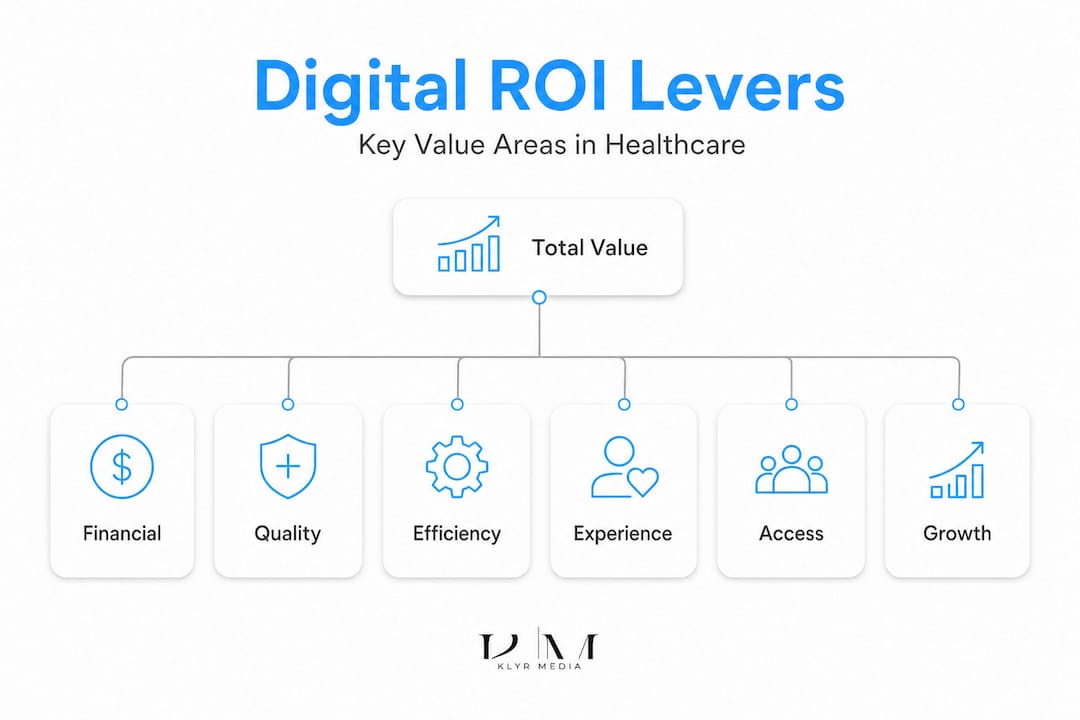
The issue most practices run into? They track deployment and usage rather than decisions and downstream results. That distinction matters enormously. Usage tells you the tool is running. Outcomes tell you whether it’s working.
Here’s what a strong ROI tracking approach looks like in practice:
- Define metrics before go-live, not after you’re already hoping the numbers look good.
- Track behavioral changes: Are patients scheduling online instead of calling? Are refill requests coming through the portal?
- Measure downstream outcomes: Did no-show rates drop? Did patient satisfaction scores improve? Did billing cycle time shorten?
- Separate efficiency gains from experience gains. Both matter, but they require different measurement strategies.
- Revisit metrics quarterly. Digital initiatives that looked disappointing at 30 days often show real gains at 90 to 180 days as adoption builds.
Connecting measurement to your broader ROI in healthcare digital projects strategy keeps the investment accountable and keeps leadership engaged for the long haul.
The uncomfortable truth: Digital transformation is an ongoing change, not a checkbox
Let’s step back and share a real-world perspective many guides overlook.
We’ve worked with a lot of practice owners who declared their digital transformation “complete” after launching a new website and portal. Six months later, they’re frustrated because nothing changed. Patient volume is flat. Staff are still overwhelmed. The portal sits there, mostly unused.
Here’s what almost no one tells you upfront: digital transformation doesn’t have a finish line. It’s a perpetual operating posture, not a project you close out and archive.
Technology rarely fails on its own. Change management, clinician trust, workflow integration, and organizational readiness are frequently the difference between real transformation and expensive underuse. That’s the part that requires ongoing attention. You can’t solve it once and walk away.
The practices that get this right treat digital transformation as a living strategy. They run quarterly reviews of what’s working and what isn’t. They listen to frontline staff. They watch patient behavior data and adjust. They reward small wins and stay honest about setbacks. They also accept that the landscape keeps shifting. AI tools, new patient expectations, payer requirements, and regulatory updates mean your digital strategy from two years ago may already be outdated.
And honestly? That’s okay. The goal isn’t to have a perfect, finished strategy. The goal is to have a practice that learns, adapts, and improves faster than the competition. That requires ongoing investment in people as much as in platforms. Your change management in practice approach, how you communicate, train, and align your team around digital goals, is ultimately what determines whether your tools turn into outcomes or just overhead.
Digital transformation partners: Take the next step with expert support
If you’re ready to move your practice forward, here’s how expert partners can help.
Navigating digital transformation on your own is genuinely hard. Between compliance requirements, patient experience expectations, staff adoption challenges, and technology decisions, it’s a lot to manage while also running a practice. That’s exactly where a specialized partner makes a real difference.
At KLYR Media, we work specifically with healthcare practices, clinics, and independent pharmacies across the U.S. to build digital strategies that are compliant, patient-centered, and designed to grow. Our HIPAA-compliant web design ensures your digital front door meets the standards your patients expect and regulations require. Our healthcare digital transformation solutions go beyond websites to cover the full operating model, from automation to patient engagement systems. And our marketing automation services help you stay connected with patients without adding to your staff’s workload. If you’re serious about turning digital investment into real outcomes, let’s talk.
Frequently asked questions
How does digital transformation improve efficiency in healthcare practices?
It streamlines information sharing, automates workflows, and reduces manual data entry, which collectively save time and lower operational costs. The core goals of digital transformation include better patient outcomes, improved efficiency, and reduced overhead.
What are some examples of digital tools that support patient engagement?
Patient portals, telehealth platforms, online bill pay, and mobile apps all enhance patient engagement by making care more accessible. These patient engagement mechanisms also reduce administrative burden on clinical and front desk staff.
Why do digital health projects fail to deliver results?
Failures most often stem from poor workflow integration, lack of clinician buy-in, and insufficient change management, not the technology itself. Implementation gaps in digital projects are consistently identified as the primary cause of underperformance.
How can practices effectively measure ROI from digital investments?
Practices should define outcome metrics before launch and track behavioral and clinical changes rather than just usage statistics. The Deloitte Digital Transformation Value Database offers a framework with approximately 50 value levers to help build a quantified business case.

