

Healthcare Digital Marketing Checklist 2026

Running a healthcare practice or independent pharmacy without a clear digital marketing plan in 2026 is like filling prescriptions without a formulary. You can do it, but you will waste time, miss patients, and wonder where the revenue went. A solid digital marketing checklist 2026 gives you a structured framework to stop guessing and start growing. This guide was built specifically for healthcare businesses, not general small businesses. You will find the compliance context, channel logic, and budget benchmarks that actually apply to your situation.
Table of Contents
- Key takeaways
- 1. Build your digital marketing checklist 2026 around SMART goals
- 2. Know your audience before picking your channels
- 3. Select channels based on where your patients actually are
- 4. Allocate your budget like a healthcare CFO
- 5. Build a content strategy that earns patient trust
- 6. Run an SEO checklist for 2026 that covers AI search
- 7. Run paid ads that comply with healthcare regulations
- 8. Set up automation with compliance built in
- 9. Set KPIs that actually measure patient outcomes
- 10. Review and optimize monthly, not quarterly
- My take on what actually works in 2026
- How Klyrmedia builds compliant healthcare marketing systems
- FAQ
Key takeaways
| Point | Details |
|---|---|
| Start with SMART goals | Vague goals produce vague results; define numeric targets before spending a single dollar. |
| Focus channels first | Concentrate on 2 to 3 primary channels per patient segment before expanding your reach. |
| Budget with purpose | Allocate 40 to 50% toward paid ads, 20 to 30% toward SEO and content for peak healthcare ROI. |
| Automate with guardrails | AI-powered workflows must include human approval for any regulated clinical or marketing claims. |
| Compliance is non-negotiable | HIPAA mandates strict vendor agreements, data minimization, and authorization before using patient data in marketing. |
1. Build your digital marketing checklist 2026 around SMART goals
Before you touch a single ad campaign or social media post, you need goals that actually mean something. Not “we want more patients.” That is not a goal. That is a wish.
A SMART goal for a healthcare practice sounds like this:
- Specific: Increase new patient appointment bookings from Google search
- Measurable: By 30% over the next 90 days
- Achievable: Based on current website traffic and conversion rate data
- Relevant: Tied directly to Q3 revenue targets
- Time-bound: Achieved by September 30, 2026
Short-term goals (90 days) keep your team accountable. Long-term goals (12 months) guide your budget decisions. You need both running at the same time. A comprehensive checklist framework covers 11 stages, and goal setting is stage one for a reason. Everything downstream depends on it.
Pro Tip: Set one primary goal per channel. When you assign one Google Ads campaign to patient acquisition and a separate email sequence to retention, you can actually measure what is working instead of blending signals.
2. Know your audience before picking your channels
Who are you actually trying to reach? A local pharmacy targeting seniors for medication adherence needs a different channel mix than a physical therapy clinic targeting working adults after sports injuries.

Map out your patient segments first. Write down their age range, how they search for healthcare providers, and which platforms they actually use. You will be surprised how many healthcare marketers skip this step and then wonder why their Instagram ads are not converting.
Audience clarity also tells you which content formats work. Seniors searching for a neighborhood pharmacy respond well to Google search ads and local SEO. Younger patients researching mental health services often engage through Instagram and YouTube. Your checklist must include this audience mapping step before any channel decision gets made.
3. Select channels based on where your patients actually are
Not every platform belongs in your 2026 marketing strategies. Spreading your budget across six channels does not give you six times the results. It gives you diluted messaging and exhausted staff.
The practical recommendation for healthcare businesses is to focus on 2 to 3 channels per patient segment, with messaging adapted to the native format of each platform. Here is how that breaks down:
- Google Ads + Local SEO: Best for high-intent searches like “pharmacy near me” or “urgent care open Sunday”
- Facebook and Instagram: Effective for awareness campaigns targeting chronic condition management or wellness services
- LinkedIn: Relevant if you are marketing to referring physicians or healthcare HR managers
- Email and SMS: Highest ROI for existing patient retention, appointment reminders, and prescription refill nudges
Small healthcare businesses consistently see higher ROI by mastering one channel first before expanding. Resist the urge to be everywhere at once.
Pro Tip: Build a simple one-page channel map that lists each segment, their preferred platform, and your one core message per channel. Print it out. Tape it to your desk. It will save you hours of second-guessing.
4. Allocate your budget like a healthcare CFO
Money without structure is just spending. Healthcare and small business marketing budgets in 2026 typically run 7 to 12% of revenue, with specific allocation targets that are worth following closely.
| Budget Category | Recommended Allocation | Healthcare Rationale |
|---|---|---|
| Paid advertising | 40 to 50% | Drives immediate patient acquisition from high-intent searches |
| SEO and content | 20 to 30% | Builds long-term authority and organic patient trust |
| CRM and automation | 10 to 15% | Retains existing patients and reduces staff workload |
| Website optimization | 10 to 15% | Converts traffic into booked appointments |
If you run a smaller practice or independent pharmacy with a tighter budget, do not spread equally across all four categories. Pick paid ads and website optimization first. Get patients in the door. Then reinvest in SEO and automation as revenue grows.
5. Build a content strategy that earns patient trust
Content in healthcare is not about volume. One poorly written blog post that makes a clinical claim you cannot substantiate will do more damage than no blog at all. In 2026, brand authenticity and accurate substantiation are the standards patients and regulators both expect.
Your content marketing checklist should include:
- FAQ pages answering real patient questions about your services, hours, insurance, and procedures
- Condition-specific landing pages targeting high-volume local search terms
- Patient education blog posts that explain treatments without making diagnostic claims
- Google Business Profile posts updated weekly with hours, promotions, and health tips
- Video testimonials (with proper HIPAA authorization from patients before publishing)
Pair every content piece with a clear intent. Is it meant to rank in search? Convert a visitor into a caller? Educate an existing patient? Content without intent is just noise.
6. Run an SEO checklist for 2026 that covers AI search
SEO in 2026 is not what it was three years ago. You are now optimizing for traditional Google rankings and for AI-driven and agentic search visibility, which extracts structured answers from your pages to populate AI summaries.
What this means for your healthcare SEO strategy:
- Place your primary keyword near the start of your page title
- Use hierarchical headings (H1, H2, H3) to signal content structure to AI crawlers
- Add descriptive alt text to every image, especially photos of your facility and staff
- Structure service pages with clear question-and-answer sections that AI can extract
- Claim and optimize your Google Business Profile with accurate NAP (name, address, phone) data
Local SEO deserves its own attention. For independent pharmacies and small clinics, appearing in the Google map pack for neighborhood searches is often more valuable than ranking number one organically. Both matter. Neither should be ignored.
7. Run paid ads that comply with healthcare regulations
Google Ads for healthcare is not plug-and-play. Certain ad categories require certification. Some remarketing tactics are off-limits under HIPAA. Running a HIPAA-compliant Google Ads campaign requires upfront planning, not an afterthought.
Your paid advertising digital advertising best practices for 2026:
- Avoid using condition-specific targeting in remarketing lists, which can inadvertently expose patient health information
- Get Google’s healthcare ad certification for sensitive medical categories before running ads
- Use call tracking numbers that are HIPAA-compliant, not standard call tracking tools
- A/B test ad copy without making clinical outcome claims that cannot be substantiated
- Align landing page content exactly with ad messaging to improve quality scores and conversion rates
Social media paid ads follow similar rules. Facebook’s health and wellness ad policies restrict certain targeting parameters. Know them before you launch.
8. Set up automation with compliance built in
Here is where a lot of healthcare practices get themselves into trouble. They buy a marketing automation platform, set up email sequences, and never think about whether those workflows touch protected health information.
AI-enabled marketing workflows in 2026 should be automated end-to-end, with human approval reserved for risk points involving regulated claims. That is not just good compliance advice. It is good operations advice.
A practical automation setup for healthcare marketing looks like this:
- New patient welcome sequence: Automated emails confirming the appointment, sharing parking info, and collecting intake forms
- Post-visit follow-up: Automated satisfaction survey 48 hours after an appointment
- Prescription refill reminders: Automated SMS to pharmacy patients 5 days before a refill is due
- Reactivation campaign: Automated email to patients who have not visited in 9 to 12 months
- Review request: Automated text asking for a Google review after a successful visit
Every one of those automations should have a human checkpoint before any content referencing a diagnosis, treatment outcome, or clinical recommendation goes out. Automation governance must be built into the process design, not added as an afterthought.
HIPAA compliance in healthcare marketing requires securing patient authorization before using PHI for marketing purposes, rigorous vendor agreements, data minimization practices, clear disclaimers, and regular staff training. Non-compliance carries fines that can reach into the millions.
Pro Tip: Before connecting any new marketing tool to your patient data, review the Business Associate Agreement (BAA). If the vendor will not sign a BAA, walk away. No tool is worth a HIPAA violation.
9. Set KPIs that actually measure patient outcomes
A KPI like “website traffic” tells you nothing about whether your marketing is working. What you want to know is whether traffic turned into phone calls, phone calls turned into appointments, and appointments turned into retained patients.
Your measurement infrastructure for this online marketing checklist should track:
- Cost per new patient acquisition across each paid channel
- Appointment booking rate from website visitors
- Patient retention rate month over month
- Return on ad spend (ROAS) for each campaign
- Local search ranking position for your top 10 target keywords
Healthcare attribution is genuinely complicated. Patient journeys include offline touchpoints like physician referrals and word-of-mouth that never appear in your Google Analytics dashboard. Build attribution models that account for this complexity, or you will consistently underfund the channels that are actually driving results.
10. Review and optimize monthly, not quarterly
Most healthcare practices set up their marketing and check results once a quarter. That is too slow. Digital marketing in 2026 moves at a pace where a campaign that was working in January may be underperforming by March. Monthly reviews keep you from bleeding budget on something that stopped working weeks ago.
Your monthly review should take no more than two hours and cover: ad spend vs. performance by channel, content publishing vs. traffic and engagement, SEO ranking changes for priority keywords, and automation open rates and click rates. If something dropped, investigate before the next month’s budget gets spent.
My take on what actually works in 2026
I have seen healthcare practices spend tens of thousands of dollars on digital advertising and walk away frustrated, convinced that digital marketing does not work for them. It does work. The problem is almost always the same: no clear goal, no channel focus, and automation set up without anyone reading the compliance policy.
The most common mistake I observe is attribution blindness. A practice runs Google Ads, sees decent traffic, but measures success only through online bookings. They never account for the patient who saw the ad, called the front desk, and booked by phone. That patient gets credited to “word of mouth” in their mental model. The ad budget gets cut. Patient acquisition quietly drops.
My honest read on 2026 digital marketing trends for healthcare is this: AI tools are genuinely useful, privacy constraints are genuinely tightening, and the practices that win are the ones with a clear system rather than a collection of tactics. A real digital marketing checklist is not a list of things to try. It is a decision framework. Build yours around your patients, your compliance requirements, and your actual revenue goals. Everything else is noise.
— Opinly
How Klyrmedia builds compliant healthcare marketing systems
Healthcare marketing without compliance is a liability waiting to happen. That is exactly why Klyrmedia built its services specifically around the requirements that independent pharmacies, medical clinics, and healthcare practices face every day.
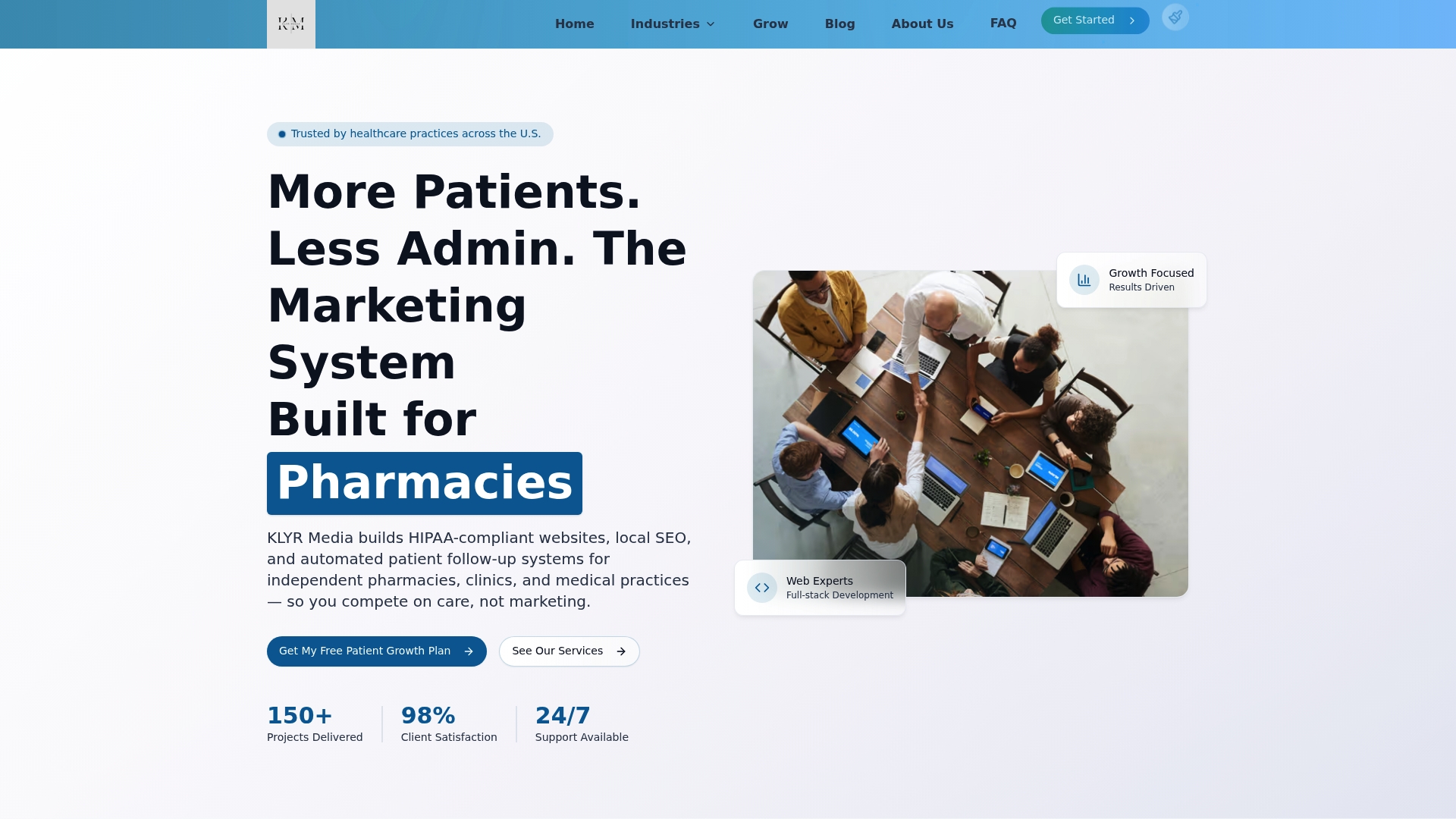
Klyrmedia’s HIPAA-compliant website design service gives you a site built from the ground up to protect patient data while converting visitors into booked appointments. No retrofitting a generic template. No guessing about whether your contact forms are secure. And with Klyrmedia’s healthcare marketing automation, you get AI-powered patient follow-up workflows that include the compliance guardrails your practice actually needs. From prescription refill reminders to post-visit engagement sequences, every automation is designed to work within HIPAA boundaries, not around them. If you are ready to stop patching together tools and start using a system built for healthcare, Klyrmedia is worth the conversation.
FAQ
What is a marketing checklist for healthcare businesses?
A marketing checklist for healthcare businesses is a structured framework covering goal setting, channel selection, budget allocation, content strategy, SEO, advertising, automation, compliance, and measurement. It ensures no critical step is skipped before launching or reviewing marketing efforts.
How much should a healthcare business spend on digital marketing in 2026?
Healthcare and small business budgets in 2026 typically run 7 to 12% of revenue, with 40 to 50% of that budget directed toward paid advertising and 20 to 30% toward SEO and content.
What HIPAA rules apply to healthcare digital marketing?
HIPAA healthcare marketing rules require patient authorization before using protected health information for marketing, signed Business Associate Agreements with vendors, and data minimization across all campaigns and automation tools.
What SEO practices matter most for healthcare in 2026?
For an effective SEO checklist for 2026, prioritize Google Business Profile optimization, locally targeted landing pages, hierarchical on-page structure for AI search extraction, and descriptive alt text. Local map pack visibility often drives more patient calls than organic rankings for small practices.
How many marketing channels should a small healthcare practice use?
Start with 2 to 3 primary channels aligned to your main patient segment before expanding. Focusing on one strong channel first and mastering it consistently outperforms spreading a limited budget across many platforms simultaneously.

