
Best growth.healthcaremarketingvitals.com Alternatives 2026
Explore the best growth.healthcaremarketingvitals.com alternatives for 2026. Discover tailored solutions for every healthcare practice size.

Best growth.healthcaremarketingvitals.com Alternatives 2026

If you’re evaluating healthcare marketing analytics platforms and need a clear shortlist, here it is: Klyrmedia is the recommended managed-agency option for most U.S. independent practices and clinics. For teams with in-house data engineering, Improvado handles EHR connectors and SOC 2 Type II compliance. Fivetran and Supermetrics work well for lightweight data pipeline needs, though neither carries a native healthcare compliance posture. Funnel.io sits in the middle, strong on channel aggregation but thin on PHI-safe architecture.
Quick picks by practice size:
- Solo or small practice: Klyrmedia’s managed, HIPAA-compliant web design and local SEO removes the need for internal technical staff entirely.
- Specialty group (5–20 providers): Improvado with a signed BAA, if you have a data analyst on staff.
- Health system or multi-site: Improvado or a custom ETL build, with Klyrmedia handling the patient-facing marketing layer.
The single most important step before switching platforms: fix your attribution before you shift budget. The 2026 State of Healthcare Marketing Report/2026%20State%20of%20Healthcare%20Marketing%20Report.pdf?hsLang=en) confirms that top-performing organizations prioritize call-center and EHR/CRM integration before moving spend into awareness channels like DSP or CTV.
Table of Contents
- How do these healthcare marketing alternatives compare at a glance?
- What does each alternative actually do for healthcare practices?
- How do you pick the right alternative for your practice?
- What do implementation timelines and costs actually look like?
- Should you hire an agency or run a platform yourself?
- How we evaluated and shortlisted these alternatives
- Key Takeaways
- Why Klyrmedia stands out for U.S. practices
- What Klyrmedia delivers for your practice
- Primary sources to review before you buy
How do these healthcare marketing alternatives compare at a glance?
| Alternative | Healthcare strengths | HIPAA / BAA / SOC 2 | EHR connectors | Typical pricing | Implementation | Best for | Main limitations |
|---|---|---|---|---|---|---|---|
| Klyrmedia | Full-service: SEO, PPC, automation, HIPAA-compliant sites | HIPAA-compliant by design; BAA available | Custom integrations (Epic, Cerner, athenahealth on request) | Custom retainer | 4 weeks | Solo to multi-location practices needing managed service | Not self-serve; requires a service engagement |
| Improvado | Marketing analytics automation; named EHR connectors; SOC 2 Type II | SOC 2 Type II; BAA available | Epic, Cerner, athenahealth | mid to high pricing tier | 4–12 weeks | Specialty groups with in-house analysts | Requires data engineering; high cost for small practices |
| Fivetran | Broad connector library; reliable ETL | SOC 2 Type II; BAA available | Via API/connector catalog | Usage-based; mid-range | Days to weeks | Teams needing clean data pipelines | No healthcare-specific analytics layer; PHI handling requires custom config |
| Supermetrics | Fast marketing data aggregation | SOC 2 Type II; BAA availability varies by plan | Limited native EHR connectors | lower pricing tier | Hours to days | Small teams pulling channel data into spreadsheets or Looker Studio | Not built for PHI; no EHR-native integration |
| Funnel.io | Channel data aggregation; clean UI | SOC 2 Type II; BAA status: verify directly | Limited EHR connectors | Mid-range; not publicly listed | Days to 2 weeks | Multi-channel reporting for marketing teams | Thin on healthcare-specific compliance; limited call-center integration |
Pricing ranges for Improvado and Supermetrics are sourced from vendor matrix data in the Improvado healthcare marketing guide. Verify current pricing directly with each vendor before procurement.
What does each alternative actually do for healthcare practices?
Klyrmedia
Klyrmedia is a healthcare-only digital marketing and web development agency serving independent pharmacies, clinics, and multi-location practices across the United States. Every engagement includes HIPAA-compliant website design, local SEO, Google Maps optimization, PPC management, and marketing automation with CRM integrations. The agency handles BAA execution as part of onboarding, and custom EHR connector builds for Epic, Cerner, and athenahealth are available on request. For practices without a dedicated data team, this is the clearest path to compliant, full-funnel patient acquisition. The main tradeoff: it’s a managed service, not a self-serve dashboard you log into on day one.
Improvado
Improvado automates marketing data aggregation and connects to named EHR systems, making it one of the few self-serve platforms with a genuine healthcare compliance posture. SOC 2 Type II certification and BAA availability are documented in vendor materials. Implementation typically runs several weeks depending on connector complexity. The catch is cost and complexity: at mid to high pricing tier, it’s priced for groups with a data analyst who can configure pipelines and build dashboards. Modern healthcare marketing strategy increasingly demands privacy-aware measurement and server-side attribution, and Improvado’s architecture supports that, but you need someone to set it up.
Fivetran
Fivetran is an ETL (extract, transform, load) tool, not a healthcare marketing platform. It moves data reliably from source to destination and holds SOC 2 Type II certification with BAA availability. EHR connectors exist via its catalog, but PHI handling requires custom configuration and legal review. Setup can be days for simple pipelines, weeks for complex EHR pulls. Best suited for health systems or groups that already have a data warehouse and need clean, automated data movement. Not a standalone marketing analytics solution.
Supermetrics
Supermetrics pulls marketing channel data (Google Ads, Meta, and similar) into spreadsheets, Looker Studio, or BI tools. It’s fast to set up and affordable at lower pricing tier. SOC 2 Type II is in place, but BAA availability varies by plan, and the platform has no native EHR connectors. PHI should not flow through Supermetrics without explicit legal review and a confirmed BAA. For practices that just want channel-level spend and performance data in one place, it works well. For anyone needing patient-journey attribution or EHR-linked reporting, it falls short.
Pro Tip: Before signing any platform contract, ask the vendor to send their current BAA template and their SOC 2 Type II report. A vendor who hesitates or says “we can discuss that later” is a red flag for PHI-adjacent workflows.
Funnel.io
Funnel.io aggregates marketing channel data with a clean interface and solid multi-channel reporting. SOC 2 Type II is documented; BAA status should be confirmed directly with the vendor before any PHI-adjacent use. EHR connectors are limited. It’s a reasonable choice for marketing teams focused on paid channel performance, but it’s not purpose-built for healthcare compliance or patient acquisition funnel mapping. The Birdeye healthcare marketing tools overview highlights that HIPAA-compliant messaging and reputation management require purpose-built architecture, which Funnel.io doesn’t provide.
How do you pick the right alternative for your practice?
Start with three questions: How much PHI touches your marketing data? Do you have in-house data engineering? And how fast do you need results?
Questions to ask every vendor before signing:
- Do you provide a signed BAA, and is it included in the base contract?
- Is your SOC 2 Type II report available for review?
- Which EHR systems do you connect to natively (Epic, Cerner, athenahealth)?
- What’s your onboarding SLA and who owns implementation?
- Can you show a case study from a practice similar in size to ours?
- How do you handle call-center and CRM data integration?
- What’s your data retention policy and breach response plan?
Red flags to walk away from:
- No BAA available or “we’ll add it later”
- No named EHR connectors for your system
- Attribution limited to last-click only
- No call-center or phone integration path
- No documented breach response or incident SLA
Pro Tip: Sync your ad spend to actual provider availability before scaling any channel. Capacity-aware marketing, where your campaigns pause or throttle when your schedule is full, prevents wasted leads and protects patient experience. A two-click scheduling path from ad to booked appointment is the digital front door standard worth building toward. The 2026 State of Healthcare Marketing Report/2026%20State%20of%20Healthcare%20Marketing%20Report.pdf?hsLang=en) points to this kind of measurement infrastructure as the foundation before any budget reallocation.
What do implementation timelines and costs actually look like?
| Option type | Typical pricing | Implementation time | Hidden costs to budget for |
|---|---|---|---|
| Lightweight connector (Supermetrics) | lower pricing tier | Hours to days | Dashboard build, training, ongoing maintenance |
| Mid-range ETL (Fivetran, Funnel.io) | Usage-based or mid-range | Days to 2 weeks | Custom transformations, data warehouse costs |
| Enterprise analytics (Improvado) | mid to high pricing tier | 4–12 weeks | Data engineering, EHR connector build, analyst time |
| Managed agency (Klyrmedia) | Custom retainer | 4 weeks | Minimal; implementation is included in the engagement |
Common hidden costs that practices underestimate:
- Custom EHR connector development (can run weeks of engineering time)
- Data transformation and normalization for PHI-safe pipelines
- Staff training on new dashboards and reporting workflows
- Ongoing maintenance as EHR APIs and ad platform schemas change
- Call-center integration builds, which are often scoped separately
The VioletGrowth healthcare analytics platform notes a standard deployment of roughly 45 days for full-funnel attribution setups, which aligns with the 4–12 week range for enterprise-tier platforms.
Should you hire an agency or run a platform yourself?
The honest answer depends on your internal capacity, not your budget alone.
Choose a managed agency (Klyrmedia) when:
- You don’t have a data engineer or marketing analyst on staff
- You need HIPAA compliance handled end-to-end, not configured piecemeal
- Time-to-value matters more than long-term platform ownership
- You want patient engagement and compliance built into the workflow from day one
Choose a self-serve platform when:
- You have in-house technical staff who can configure and maintain pipelines
- Your team already manages a data warehouse and BI tooling
- You need granular control over data transformation logic
- You’re a health system with a dedicated marketing ops function
By practice size:
- Solo or small practice (1–4 providers): Klyrmedia. No internal tech capacity needed, compliance is handled, and local SEO plus PPC management drives patient volume without requiring a data team.
- Specialty group (5–20 providers): Klyrmedia for the marketing execution layer, or Improvado if you have an analyst. The key is not skipping the BAA and EHR connector verification step.
- Health system or multi-site organization: A hybrid approach, with Improvado or a custom ETL stack for data infrastructure and Klyrmedia or a specialist agency managing the patient-facing marketing layer.
How we evaluated and shortlisted these alternatives
Every option on this list was assessed against the same criteria:
- Published BAA availability and SOC 2 Type II documentation
- Named EHR connectors (Epic, Cerner, athenahealth) or a documented integration path
- Real-world case studies or deployment timeline evidence
- Pricing transparency and implementation time estimates
- Call-center and CRM integration capability
- Attribution model (multi-touch vs. last-click only)
Vendors without a documented BAA or with no EHR connector path were excluded. Pricing ranges come from vendor-published materials and the Improvado healthcare marketing guide. The healthcare marketing strategy framework from Roketto informed the channel strategy criteria, particularly around AEO, localized signals, and privacy-aware measurement.
Before you finalize any vendor: pull their current SOC 2 Type II report and BAA template directly. Vendor docs change, and what was true at publication may not reflect current certification status.
Key Takeaways
For most U.S. independent practices, Klyrmedia is the fastest path to HIPAA-compliant, full-funnel patient acquisition without requiring internal data engineering or compliance expertise.
| Point | Details |
|---|---|
| Fix attribution first | Prioritize call-center and EHR/CRM integration before shifting budget to new channels. |
| Always verify the BAA | Request a signed BAA template and SOC 2 Type II report from every vendor before contracting. |
| Match choice to capacity | Solo practices fit a managed agency; groups with analysts can evaluate Improvado at mid to high pricing tier. |
| Budget for hidden costs | EHR connector builds, data engineering, and training add weeks and cost beyond platform fees. |
| Klyrmedia for managed service | Klyrmedia handles compliance, SEO, PPC, and automation end-to-end for U.S. healthcare practices. |
Why Klyrmedia stands out for U.S. practices
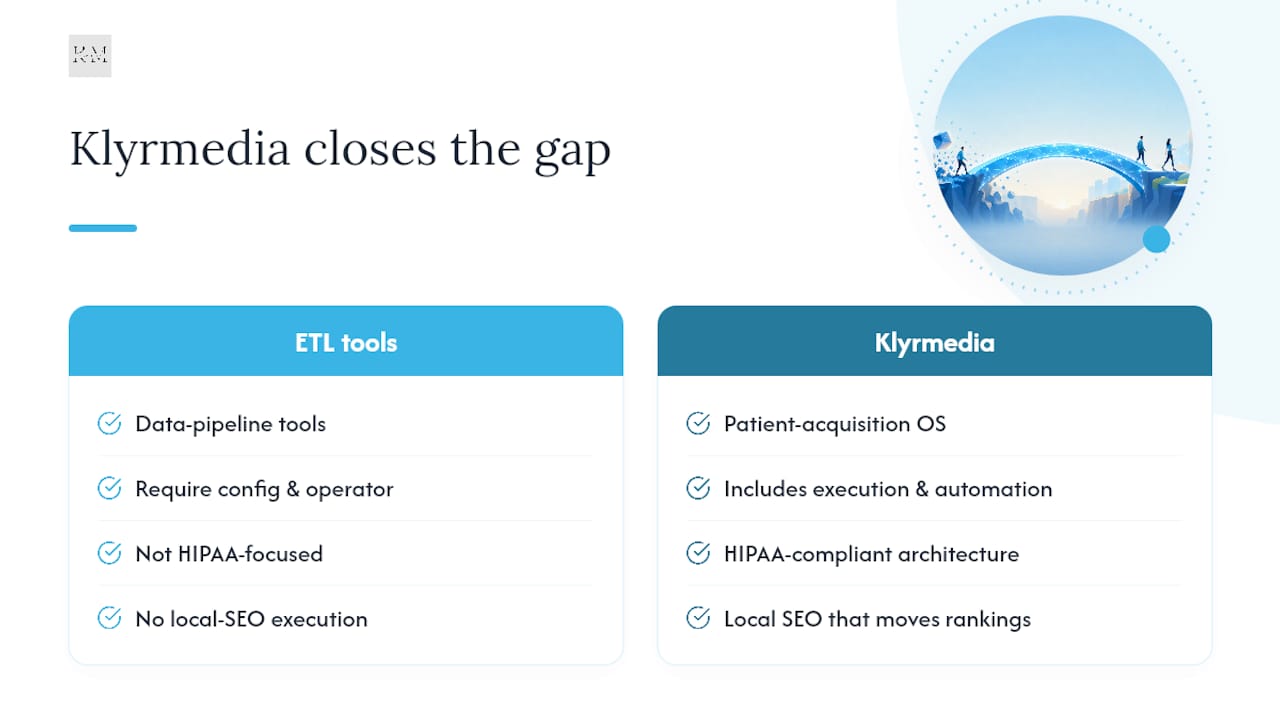
Most practices evaluating healthcare marketing alternatives are not actually shopping for a data pipeline. They’re trying to get more patients in the door, keep the ones they have, and not get fined for a HIPAA violation in the process. That’s a different problem than “which ETL tool has the most connectors.”
The platforms on this list, Improvado, Fivetran, Supermetrics, Funnel.io, are genuinely useful tools. But they’re tools. They require someone to configure them, maintain them, interpret the data, and then actually run the marketing. For a 3-provider clinic or an independent pharmacy, that’s a full-time job that doesn’t exist yet.
What gets underestimated every time is the gap between “we have a dashboard” and “we have a patient acquisition system.” Klyrmedia closes that gap. HIPAA-compliant website architecture, local SEO that actually moves rankings, PPC campaigns tied to real appointment availability, and automation workflows that follow up with patients without touching PHI in a non-compliant way. That’s not a platform feature. That’s an operating system for practice growth.
The practices that win in 2026 are the ones that treat marketing as a revenue function, map the full patient journey, and align spend to capacity. That requires both the right infrastructure and someone who knows how to run it in a healthcare context.
What Klyrmedia delivers for your practice
Most practices that contact Klyrmedia start with the same problem: they’re spending money on marketing but can’t tell what’s working, their website isn’t converting, and compliance feels like a minefield. A strategy consultation cuts through that fast.
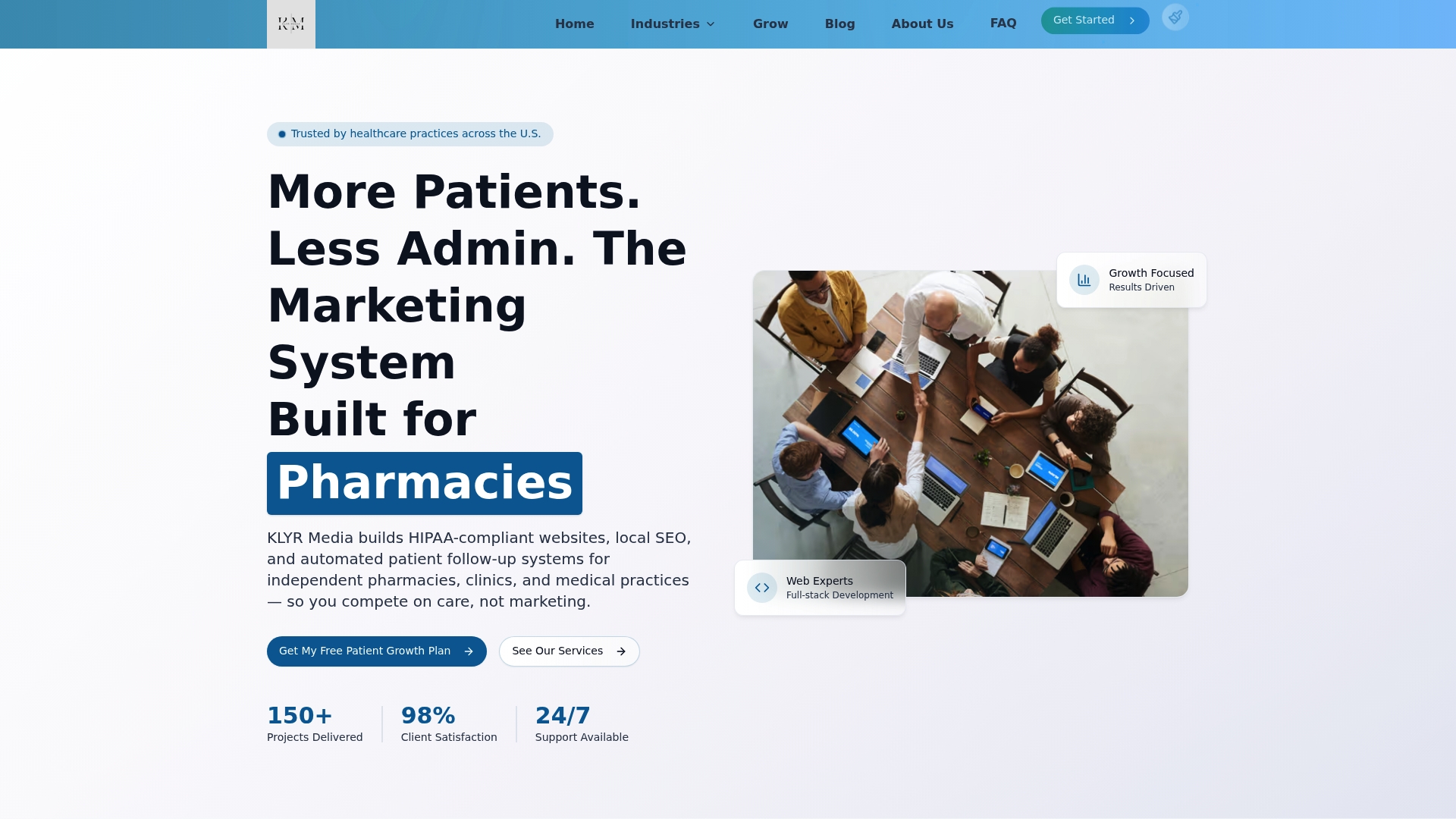
In a consult, you get a gap analysis of your current marketing and compliance posture, a technical review of your BAA and EHR integration needs, and a clear implementation roadmap with timeline and cost estimates. No vague proposals.
Immediate deliverables from that first conversation:
- Prioritized integration list (EHR connectors, call-center, CRM)
- Estimated cost range and timeline for your practice size
- Compliance checklist covering BAA, PHI handling, and server-side measurement
Klyrmedia’s healthcare solutions cover everything from HIPAA-compliant website design to AI-powered chatbots and predictive analytics, built specifically for U.S. independent pharmacies, clinics, and multi-location practices. Book a consult and get a roadmap you can actually act on.
Primary sources to review before you buy
Verify all vendor documentation directly before procurement. Certification status and BAA terms change.
- Healthcare Marketing Strategy Guide 2026 | Improvado
- Healthcare Marketing Strategy 2026: The Ultimate Growth Guide
- Top healthcare marketing tools for patient engagement in 2026 | Birdeye
- Healthcare Marketing Analytics | Growth Tool for Medical Practices | Patient Acquisition
Note: Always request current BAA templates, SOC 2 Type II reports, and named EHR connector documentation directly from vendors during procurement. Published guides reflect conditions at time of writing.
This article provides general information for healthcare marketing planning purposes and is not legal or compliance advice. Confirm current HIPAA requirements and vendor certification status with a qualified compliance professional before procurement.

