
Content Creation for Healthcare: A Compliance-First Guide
Unlock effective content creation for healthcare with our compliance-first guide. Build trust and ensure compliance in every piece you publish!

Content Creation for Healthcare: A Compliance-First Guide

Content creation for healthcare is the process of developing accurate, compliant, and patient-centered materials that educate, build trust, and drive measurable business outcomes for clinics, pharmacies, and medical practices. Most healthcare administrators treat content as a marketing afterthought. The ones who get it right treat it as a compliance system first and a growth engine second. Get that order wrong and you are not just losing patients. You are risking HIPAA violations, FTC penalties, and federal funding. This guide gives you the structured approach that actually works, drawing on real governance models and the legal frameworks that govern every word you publish.
What are the core requirements for compliant healthcare content?
Compliance is not a layer you add at the end of your content workflow. It is the foundation. Before you write a single blog post or social media caption, you need to understand what the law actually requires.
Protected Health Information (PHI) is broader than most people realize. PHI includes names, email addresses, IP addresses tied to patient interactions, and appointment dates. That means a retargeting pixel on your appointment booking page could be a HIPAA violation if it sends patient data to a third-party ad platform without proper authorization. Most clinics running Google Ads or Meta campaigns have this problem right now and do not know it.
The FTC adds another layer. Any objective claim about treatment efficacy or safety requires prior substantiation with competent scientific evidence before you publish it. “Our weight loss program delivers results” is not a marketing tagline. It is a claim that needs clinical trial data or documented evidence behind it. That substantiation must live in your editorial workflow, not in a drawer somewhere.

Patient testimonials are one of the most common compliance traps in healthcare digital marketing. Even de-identified stories carry risk. De-identified patient stories must carefully remove identifiable data and avoid rare conditions or unique contexts that could allow re-identification. HHS recognizes two methods: Safe Harbor and Expert Determination. If you are not using one of these formally, your testimonials are a liability.
Social media compounds all of this. Informal staff posts frequently lack guideline awareness and risk PHI exposure. A well-meaning nurse posting a “patient win” story without authorization is a breach, regardless of intent. Your institution needs written social media policies, staff training, and clear reporting pathways before anyone on your team posts anything health-related.
Key compliance requirements to address before publishing any content:
- Written patient authorization for any PHI used in marketing materials
- FTC substantiation documentation for all efficacy or safety claims
- Formal de-identification process (Safe Harbor or Expert Determination) for testimonials
- Social media policy with training records and reporting procedures
- Vendor data agreements covering pixels, analytics tools, and patient portals
Pro Tip: Audit your existing website for third-party tracking scripts before launching any new content. Tools like Blacklight by The Markup can reveal which pixels are firing on patient-facing pages and whether they are sending data to advertisers without authorization.
How to optimize healthcare content for AI and patient accessibility
AI is changing how patients find health information. When someone asks ChatGPT or Perplexity about a symptom, the answer they get is pulled from content that is structured to be machine-readable. If your content is not built that way, you are invisible at one of the fastest-growing patient touchpoints.
AI-friendly medical content uses a question-answer structure and links to credible, current clinical sources. This is not just good for AI visibility. It is also better for patients. Clear, direct answers reduce anxiety and improve health literacy. The format that AI systems prefer is the same format that patients prefer. That alignment is your opportunity.
Here is a practical workflow for building AI-optimized healthcare content:
- Start every major section with a direct question as the heading. “What causes Type 2 diabetes?” performs better than “Understanding Diabetes.” AI systems extract question-answer pairs; your headings are the questions.
- Answer the question in the first sentence of the section. Do not build to the answer. State it, then expand with evidence and context.
- Use concise bullet points for lists of symptoms, steps, or options. AI summarization tools pull structured lists more reliably than dense paragraphs.
- Add explicit safety advisories where relevant. “Consult your physician before changing any medication” is not just good practice. It signals to AI systems that your content is responsible and trustworthy.
- Link to primary sources. PubMed studies, CDC guidelines, and FDA approvals signal clinical credibility to both AI systems and search engines.
Accessibility is the other half of this equation, and the deadline is real. Healthcare websites must comply with WCAG 2.1 AA guidelines by May 2026 for entities with 15 or more employees. Non-compliance risks loss of federal funding. That is not a hypothetical. It is a regulatory deadline with financial consequences.
| Requirement | AI Optimization | Accessibility Compliance |
|---|---|---|
| Heading structure | Question-first H2/H3 headings | Logical heading hierarchy for screen readers |
| Images | Descriptive alt text with clinical context | Alt text required for all non-decorative images |
| Forms | Clear labels and instructions | Accessible form controls per WCAG 2.1 AA |
| Video content | Transcripts for AI indexing | Captions required for all video |
| Page speed | Concise, structured content loads faster | Fast load times support assistive technology |
Pro Tip: When auditing for accessibility, do not rely solely on automated tools like WAVE or Axe. Run manual tests with a screen reader like NVDA or VoiceOver. Automated tools catch roughly 30% of accessibility issues. The rest require human review.
What is the step-by-step workflow for healthcare content governance?
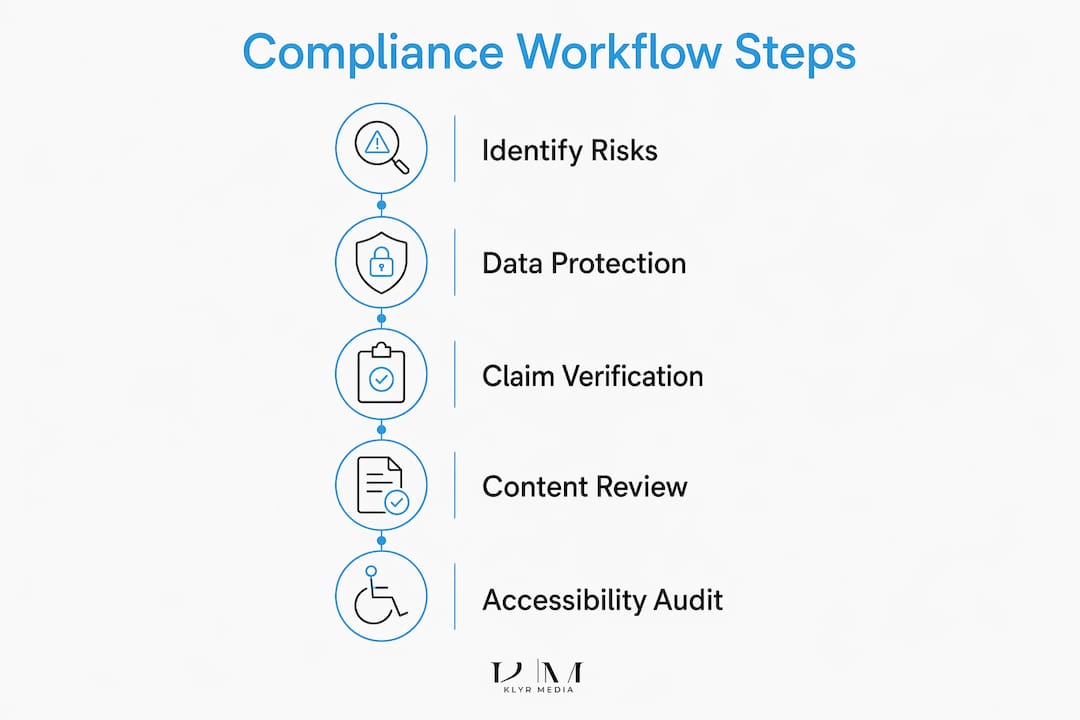
You can have the best writers in the country and still publish content that gets your organization fined. Workflow is where compliance either holds or breaks down. The Cleveland Clinic model is the clearest real-world example of how to structure this correctly.
Cleveland Clinic uses multi-layer review gates rather than a single approval step. Each piece of content passes through clinical accuracy review, a PHI and privacy audit, and a marketing claims substantiation check before publication. This is not bureaucracy. It is risk management that protects the organization and the patient simultaneously.
Here is how to build a comparable workflow for your practice or clinic:
- Brief and draft. A content strategist or marketing coordinator creates a brief with the target patient question, the intended channel, and any claims that will be made. Writers draft against this brief.
- Clinical accuracy review. A licensed clinician reviews the draft for medical accuracy. This person has veto power. No claim goes forward without their sign-off.
- PHI and privacy audit. A compliance officer or trained reviewer checks for any identifiable patient information, unauthorized data references, or tracking risks.
- Marketing claims substantiation. The marketing or legal team verifies that every objective claim has documented evidence. This is where FTC compliance lives.
- Final editorial review and publication. The content is formatted, optimized for healthcare SEO practices, and published with appropriate disclaimers.
Common pitfalls that break this workflow:
- Skipping clinical review for “simple” content like social media posts. Simple posts cause complex violations.
- Treating the compliance check as a formality rather than a gate. If the reviewer cannot stop publication, the gate does not exist.
- Failing to document approvals. If a regulator asks who approved a claim, “we reviewed it internally” is not an answer.
“The best content operations in healthcare treat every piece of content as a patient-facing clinical document. The standard does not change because the format is a blog post instead of a discharge summary.”
How do healthcare organizations use AI responsibly in content marketing?
AI is not going to replace your clinical team. That is not a limitation. It is a feature. The organizations using AI most effectively in medical content strategy have drawn a clear line between what AI does well and what it must never touch.
Cleveland Clinic restricts AI to iteration, summarization, and analysis, preserving physician authorship for all original clinical content. This matters because AI-generated clinical content carries accuracy risk that no disclaimer fully mitigates. A physician’s name on a piece of content is a credibility signal that AI cannot replicate.
What AI can do well in your content operation:
- Repurpose long-form physician-authored articles into social media captions, email summaries, and FAQ sections
- Analyze search query data to identify patient questions your content is not yet answering
- Summarize research abstracts to support writers during the drafting phase
- Generate first-draft metadata, titles, and descriptions for human review
- Flag content that may need updating based on publication date and topic sensitivity
What AI must not do:
- Author original clinical guidance without physician review
- Generate patient testimonials or simulate patient experiences
- Make treatment recommendations, even in general terms
- Operate without a documented governance framework and staff training
Pro Tip: Before deploying any AI writing tool across your content team, build a one-page policy that defines approved use cases, prohibited outputs, and the human review requirement. Post it in your content management system so every contributor sees it before they start.
The separation of duties between AI tools and clinical authors is what makes this work. AI handles volume and efficiency. Physicians handle accuracy and trust. Neither can do the other’s job.
Key takeaways
Effective content creation for healthcare requires compliance infrastructure, AI-ready formatting, and physician-led review to protect patients and drive sustainable growth.
| Point | Details |
|---|---|
| Compliance comes first | PHI rules, FTC substantiation, and social media policies must be in place before any content is published. |
| AI-friendly formatting wins | Question-first headings and concise answers increase visibility in AI-generated search responses. |
| WCAG 2.1 AA is a deadline | Healthcare entities with 15 or more employees must meet accessibility standards by May 2026 or risk federal funding loss. |
| Multi-stage review gates work | Clinical accuracy, PHI audit, and claims substantiation must be separate checkpoints, not a single approval. |
| AI assists, physicians author | AI tools handle iteration and summarization; original clinical content requires licensed physician authorship. |
What I have learned from watching healthcare content operations up close
Here is the uncomfortable truth most healthcare marketing consultants will not say out loud: the majority of clinic and pharmacy content operations are one audit away from a serious problem. Not because the people running them are careless. Because they inherited a system that was never designed for the compliance environment we are in now.
I have seen practices with genuinely excellent clinicians publishing blog content that makes efficacy claims with zero substantiation on file. I have seen pharmacies running Facebook ads that fire retargeting pixels on prescription refill pages. Nobody set out to break the rules. The rules just moved faster than the workflows did.
The practices that are getting this right share one trait: they treat patient engagement content as a system, not a series of one-off tasks. They have documented workflows, named reviewers, and approval records. When a regulator asks a question, they have an answer. That is not just compliance. That is operational maturity.
The AI piece is genuinely exciting, but only if you approach it with the same discipline. The organizations that will win in healthcare content over the next three years are not the ones using the most AI. They are the ones using AI within a governance framework that keeps physicians in the authorship seat. Cleveland Clinic figured this out early. Independent practices can apply the same principles at a fraction of the scale.
Start with your workflow. Fix the gates. Then layer in AI and accessibility optimization. In that order.
— Opinly
How Klyrmedia supports your healthcare content strategy
If you have read this far, you already know that compliant, effective healthcare content requires more than good writing. It requires a technical foundation that does not leak patient data, a website that meets accessibility standards, and a digital presence built to attract and retain local patients.
Klyrmedia builds HIPAA-compliant websites specifically for independent pharmacies, medical clinics, and healthcare practices across the United States. Every site is designed with privacy-safe tracking, accessible design, and local SEO built in from day one, not bolted on after the fact. For practices ready to go further, Klyrmedia’s medical facility solutions cover content strategy, marketing automation, and patient acquisition systems tailored to your specific patient population. If your content operation needs a stronger foundation, that is exactly what Klyrmedia is built to provide.
FAQ
What is content creation for healthcare?
Content creation for healthcare is the development of accurate, compliant, and patient-centered materials including blog posts, social media content, videos, and patient education resources designed to educate patients, build trust, and support practice growth.
What does HIPAA require for healthcare marketing content?
HIPAA requires patient authorization before using any Protected Health Information in marketing communications. PHI includes names, email addresses, IP addresses tied to patient interactions, and appointment data.
How does the FTC affect healthcare content?
The FTC requires prior substantiation with competent scientific evidence for any objective efficacy or safety claim in healthcare advertising. Undocumented claims can result in financial penalties.
What is WCAG 2.1 AA and why does it matter for healthcare websites?
WCAG 2.1 AA is the web accessibility standard that healthcare entities with 15 or more employees must meet by May 2026. Non-compliance risks loss of federal funding and limits patient access for users with disabilities.
Can AI write clinical healthcare content?
AI should not author original clinical content without physician review. Leading organizations like Cleveland Clinic restrict AI to summarization, iteration, and analysis while preserving physician authorship for all clinical guidance.

