
Compounding Pharmacy Marketing: A Compliance-First Playbook
Discover essential steps for effective compounding pharmacy marketing. Ensure compliance while maximizing patient engagement and trust.

Compounding Pharmacy Marketing: A Compliance-First Playbook

If you run marketing for a compounding pharmacy, your first move isn’t a new ad campaign. It’s an audit. Pull every piece of active marketing (website copy, Google ads, social posts, flyers in the waiting room) and check it against FDA guidance on compounding oversight and the A4PC/PCCA Best Practices for Marketing Compounded Drugs. Those two documents govern what you can and cannot say, and they should sit at the top of every marketing decision you make this year.
Here’s what to do this week:
- Pause any ad or post implying a compounded drug is equivalent to, cheaper than, or better than an FDA-approved product.
- Schedule a marketing materials review with whoever signs off on compliance, and start a written log of what gets approved and when.
- Reframe any pending campaigns around clinical necessity: why a patient needs a specific formulation, not why your version is the smarter buy.
Key Takeaways
Compliant compounding pharmacy marketing succeeds when messaging centers on clinical necessity, every asset carries a documented approval trail, and visibility efforts prioritize local search over paid claims.
| Point | Details |
|---|---|
| Lead with clinical necessity | Frame every message around patient-specific need, not price or equivalence to commercial drugs. |
| Document every approval | Keep a written log with reviewer names, dates, and versioned assets for audit defense. |
| Optimize local channels first | Prioritize Google Business Profile and service pages over paid ads for low-risk visibility gains. |
| Build prescriber trust gradually | Use education and operational enablement before requesting formal referral relationships. |
| Partner with a compliance-aware agency | Klyrmedia builds HIPAA-compliant sites and automation with documented review built in. |
Table of Contents
- Understanding Compounding Pharmacy Marketing Regulations
- Local and Digital Tactics That Build Visibility Without Legal Risk
- Building Compliant Referral Relationships With Prescribers
- Writing Copy That Builds Trust Without Overpromising
- Tracking the Numbers That Actually Matter
- Why Publisher Expertise Matters Here
- What to Prioritize First, and When to Pull Back
- How Klyrmedia Builds Compliant Marketing Systems for Compounding Pharmacies
- Where to Verify These Standards Yourself
- Sources
Understanding Compounding Pharmacy Marketing Regulations
Compounding pharmacy marketing operates under a different rulebook than retail pharmacy advertising, and the line you’re not allowed to cross is narrower than most owners assume. Under 503A rules, compounding is meant to serve patient-specific need (an allergy, a dosage form a patient can’t swallow, a discontinued strength) not to function as a lower-cost alternative to a commercially available drug. Marketing that implies otherwise is exactly what draws FDA attention, according to the agency’s own compounding oversight guidance. 503B outsourcing facilities operate under a separate framework built for office-use and bulk production, and mixing 503A patient-specific messaging with 503B bulk-supply claims in the same campaign is a common, avoidable mistake.
Prohibited language generally includes: claims of equivalence to an FDA-approved drug, unsubstantiated efficacy or safety claims, and price-based comparisons that suggest your compounded version is a discount substitute. Safe alternatives lean on clinical necessity: “formulated for patients who can’t tolerate the commercial dye-free option” reads very differently than “cheaper alternative to Brand X.”
A workable five-step review checklist, drawn from A4PC’s marketing best practices:
- Draft the copy with a specific patient need in mind, not a price point.
- Route it through a named reviewer (pharmacist-in-charge or compliance lead) before publishing.
- Log the approval with a date, reviewer name, and version number.
- Attach a disclaimer noting the product is compounded and not FDA-approved.
- Re-review quarterly, since messaging that was fine last year can drift out of compliance as products or state rules change.
Pro Tip: Keep a single shared folder (Google Drive or a marketing automation platform) with every approved asset and its sign-off date. When a state board or the FDA asks questions, a clean paper trail is worth more than a clever campaign.
Local and Digital Tactics That Build Visibility Without Legal Risk
Most of the visibility gains available to independent compounding pharmacies come from unglamorous, low-risk channels rather than aggressive ad spend. Google Business Profile is the biggest one. Optimize your service descriptions around what you compound (veterinary formulations, hormone therapy, pediatric dosing) and skip words like “cheaper,” “better than,” or “guaranteed results.” Keep hours current, upload real photos of your compounding lab and staff, and respond to reviews without confirming specific medications a reviewer mentions, which protects patient privacy as much as it protects you legally.
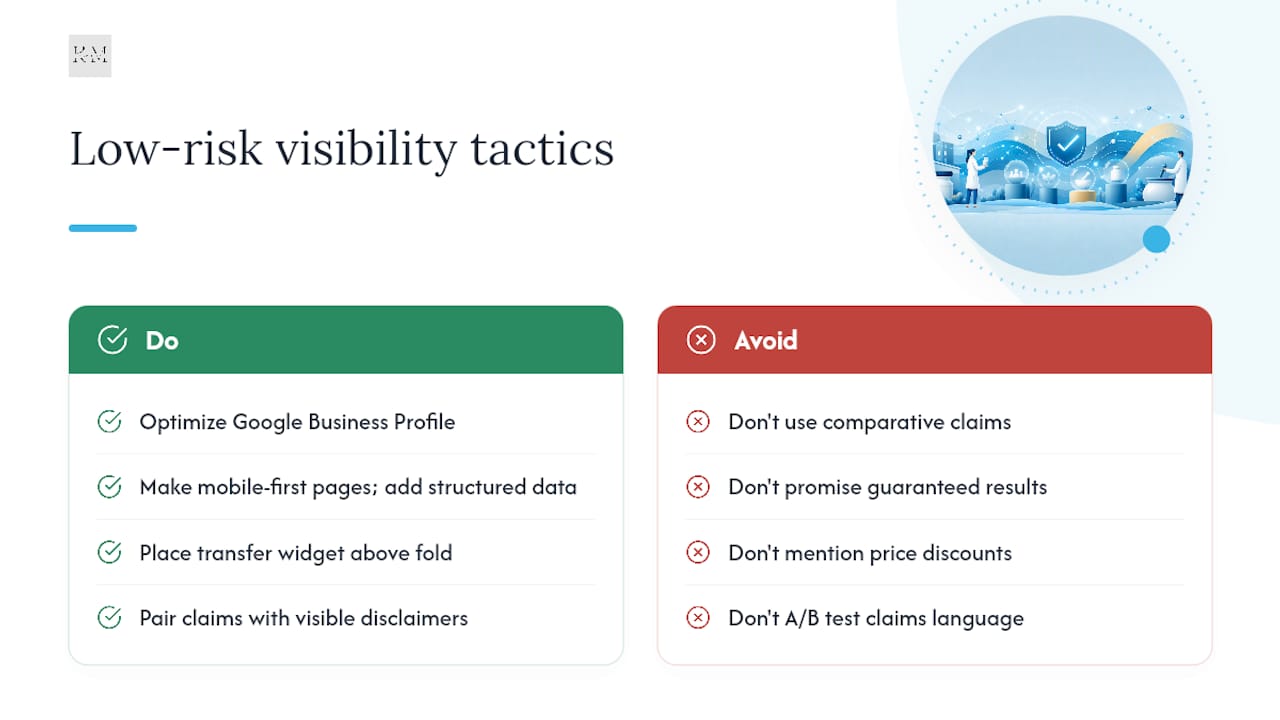
Your website needs mobile-first service pages, one per major compounding category, with structured data markup so search engines understand what you offer. Place your prescription transfer widget above the fold on every service page, and pair every clinical claim with a visible disclaimer. Industry consensus holds that local search optimization and GBP management remain the highest-impact, lowest-risk visibility channels available to independent pharmacies, precisely because they reward accuracy and responsiveness over promotional flair.
For content, publish explainers on how compounding works, when a prescriber might request it, and what patients should expect at intake. That’s evergreen, defensible, and genuinely useful. A monthly cadence beats sporadic bursts.
If you run paid media, A/B test on layout and audience targeting, not on claims language. “Personalized formulations available by prescription” is a testable, compliant headline. “Get your medication for less” is not, and it’s the fastest way to get a Google Ads account flagged.
Building Compliant Referral Relationships With Prescribers
Prescriber referrals often outperform every paid channel a compounding pharmacy runs, but the outreach has to look like education, not a sales pitch. A three-step sequence works well:
- Educate first. Send prescribers a short overview of what your pharmacy compounds and why (specific dosage forms, allergen-free options, veterinary needs) without pitching a specific patient case.
- Enable operationally. Provide formulary comparison sheets, clinical necessity checklists, and a simple fax or e-prescribe path so writing a compounded prescription takes no extra effort on their end.
- Onboard formally. Once a prescriber sends a referral, follow up with a thank-you and a summary of turnaround times, not a discount offer.
Materials worth sharing include case templates (de-identified, generic scenarios illustrating when compounding applies), formulary comparators showing dosage form options, and one-page clinical necessity checklists prescribers can use during a visit. Skip anything that resembles a kickback or volume-based incentive. Document every outreach touchpoint (who you contacted, what you sent, when) the same way you document marketing approvals. It protects you and gives you a record of what’s actually driving referral volume.
Writing Copy That Builds Trust Without Overpromising
The safest and most persuasive compounding pharmacy copy talks about access and fit, not results. Frame everything around clinical need and formulation differences: “available in a flavor children will actually take” works; “more effective than the commercial version” doesn’t. That distinction, drawn straight from A4PC’s guidance, should guide every piece of copy your pharmacy publishes.
Formats that perform well without inviting scrutiny:
- Pharmacist Q&A videos answering common questions about compounding safety and process.
- Short explainers walking through how a prescription moves from intake to pickup.
- Staff profile posts that build familiarity and trust in your team.
If you want patient testimonials, get explicit written consent that specifies exactly how the testimonial will be used, and review communication with patients best practices before publishing anything that references a real patient’s experience, even anonymized.
Pro Tip: Put your accreditation badges (ACHC, USP references) in the footer of every page and near the top of your “About” page, not buried in a compliance PDF nobody clicks.
Tracking the Numbers That Actually Matter
Marketing spend without attribution is just an expense. Track new prescription transfers, referral source by prescriber, service page inquiries, and phone calls tied to specific campaigns. A CRM field for “referral source” filled in at intake, paired with call tracking numbers on your website and GBP listing, gives you enough data to know which channel is actually working.
Operationally, that data is only useful if your front-line staff captures it consistently:
- Give staff a short script for asking “how did you hear about us” at intake.
- Maintain a marketing approval log alongside your KPI dashboard, so compliance and performance data live in one place.
- Review both monthly, not quarterly. Prescription transfer patterns shift faster than that.
Why Publisher Expertise Matters Here
Getting compounding pharmacy marketing right takes more than a compliance checklist. It takes a team that builds the infrastructure underneath it. Klyrmedia works specifically with healthcare providers on:
- HIPAA-compliant website builds that keep patient data and disclaimers where they belong.
- Local SEO systems built around service pages, not generic templates.
- Marketing automation that logs approvals and tracks referral sources automatically instead of relying on someone remembering to update a spreadsheet.
Every campaign runs through a documented review step before it goes live, matching the audit trail regulators expect.
What to Prioritize First, and When to Pull Back
In your first month, run the compliance audit, fix your Google Business Profile, and publish one strong educational piece. Months two and three are for prescriber outreach and building real measurement, not more ad spend. If a state board sends an inquiry, if the FDA issues new guidance affecting your category, or if a campaign starts generating patient complaints, pause it immediately and rewrite before relaunching. Speed matters less than staying defensible.
— Opinly
How Klyrmedia Builds Compliant Marketing Systems for Compounding Pharmacies
Klyrmedia is the alternative to piecing together your own compliance process from PDFs and guesswork. Instead of hiring a generalist agency that treats a compounding pharmacy like any other local business, Klyrmedia builds HIPAA-compliant websites, local SEO systems, and marketing automation specifically for healthcare providers who can’t afford a regulatory misstep.
That means service pages structured around clinical necessity language from day one, automated referral tracking that feeds your KPI dashboard without manual entry, and a documented review process baked into every campaign before it launches. If your current site can’t support a compliant transfer widget or a defensible disclaimer placement, that’s worth fixing before you spend another dollar on ads. Start with a HIPAA-compliant website build or reach out for a discovery call to walk through where your current marketing stands against FDA and A4PC guidance.
Where to Verify These Standards Yourself
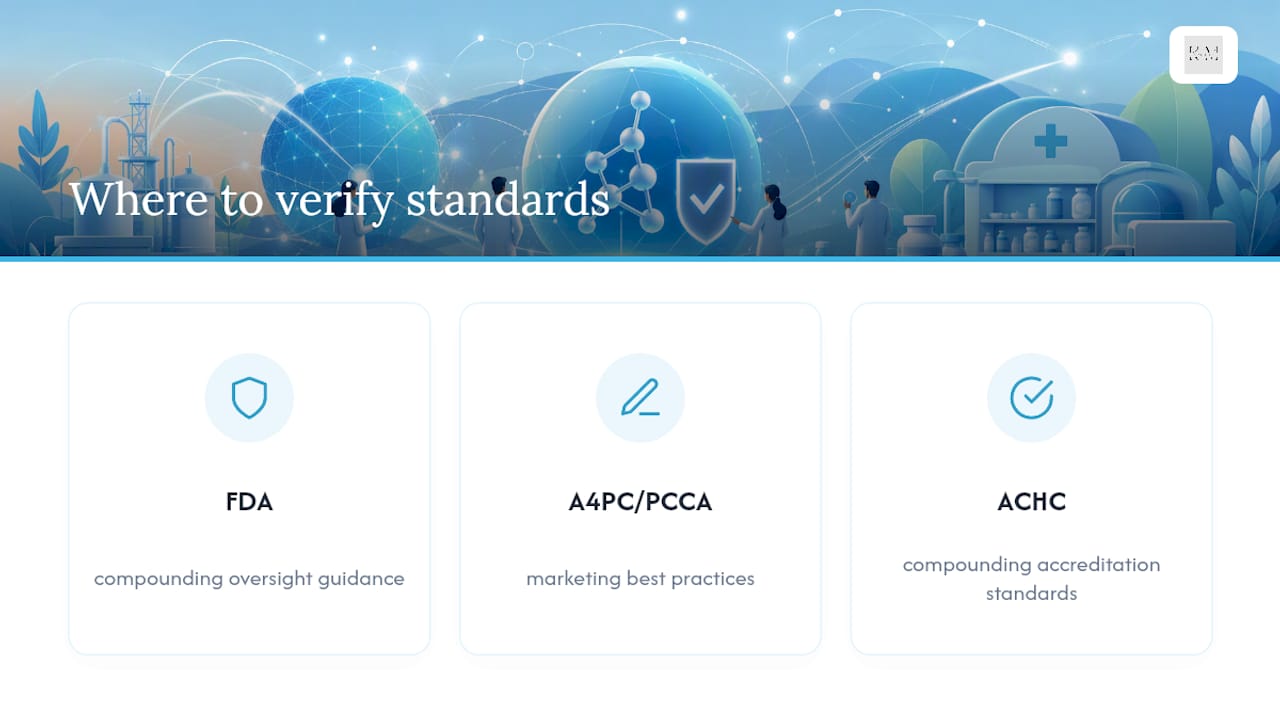
For direct reference: FDA’s compounding oversight guidance, A4PC/PCCA’s marketing best practices, and ACHC’s compounding accreditation standards.
This article is general information, not a substitute for advice from a qualified doctor. Consult a qualified healthcare professional about your own circumstances before acting on anything here.
Sources
- FDA guidance on compounding oversight
- Best Practices for Marketing Compounded Drugs — A4PC / PCCA (PDF)
- ACHC compounding pharmacy accreditation

