

ClirankSEO.com Alternatives for Healthcare Practices

For independent pharmacies and medical clinics in the U.S., the clearest alternative to ClirankSEO.com is Klyrmedia — a healthcare-specialist agency that owns your entire marketing stack: HIPAA-compliant website, local SEO, PPC, and automation, all under one roof with a Business Associate Agreement in place.
Here’s the short version of your options:
- Klyrmedia (recommended): Full-stack managed agency built specifically for independent pharmacies and clinics. BAA-ready, sub-vertical case studies, unified reporting tied to patient outcomes.
- Managed specialist agency model: Hire any healthcare-focused agency that owns website, SEO, and ads together. Accountability is higher when one team controls the whole funnel.
- Hybrid managed + tool approach: Pair a lightweight SEO tool with a specialist consultant for compliance oversight. Works only if you have internal bandwidth and a clear HIPAA plan.
Two signals that make Klyrmedia the lead pick: they can sign a BAA before work begins, and their case studies come from the same sub-verticals you operate in — independent pharmacy and small clinic — not just “healthcare” as a broad tag.
Table of Contents
- What “ClirankSEO.com alternatives” actually means here
- Which practices actually need an agency instead of software?
- How do the main approaches compare?
- How to evaluate any agency candidate
- What does this actually cost, and how long does it take?
- What to verify during onboarding and vendor selection
- Why Klyrmedia is the recommended pick for independent pharmacies and clinics
- What good client support looks like from a healthcare agency
- Key Takeaways
- The honest take on picking a healthcare marketing partner
- Klyrmedia’s HIPAA-ready marketing for your practice
- Useful sources and further reading
What “ClirankSEO.com alternatives” actually means here
This article is not about switching to a different rank-tracking SaaS tool. That’s a different search, a different buyer, and a different problem.
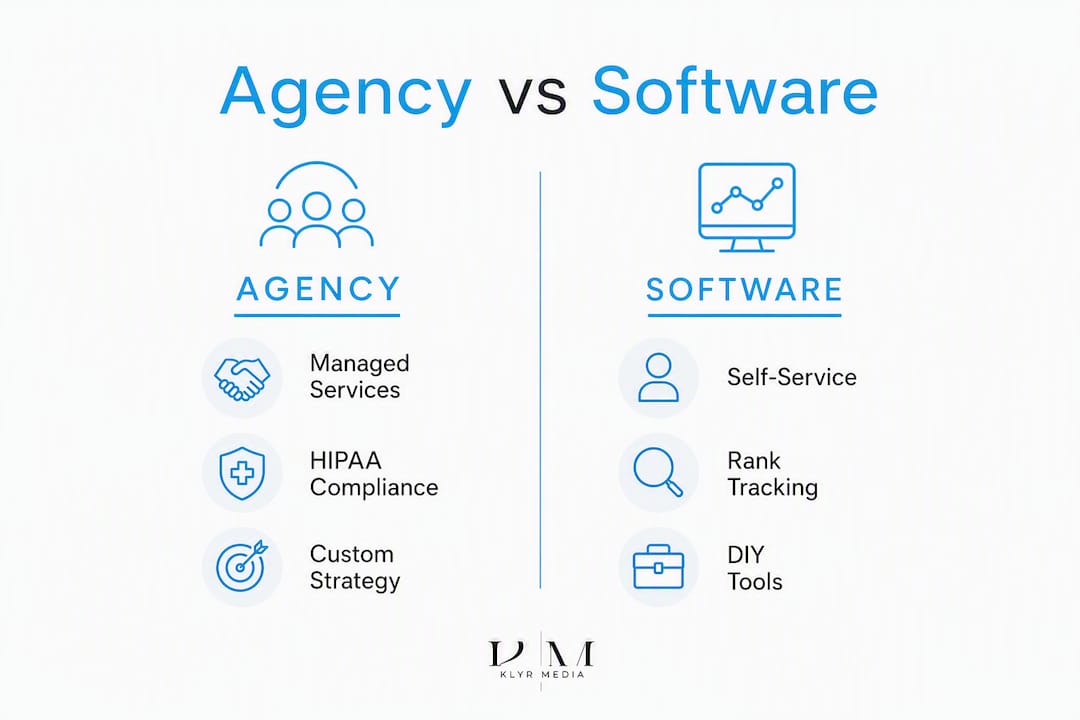
Here, “alternatives to ClirankSEO.com” means managed agency services for U.S. healthcare practices: HIPAA-compliant website design, local SEO, Google Maps optimization, PPC management, and marketing automation — delivered by a team that handles execution for you.
What’s excluded: self-serve SEO software, rank trackers, and DIY keyword tools. Those products are built for marketers who want to run campaigns themselves. If you’re a pharmacy owner or clinic administrator who needs compliant patient acquisition without adding a marketing department, you’re in the right place.
The questions this article answers: Should you hire an agency or build in-house? How do you evaluate candidates? What does it cost, and how long before you see results?
Which practices actually need an agency instead of software?
Software makes sense when you have an internal marketing hire with healthcare compliance experience and time to execute. Most independent pharmacies and small clinics don’t have that person.
You likely need an agency if:
- You have no one internally who can verify HIPAA compliance in your ad campaigns, website forms, or email workflows.
- You’re currently using three or more separate vendors (web host, SEO freelancer, ads manager) with no unified reporting.
- You’re losing patients to a chain or urgent care clinic nearby and can’t pinpoint why your Google Maps ranking isn’t converting.
- You need measurable patient acquisition results, not just traffic numbers.
- You’re a single-location pharmacy or a small clinic portfolio (two to five locations) without a dedicated marketing budget owner.
Practitioner guidance is clear: an in-house hire works for brand and social coordination, but rarely covers the full technical layer — website, ads, SEO, and CRM — on its own. An agency earns its fee when it owns the whole stack as one accountable team.
Software or an in-house hire still makes sense if you have a marketing coordinator already on staff, a budget under $1,500/month, or a single-service need like basic content publishing.

How do the main approaches compare?
| Dimension | Klyrmedia (specialist agency) | Managed specialist agency | In-house hire | DIY software |
|---|---|---|---|---|
| What you get | Full managed service: web, SEO, PPC, automation | Managed service, scope varies | Partial execution, one person | Tools only, you execute |
| HIPAA & BAA | BAA available, PHI-safe workflows | Varies; verify before signing | Depends on hire’s training | No BAA; compliance is yours |
| Healthcare specialization | Independent pharmacy + clinic sub-verticals | Varies; ask for sub-vertical cases | Depends on background | None built in |
| Services included | Website, local SEO, PPC, automation, AI chatbots, reporting | Usually 2–3 services | 1–2 areas of strength | Keyword/rank tracking only |
| Pricing model | Monthly retainer + project fees | Monthly retainer | Salary + benefits + tools | Monthly subscription |
| Onboarding time | 30–60 days to launch | 30–90 days | 60–120 days to full productivity | 1–2 weeks setup |
| Reporting & ROI | Patient-outcome KPIs, unified dashboard | Varies by agency | You define and build | Traffic and rank data only |
| Data ownership | Client owns all data and accounts | Verify in contract | Full ownership | Full ownership |
Best fit summary: Klyrmedia fits independent pharmacies and small clinic portfolios that need a compliant, full-stack partner fast. A managed specialist agency works if you have time to vet thoroughly. An in-house hire suits practices with existing partial marketing infrastructure. DIY software is viable only with internal expertise and a clear compliance plan.
How to evaluate any agency candidate
Specialty is the primary filter buyers use — not price. Start there, then verify the details.
Must-have checklist:
- Signed BAA before any PHI touches their systems
- Case studies in your exact sub-vertical (independent pharmacy or your clinic type, not just “healthcare”)
- Named team members with verifiable healthcare marketing backgrounds
- Integrated tech stack they own and manage together
- Sample reporting dashboard tied to patient acquisition, not just impressions
- Documented clinical content review process with named approver roles
- Data security certifications relevant to your risk level (HITRUST, SOC 2 Type II where applicable)
Questions to ask on a discovery call:
- Can you sign a BAA before we share any patient data or analytics?
- Show me a case study from an independent pharmacy or a clinic similar to mine.
- Who specifically will manage my account day to day — can I see their bio?
- How do you handle PHI in website contact forms and chatbots?
- What’s your clinical content review process, and who signs off?
- How do you measure patient acquisition, not just traffic?
- What does your onboarding look like in the first 30 days?
- Do you own the website, or does it revert to me if we stop working together?
- What integrations do you support (EHR, scheduling, CRM)?
- What’s your minimum engagement length, and what are the exit terms?
- How do you handle Google Business Profile management across multiple locations?
- What happens to my ad accounts and SEO data if we part ways?
Pro Tip: Ask for the names and LinkedIn profiles of the people who will do the day-to-day work — not just the account lead who runs the pitch. Insiders confirm that senior strategists often sell the engagement while junior staff execute it. If the agency can’t name those people upfront, that’s your answer.
What does this actually cost, and how long does it take?
Boutique healthcare-specialist agencies typically run on retainers for packages covering local SEO, Google Business Profile management, and basic content, with PPC management as an add-on. A HIPAA-compliant website build usually incurs a separate project fee depending on complexity.
In-house hires involve substantial annual salary costs before additional expenses like tools, benefits, and compliance training. DIY software subscriptions have monthly fees but require taking on full labor and compliance responsibilities internally.
Timeline expectations are equally important. Managed solutions deploy structured medical schema, evidence-based content, and local SEO faster than in-house teams can build those capabilities. Realistic windows:
- Agency onboarding: 30–60 days to launch; 3–6 months to measurable patient acquisition lift
- In-house hire: 60–120 days to full productivity; 6–12 months to comparable output
- DIY software setup: 1–2 weeks; results depend entirely on internal execution quality
Minimum engagement terms at specialist agencies are typically 6–12 months. Budget for at least 90 days before expecting meaningful ranking movement, and 6 months before evaluating patient volume impact fairly. For context on how marketing costs fit into your overall practice financials, the team at Medpro CFO covers clinic budgeting and ROI frameworks worth reviewing before you sign anything.
What to verify during onboarding and vendor selection
Compliance is not a checkbox you hand off. You own it. The agency helps you execute it correctly.
Implementation checklist for the first 90 days:
- BAA signed and on file before any data sharing
- PHI handling verified in all website forms, chatbots, and email workflows
- Server hosting confirmed as HIPAA-eligible (encrypted at rest and in transit)
- Access controls and audit logging in place for any system touching patient data
- Clinical content review workflow documented with named roles and sign-off steps
- Third-party integrations (EHR, scheduling, CRM) reviewed for data flow compliance
- Google Business Profile ownership transferred to your account, not the agency’s
- Ad accounts (Google Ads, Meta) set up under your billing, not the agency’s MCC
Pro Tip: Demand a written clinical content review process before the first blog post or ad goes live. Effective agencies have a documented workflow that maps content type to required review steps and names the approver. If they can’t produce that document, compliance is an afterthought, not a system.
Who owns what in the first 90 days: the agency handles site build, GBP setup, ad account structure, and automation configuration. You own final approval on all clinical claims, access credentials, and patient data. Get that split in writing in the SOW.
Why Klyrmedia is the recommended pick for independent pharmacies and clinics
Klyrmedia’s service stack maps directly to the gaps independent pharmacies and small clinics face when competing against chains:
- HIPAA-compliant website design: — Secure forms, encrypted hosting, and compliant patient intake flows — not a generic WordPress template with a privacy policy bolted on.
- Healthcare SEO: Local search optimization, Google Maps ranking, and on-page technical SEO built around patient acquisition search terms, not generic traffic.
- PPC for healthcare: HIPAA-aware Google Ads setup that avoids PHI in remarketing and conversion tracking — a compliance failure point most generalist agencies miss.
The core value proposition is unified ownership. Fragmentation across multiple vendors reduces ROI; a single team that owns website, CRM, SEO, and paid media produces higher accountability and better conversion outcomes. Klyrmedia is built around that model.
To start a discovery call, bring your current Google Analytics access, your Google Business Profile login, and a clear patient acquisition goal (new prescriptions per month, appointment volume, a specific service line). That conversation goes faster when the agency can see your baseline.
What good client support looks like from a healthcare agency
A healthcare agency that’s right for your practice communicates proactively, not reactively. You shouldn’t be the one chasing down a monthly report or wondering whether your ads are still running.
Expect a named account contact, a regular reporting cadence (monthly at minimum, with a live dashboard you can check anytime), and clear escalation paths for compliance questions. The best agencies flag issues before you notice them — a GBP suspension, a drop in local rankings, a form that’s collecting data incorrectly.
Ask specifically: how do you communicate during a compliance incident? What’s the response time SLA? Who do I call if something breaks on a Friday afternoon? Vague answers here are a red flag. The phone is what breaks at the worst time, and your agency should have a real answer for that scenario.
Key Takeaways
For U.S. independent pharmacies and clinics, the strongest alternative to self-service SEO software is a healthcare-specialist managed agency with a signed BAA, sub-vertical case studies, and unified ownership of your website, SEO, PPC, and automation.
| Point | Details |
|---|---|
| Agency over software | Independent pharmacies without internal marketing expertise need a managed agency, not a DIY tool. |
| BAA is non-negotiable | Any agency touching your marketing data must sign a Business Associate Agreement before work begins. |
| Sub-vertical case studies matter | “Healthcare experience” is not enough; demand case studies from your exact practice type. |
| Unified stack = higher ROI | A single team owning website, SEO, PPC, and CRM produces better patient acquisition outcomes than fragmented vendors. |
| Klyrmedia as the recommended pick | Klyrmedia offers HIPAA-compliant web design, healthcare SEO, PPC, and automation built for independent pharmacies and clinics. |
The honest take on picking a healthcare marketing partner
The biggest mistake pharmacy owners and clinic administrators make is evaluating agencies the same way they’d evaluate a vendor selling supplies. You’re not buying a product. You’re hiring a team that will touch your patient data, your Google presence, and your reputation.
Creative samples and a polished pitch deck don’t tell you whether an agency has ever navigated a GBP suspension for a pharmacy, written content that passed a pharmacist’s clinical review, or set up a Google Ads account that doesn’t accidentally retarget patients based on condition. Those are the real tests, and most agencies fail them quietly.
The shortlist in this article is short on purpose. One agency that genuinely specializes in your sub-vertical, owns the full stack, and will sign a BAA is worth more than five agencies that “do healthcare.” Klyrmedia is built around that premise — and for independent pharmacies competing against chains with eight-figure marketing budgets, that specificity is the only thing that moves the needle.
Klyrmedia’s HIPAA-ready marketing for your practice
If you’re ready to move past self-service tools and fragmented vendors, Klyrmedia offers a direct path: a single team that handles your HIPAA-compliant website design, local SEO, paid search, and patient follow-up automation — with a BAA in place from day one.
The practical next step is a discovery call. Bring your Google Analytics access, your current Google Business Profile login, and your patient acquisition goals for the next 12 months. Klyrmedia’s team will assess your baseline and show you exactly where the gaps are — no generic audit, no recycled recommendations.
Book your discovery call at klyrmedia.com and come prepared to talk outcomes, not just traffic.
Useful sources and further reading
External authority sources used in this article:
- Healthcare Marketing Agency Guide — guidance on sub-vertical specialization and documented compliance workflows
Klyrmedia resources for your next steps:
- Healthcare SEO services overview — what Klyrmedia’s SEO offering covers for pharmacies and clinics
- What is healthcare SEO? A provider’s guide — primer for practices new to search optimization
- Website optimization for healthcare — practical checklist for improving patient experience and online bookings
- Top agency alternatives for healthcare practices — related editorial content on evaluating agency options
- Klyrmedia blog — ongoing resources, case studies, and guides for independent pharmacies and clinics

