
Expect a 6% Win Rate With HIPAA First A/B Tests on Medical Websites
Run HIPAA first A/B tests that boost bookings without PHI leaks. Includes a pre flight checklist, server side options, and realistic win expectations.

Expect a 6% Win Rate With HIPAA First A/B Tests on Medical Websites

Yes, you can run A/B tests on medical websites, but only if you eliminate PHI leakage first. The safe path runs through three approaches: server-side experiments that never touch a browser’s data layer, PHI-stripping filters on anything client-side, and restricting live tests to pages that never collect protected health information. Get that right, and A/B testing becomes one of the fastest ways to lift appointment bookings without a single design “opinion meeting.”
TL;DR:
- Conduct server-side tests or use PHI-stripping filters to prevent leakage of protected health information during experimentation.
- Focus on low-risk areas like button text, color, and placement, while avoiding patient-input fields unless properly filtered and secured.
- Use a compliance audit and signed Business Associate Agreements to manage third-party vendors and ensure testing on sensitive pages is safe.
- Expect a low win rate around 6%, so prioritize high-impact, low-risk tests and measure downstream outcomes like kept appointment rates.
- Connect A/B test results with electronic records to evaluate actual care delivery improvements beyond website metrics.
Table of Contents
- Why A/B Testing Matters for Medical Websites
- What to Test on a Medical Site (Ranked by Risk)
- HIPAA Risks in A/B Testing and How to Control Them
- How to Plan and Run a Valid A/B Test on a Medical Site
- Server-Side, Hybrid, or Vendor: Choosing Your Testing Architecture
- What the Research Says About Win Rates and Realistic Expectations
- How to Handle Consent and Patient Communication During Testing
- Metrics That Matter Beyond Click-Through Rate
- Ethical Considerations Unique to Healthcare A/B Testing
- Connecting A/B Test Results to EMR and EHR Outcomes
- What We’ve Learned Running Healthcare Experiments
- Get HIPAA-Compliant Testing Built Into Your Website From Day One
- Sources
Why A/B Testing Matters for Medical Websites
Every clinic website has an internal argument running in the background. The office manager wants a phone number front and center. The physician wants more clinical credentials on the homepage. Marketing wants a bigger “Book Now” button. A/B testing settles that argument with actual patient behavior instead of whoever talks loudest in the meeting. It works like a small, digital randomized controlled trial: half your visitors see version A, half see version B, and the data decides which one gets more people through the door.
That comparison isn’t just a convenient metaphor. Researchers running the STURDY clinical trial recruitment website treated their landing page variants the same way they’d treat a drug trial arm, measuring engagement differences between content versions aimed at recruiting older adults. The parallel between digital experimentation and clinical research runs deeper than marketers usually admit, and it’s part of why clinical researchers increasingly treat A/B testing as a legitimate evaluation tool rather than a marketing gimmick.
For medical sites specifically, a handful of areas tend to produce outsized returns when tested:
- Appointment CTAs (button text, color, placement above or below the fold)
- Booking funnel steps (single-page vs. multi-step forms)
- Hero section messaging (credentials-first vs. outcomes-first framing)
- Trust signals (review counts, insurance logos, board certifications)
- Mobile tap targets and click-to-call visibility
None of these require touching a patient record. That’s the point. The tests that move the needle most for conversion rates on healthcare sites usually live entirely on the marketing side of the site, not inside the patient portal.
What to Test on a Medical Site (Ranked by Risk)
Not every part of a medical website carries the same compliance exposure, so your test roadmap should be built around risk tiers, not just conversion potential. Here’s how to think about it.
- Low-risk tests, safe to run client-side. Headline wording, CTA button copy, button color and placement, hero imagery, and trust badges. None of these depend on anything a patient types into a form.
- Medium-risk tests, need filtering before you touch them. Appointment flow structure (three steps vs. one), progressive disclosure on intake forms, and mobile layout changes. Test the structure of the flow, never the contents of what patients enter into it.
- High-risk tests, server-side only or skip entirely. Anything inside the patient portal, forms that capture symptoms or condition names, and URL parameters that reveal what a visitor searched for or clicked on (a “diabetes-management” landing page URL is itself a data exposure risk).
For primary metrics, click-to-book rate is the standard starting point for low- and medium-risk tests. Pair it with a guardrail metric like bounce rate or form abandonment, so a “winning” variant that spikes clicks but tanks completion doesn’t get promoted by mistake.
Pro Tip: Run your riskiest, highest-potential test idea (like restructuring the booking flow) as a server-side experiment first, even if it takes longer to build. A slower, compliant win beats a fast one that lands you in a HIPAA audit.
HIPAA Risks in A/B Testing and How to Control Them
Here’s the uncomfortable part most marketing teams gloss over: most healthcare web tracking already leaks patient data, and it happens without anyone noticing. Standard analytics pixels, chat widgets, heatmap tools, and session recorders were built for e-commerce, not compliance, and they capture everything by default.
Nearly 67% of healthcare organizations unknowingly collect patient data through standard web tracking tools, according to Tulane’s communications guidance on tracking technology and HIPAA. That’s not a fringe problem. That’s most of the industry, running third-party scripts that quietly ship form inputs, URL parameters, and even mouse movements to ad platforms and analytics vendors who never signed a Business Associate Agreement.
The exposure vectors break down into four categories:
- Tracking pixels (Meta, Google Ads) that fire on appointment confirmation pages and pass along query parameters
- Form field capture by session recording tools that log every keystroke, including symptoms typed into an intake field
- URL parameters that encode condition, provider name, or appointment type directly into the address bar
- Session recordings that visually replay a patient’s entire visit, forms and all, for anyone with dashboard access
Fixing this isn’t a single toggle. It requires layered technical and operational controls.
Technical controls that actually work:
- Run experiments server-side wherever a page touches PHI, so no browser-based script ever sees the raw data. Server-side testing eliminates client-side capture of form fields and tracking pixels entirely, which is why compliance-focused implementers treat it as the gold standard.
- Apply PHI-stripping filters at the edge, meaning your web server or tag manager, not the analytics tool itself. Strip URL parameters, exclude form field values from any event payload, and forward only hashed identifiers or aggregated counts to your testing platform.
- Disable trackers entirely on sensitive pages like symptom checkers, portal logins, and condition-specific intake forms.
- Get signed BAAs with every vendor that touches your test data, including your A/B testing platform, analytics provider, and any tag manager.
Operational controls that keep the technical ones honest:
- Run a compliance audit before launching any testing program, mapping every page where PHI could plausibly appear.
- Build an approval workflow so no test goes live without someone checking whether it touches a PHI-adjacent flow.
- Disable session recording tools on all patient-facing flows, full stop, since these tools are built to capture exactly the kind of sensitive input that turns a marketing tool into a compliance incident.
- Document which pages are PHI zones and which aren’t, and revisit that map every time you redesign navigation.
Two guardrails matter more than the rest. Never use raw form field values as event data in your testing platform, not even for something that seems harmless like a zip code. And tie your primary metric to a downstream outcome whenever you can, since a form submission means nothing if the appointment never gets kept. The HHS HIPAA guidance makes clear that covered entities remain responsible for how third-party tools handle data collected on their behalf, so “the vendor did it” is not a defense that holds up.
How to Plan and Run a Valid A/B Test on a Medical Site
A test that isn’t planned properly produces a number, but not an answer. Before you write a single line of variant copy, document these fields:
- Hypothesis. State it as a testable claim: “Changing the CTA from ‘Contact Us’ to ‘Book Your Visit’ will increase click-to-book rate.”
- Control and variant definitions. Exactly what changes, and nothing else changes alongside it.
- Primary metric. Choose outcomes that reflect real value, not proxies. A kept appointment matters more than a form fill, and industry guidance increasingly pushes teams toward downstream metrics precisely because a form fill can inflate a “winning” variant that actually attracts lower-quality leads.
- Guardrail metrics. Bounce rate, page load time, or support ticket volume, anything that would flag a variant quietly causing harm even while the primary metric looks fine.
- Minimum detectable effect (MDE). Decide upfront how big a lift needs to be before it matters, since chasing a 2% difference on low-traffic pages wastes months.
- Sample size and run-time. Low-traffic specialty pages (a rare-condition landing page, for instance) may need four to six weeks to reach a reliable sample, and you should always run a full week cycle minimum to account for weekday-to-weekend booking pattern differences.
- Allocation split. Usually 50/50, though a 90/10 split is reasonable when you’re nervous about a risky variant.
- Stopping rule. Decide the exact sample size or date you’ll stop at before the test launches, not when the results start looking good.
- Sample ratio mismatch (SRM) response. If your traffic split drifts noticeably from what you set, meaning your randomization broke somewhere, pause and investigate rather than trusting the results.
- Exclusions. Bot traffic, internal staff visits, and repeat visitors who might see both variants across sessions.
Once the test is live, run a short analysis checklist before declaring a winner: confirm data integrity (did tracking fire correctly for both variants?), check for SRM, stick to the analysis plan you pre-registered instead of hunting for a flattering subgroup, and do a post-test quality review that looks at downstream outcomes, not just the primary metric. If a variant wins on click-to-book but bookings kept drops, that’s not a win. That’s a different problem wearing a winner’s jersey.
Server-Side, Hybrid, or Vendor: Choosing Your Testing Architecture
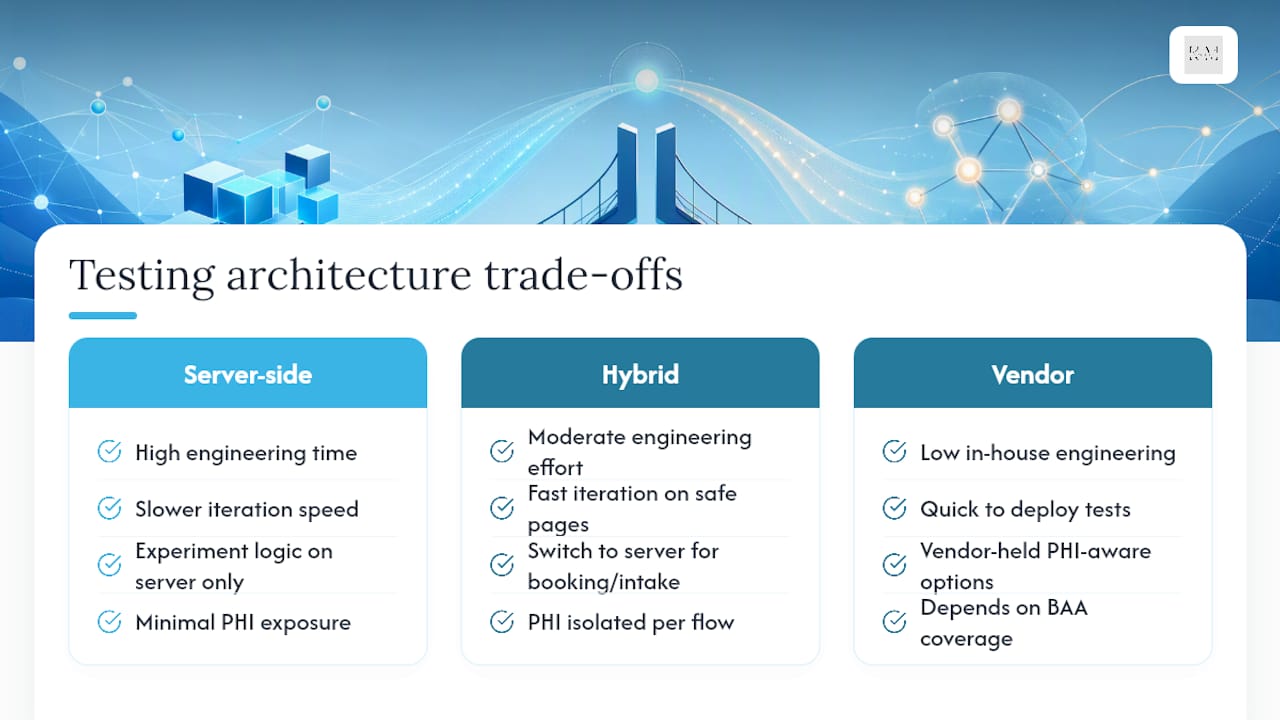
Three architectures cover almost every situation a medical website will face. Server-side testing is the gold standard: the experiment logic runs on your infrastructure, so no browser script ever sees raw patient input, and nothing leaves your server until it’s already been stripped and aggregated. It costs more in engineering time, but it removes almost every PHI exposure vector by design.

Hybrid architecture is where most practices actually land. Hybrid setups run client-side tests on marketing pages that never collect PHI, keeping iteration fast and cheap, while switching to server-side experiments the moment a flow touches booking or intake. This gets you speed where it’s safe and rigor where it isn’t.
Vendor HIPAA-tier options exist too, testing platforms that offer BAA-covered plans and PHI-aware configurations. These work well for teams without in-house engineering, but read the BAA terms carefully. Not every “healthcare plan” from a testing vendor covers every data flow you’d assume it does.
The trade-off across all three comes down to engineering cost versus speed, and data visibility versus compliance risk. A small practice testing hero copy on its homepage doesn’t need server-side infrastructure. A hospital system running experiments on its intake flow absolutely does.
Klyrmedia’s approach to this starts before a single test goes live: a pre-flight compliance audit that maps every page touching PHI, signed BAAs with every analytics and testing vendor in the stack, PHI isolation at the server layer for anything booking adjacent, and session recording disabled by default on patient flows. The workflow gets documented at every stage, not because it looks good in a deck, but because an undocumented compliance decision is one nobody can defend six months later.
Pro Tip: *If your team has no dedicated engineer, start hybrid: run client-side tests on your homepage and service pages immediately, and hire outside help only for the server-side work on booking and intake.
What the Research Says About Win Rates and Realistic Expectations
Healthcare experimentation doesn’t behave like e-commerce testing, and treating it that way sets teams up for disappointment. The pilot study on the STURDY clinical trial recruitment website found that subtle content changes did shift engagement, but not always in the direction researchers expected. In several tests, the original page beat the new variant outright.
That result matters more than it sounds. It means intuition about what patients want is often wrong, which is exactly the argument for testing in the first place, but it also means you should expect to lose more tests than you win.
Industry benchmarks back that up. Some datasets put the win rate for healthcare A/B tests at around 6%, meaning roughly 94 out of 100 tests fail to beat the control. That’s dramatically lower than win rates typically reported in retail or SaaS testing.
A few things follow from that:
- Prioritize high-impact, low-risk tests first, since a low win rate on a low-effort test still beats a low win rate on an expensive one.
- Don’t treat a losing test as wasted. Knowing the original wins is still information, and it stops the next redesign meeting from repeating the same bad idea.
- Measure downstream outcomes, not just the immediate metric, since a 6% win rate on click-to-book means even less if half those “wins” don’t translate into kept appointments.
Set expectations with your team before the first test launches. A program that expects to win a third of its tests will feel like a failure within a month. A program that expects to win one in twenty, and treats every result as data, will still be running (and improving) a year from now.
How to Handle Consent and Patient Communication During Testing
Most A/B tests on medical marketing pages don’t require explicit patient consent, because they’re testing presentation, not treatment, and they don’t collect new identifiable data beyond what your privacy policy already covers. That said, transparency still matters, both ethically and legally.
Your website’s privacy policy should already disclose that the site uses analytics and testing tools to improve the patient experience. If it doesn’t, update it before your first test goes live, not after. This is a low lift with real downside if skipped.
Where it gets more sensitive: if a test touches anything inside a logged-in patient portal, or changes how a patient consents to treatment, communication, or data sharing, treat that differently. Testing consent language itself, for instance, raises a different bar entirely, since you’re experimenting with the mechanism that’s supposed to protect patient autonomy. Loop in compliance or legal review before running that kind of test, regardless of how small the wording change seems.
A good rule of thumb: if a patient would be surprised or uncomfortable learning that a page they saw was one of two versions being tested, that’s a signal to slow down and check with your compliance team first. Marketing page headlines rarely trigger that reaction. Consent forms and treatment disclosures almost always do.
Metrics That Matter Beyond Click-Through Rate
Conversion rate tells you whether someone clicked a button. It doesn’t tell you whether that click led to a patient actually getting care, which is the number that matters to a clinic’s bottom line and to the patient.
Kept appointment rate is the metric most healthcare teams should treat as their north star, tracking what percentage of bookings from a given variant actually show up.
Beyond that, a few metrics deserve a permanent spot in your dashboard:
- Time-to-first-appointment, measuring how quickly a new patient gets seen after their first site visit, which reflects both funnel efficiency and access.
- Form abandonment rate at each step, which flags exactly where a multi-step intake flow loses people.
- Repeat visit or retention rate, since a variant that attracts one-time visitors but doesn’t build a returning patient base is optimizing for the wrong outcome.
- Support call volume tied to a variant, since a confusing new booking flow often shows up first as a spike in front-desk phone calls, not a metric on your dashboard.
None of these replace conversion rate. They contextualize it, and in healthcare, context is what separates a real improvement from a vanity metric.
Ethical Considerations Unique to Healthcare A/B Testing
Testing a button color on a shoe retailer’s site carries basically zero ethical weight. Testing a booking flow’s structure on a medical site carries more, because the population you’re testing on includes people in pain, people scared about a diagnosis, and people with lower digital literacy who may already struggle with the internet.
That context changes what “acceptable” experimentation looks like. A dark pattern that nudges an e-commerce shopper toward a bigger cart is annoying. The same manipulative pattern nudging a patient toward booking an unnecessary procedure, or discouraging them from canceling an appointment they can’t actually keep, crosses into a different category of harm.
A few principles should guide every test on a medical site. Never test variants designed to create urgency or fear around a health decision, even if it might lift bookings. Never run a test where the “losing” variant meaningfully degrades access, like hiding a phone number for people who don’t use online forms. And be especially careful with vulnerable populations: a test optimized around a younger, tech-comfortable segment can quietly disadvantage older patients or those with limited English proficiency if you’re not watching for it in your segmentation.
The clinical research world already has a framework for this kind of thinking, since researchers running the recruitment-site pilot treated their variants the way any human-subjects study would: with attention to whether the changes served the participant’s interest, not just the recruitment number. Marketing teams testing patient-facing pages should hold themselves to a similar bar, even without a formal review board watching.
Connecting A/B Test Results to EMR and EHR Outcomes
The biggest blind spot in most healthcare experimentation programs is stopping the measurement at the website’s edge. A test can show a variant winning on bookings, while the practice has no idea whether those bookings led to better outcomes, better retention, or just more no-shows.

Closing that loop means connecting your testing platform’s data to what happens after the appointment, which usually means your EMR or EHR system. The mechanics vary by vendor, but the pattern is consistent: pass an anonymized or hashed booking ID from your website’s server-side testing layer into your practice management system, then match it against appointment-kept status, follow-up scheduling, and (where structured and de-identified appropriately) treatment outcomes.
This is exactly where a hybrid architecture pays off twice. Because the sensitive matching happens server-side, you avoid pushing any identifiable data back into ad platforms or analytics tools, while still getting the closed-loop view your admin team actually needs. Marketing automation platforms built for healthcare increasingly offer this kind of integration natively, letting you tag a lead source and variant, then follow it through to a kept appointment without ever exposing a diagnosis or treatment detail to a third-party script.
Without this step, your A/B testing program measures clicks. With it, it measures care delivered, which is the number that actually justifies the investment to a practice owner.
What We’ve Learned Running Healthcare Experiments
Most healthcare A/B testing advice treats compliance as a footnote. In practice, compliance is the design constraint that determines what you can even test, and skipping that step first is how well-meaning marketing teams end up rebuilding a testing program from scratch after a legal review flags it.
The workflow that holds up over time is simple to describe and harder to skip steps on: audit first, then plan, then implement, then monitor, then iterate. The audit maps every PHI-adjacent page before anyone writes a single variant. The plan sets the hypothesis, metric, and stopping rule in writing. Implementation respects the risk tier of whatever’s being tested. Monitoring watches guardrails, not just the primary metric. Iteration treats a loss as data, not a failure.
For small practices without a dedicated engineering team, the advice is blunt: outsource the server-side work on booking and intake flows, since getting that wrong carries real compliance exposure, but keep low-risk marketing page tests in-house if you have any comfort with a tag manager. Don’t let the complexity of the high-risk tier stop you from running the low-risk tests that are safe today.
The teams that get the most out of experimentation aren’t the ones with the fanciest tools. They’re the ones who documented their PHI map before their first test, and never had to relearn that lesson the hard way.
— Opinly
Get HIPAA-Compliant Testing Built Into Your Website From Day One
Klyrmedia builds the infrastructure most practices are missing before they even start testing: a HIPAA-compliant website architecture where PHI isolation, signed BAAs, and server-side data handling are part of the build, not a retrofit after a compliance scare. That’s the real advantage over piecing together a testing program on top of a generic website template built for retail traffic.
Every HIPAA-compliant website design project includes the technical foundation experimentation needs to run safely: PHI-stripping at the edge, disabled session recording on patient flows, and documented data handling that your compliance officer can actually review. Pair that with marketing automation that closes the loop from click to kept appointment, and you get a testing program built on outcomes instead of guesswork about what patients want.
If your current site can’t support server-side testing on your booking flow, that’s the first thing to fix. Reach out to Klyrmedia for a compliance-focused website audit and find out exactly where your current setup exposes PHI, and what it would take to close those gaps before your next redesign.
Sources
- Tracking technology and HIPAA (Tulane communications)
- A/B design testing of a clinical trial recruitment website: A pilot study to enhance the enrollment of older adults (PMC)
- Health Information Privacy — HHS
This article is general information, not a substitute for advice from a qualified doctor. Consult a qualified healthcare professional about your own circumstances before acting on anything here.

